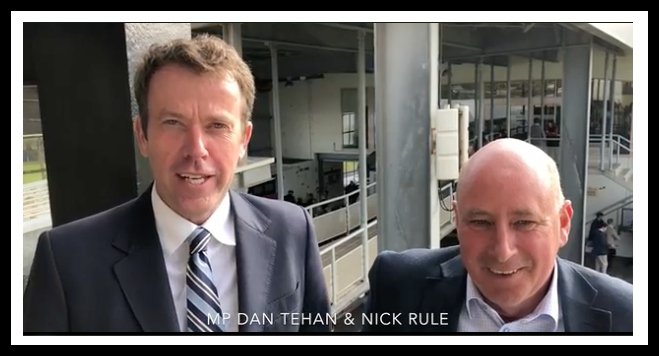
Racehorse co-owners Wannon MP Dan Tehan and Warrnambool Racing Club chairman Nick Rule at the announcement of $1.25m in funds for the WRC. Image via The Warrnambool Standard.
I have tried at least five times to stop writing about local issues so that I can focus on books that I need to write, but each time I try, some frustrated soul contacts me with a story idea or a piece of information that they know will not be investigated or published elsewhere.
So here we go.
Story number one: Dan Tehan’s friends in racing.
A week or so ago, Wannon MP Dan Tehan braved the chill winds at the Warrnambool racecourse to announce a sweet $1.25 million in funds to the Warrnambool Racing Club so it could transform, among other things, its already “first-class” eating and drinking venue into a “world-class” venue.
That little slice of pumped up Trump-speak was from WRC chairman Nick Rule, who told the local paper back in January that: “The club has the support from the Member for Wannon Dan Tehan for the project” aka, he is right behind us on this one.
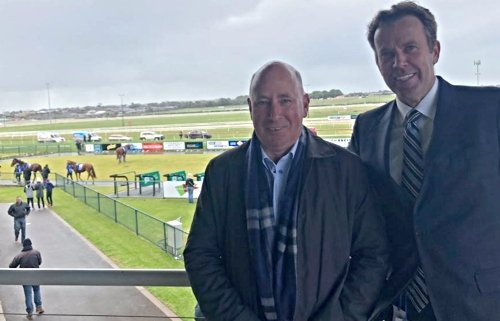
Dan is a big fan of racing, but more than that, he owns shares in racehorses and, in particular, he owns shares in a racehorse – called Wells – with Nick Rule and others.
That’s right: our local Federal MP shares a horse with the chairman of the WRC and lobbies on behalf of the WRC for public money.
What I don’t understand is why this connection is never mentioned in any media reports?
And why doesn’t Dan Tehan ever mention it in any of his public remarks and Facebook posts?
And why, if it is no big deal, does his staff refuse to answer a simple “yes” when asked if Dan and Nick co-own a racehorse?
Nick Rule and Dan Tehan at the Warrnambool races. From Dan Tehan’s Facebook page on the day of the funding announcement.
It was the same story a few years ago when Dan Tehan and then Premier Denis Napthine part-owned a racehorse (Spin the Bottle) with Midfield Meats owner and multi-millionaire Colin McKenna who, at the time, was seeking state money to expand his operations in Warrnambool. (He got the money and Denis got a political headache.)
And it is the same story, as I have written about before, every time local MP James Purcell, racehorse owner and father-of-trainer-Aaron Purcell, opens his mouth about anything to do with horse racing and allowing large numbers of racehorses to train on beaches.
Let me shout it out:
THESE MPS OWN RACEHORSES!
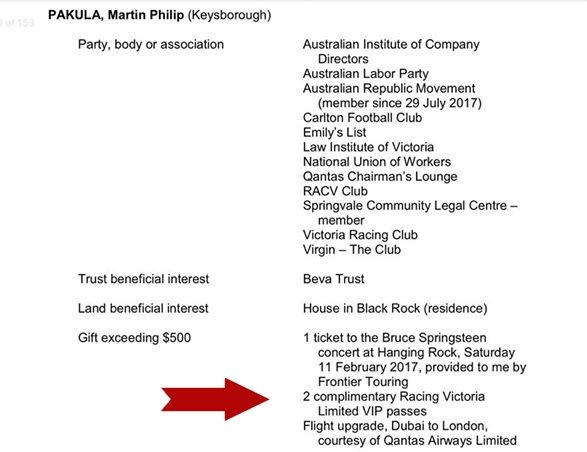
Dan Tehan and James Purcell are not alone. State ministers Lily D’Ambrosio and Martin Pakula, who are among those deciding whether commercial racehorse training should be allowed on our local beaches, have been the recipients of a free annual pass or a VIP pass to Racing Victoria.
Ah, the lure of a ringside seat at the Melbourne Cup.
I am not sure when we started to accept such potential conflicts of interest as normal.
It is difficult to think of another example where an MP would be permitted to be actively involved in any lobbying or decision making when they held such interests but, for some reason, horse racing remains exempt.
I hasten to add, before the lawyers start dictating letters, that there is no suggestion of any impropriety by any of these MPs: they are doing what we allow them to do.
If this is to change, we need to keep calling it out and to keep shining the light into the dim corners, sometimes several times over.
And that is story number one.
Edna Jones’ baby: a story of shame, secrets and setting things right
Marilla Lenne, the daughter of Edna Jones, who was adopted out after her birth in 1940. Image: supplied.
By Carol Altmann
Meet Marilla Lenne, the “secret” daughter of Edna Jones, one of the two “Jones Girls” who for decades owned and operated one of south-west Victoria’s most desirable grazing properties, The Union Station, at Woolsthorpe, and who left a legacy worth millions.
Until now, only a small group of people – among them some well-known names in our community – have known of Marilla’s existence, with both Edna and her older sister, Gwen Jones, widely thought to have died unmarried and childless.
Indeed The Gwen and Edna JonesFoundation was established as a private charity to handle the sisters’ multi-million dollar estate because, according to its website, “neither sister (had) an heir to whom they could bequeath their considerable assets”.
The Foundation, which in 2016 had assets worth more than $15 million, was launched after Gwen’s death in 2000.
It has since donated hundreds of thousands of dollars to local projects and made significant contributions to the Presbyterian Church, particularly in its support of Warrnambool’s King’s College and, most recently, its purchase of several church buildings in Warrnambool.
But Edna, who died in 1995, did have a child at the age of 30.
The baby was a girl, born in a Melbourne hospital on 28 October 1940 and given up immediately for private adoption.
The fact Edna had a baby may be a surprise, but the adoption less so. While the circumstances of Edna’s pregnancy remain unknown, the moral standards of the time stood in harsh judgement of women and girls who had babies out of wedlock.
It is worth remembering that this was an era when family skeletons were tucked firmly into closets.
What is harder to understand more than 70 years later – in 2017 – is the apparent reluctance of the Gwen and Edna Jones Foundation to formally acknowledge Marilla’s existence, despite some of its board members knowing about her for more than 20 years.
Some members, including Foundation chairman and high-profile Warrnambool lawyer James Tait, have even met her personally.
To the Foundation board, Marilla is no longer a skeleton in the closet but, for some inexplicable reason, her place in the Jones family story has remained untold.
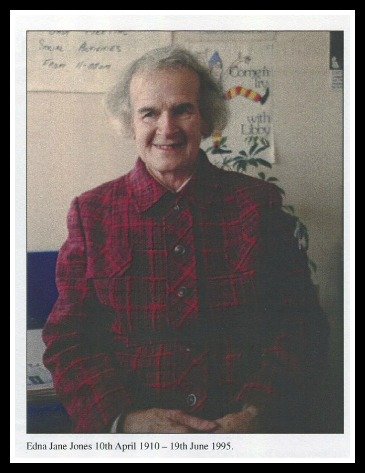
Edna Jones in her senior years, taken from Janet Paisley’s book, The Jones Girls’ Bounty. Copyright: Janet M Paisley.
I first learned of Edna’s baby through a casual remark in an email from a former foster carer,which I then repeated to another ex-Warrnambool friend, Bruce Macrae, who I knew was familiar with the history of the Jones’ girls.
“Apparently Edna Jones had a child,” I asked him. “Could that be true?”
“Oh yes,” Bruce said, “I have met her”.
“What!”
And so began my quest to find Marilla, and to talk to her myself.
Bruce pointed me in the direction of Barwon Heads author Janet Paisley, who is a cousin of the Jones’ girls and who was commissioned by the Foundation board to write the Jones’ story, The Jones Girls’ Bounty. Her book was published in 2005.
Talking to Janet revealed the full extent of an unresolved story about social class, loss and grief for Edna, but also the quiet determination of Marilla who, having confirmed her mother’s identity in 1995, set out to remove all the shadows of guilt and shame around her birth.
By the time Janet and Marilla connected, Janet was deep into the research for her book which, of course, provided the perfect opportunity to acknowledge Edna’s “secret” child.
To be part of the official family story would connect Marilla back to her birth family in a way that was both dignified and healing.
But the Foundation decided that there would be no mention of Marilla in the 2005 book and, instead, a chapter might be published in later editions as an epilogue.
With this in mind, Janet interviewed Marilla and has since written an entire chapter about Edna’s baby.
But despite the book being printed 12 years ago and numerous follow-up inquiries by both Janet and Marilla since, they are still waiting for this missing chapter to be published.
As it stands, The Jones Girls’ Bounty contains just 22 words that refer to Edna being involved in “an incident” when she was a young woman.
“I am the incident,” Marilla, who is now in her 70s, tells me by phone, somewhat sardonically.
Gwen and Edna Foundation chairman and lawyer James Tait. Image: Tait’s Legal, Warrnambool.
The stonewalling by the Foundation is one thing, but then there is this: an inexplicable sentence in the book’s foreword, written by James Tait in February 2005:
“They (Gwen and Edna Jones) had no one within a close degree of relationship,” he writes (my emphasis).
When this was written, the board had known of Marilla for years and James had had several contacts with her, including sending her a catalogue for the auction of The Union Station and Gwen and Edna’s possessions in late 2001.
(The Union was sold to Midfield Meats founder and racing identity, Colin McKenna, in November 2001 for more than $7 million.)
Given the board knew of Marilla, why, in early 2005, would its chairman write such a sentence?
I asked James this, together with several other questions that relate to his role as Foundation chair, but have had no reply.
Taits were the Jones’ family lawyers for years, they documented the rules for the Foundation and prepared both Gwen and Edna’s wills, and James has been chair of the Foundation since it began.
He joins other long-serving directors, retired accountant John Hunt, from Coffey Hunt and Co, who were the Jones’ accountants, and retired bank manager and former Warrnambool Citizen of the Year Eric Williams. Thefourth, and most recently appointed director isformer head of the Warrnambool Racing Club, Margaret Lucas.
This is the group that, for reasons unknown, have so far refused to offer any public acknowledgment of Marilla.
“That recognition is really important to Marilla,” Janet says, “it would offer a closure, of sorts, and it is what she has been waiting for, for many years”.
It is not known if the Foundation directors have even read Janet’s “missing” chapter about Edna’s baby.
They did, however, send Marilla a complimentary copy of the book when it was published.
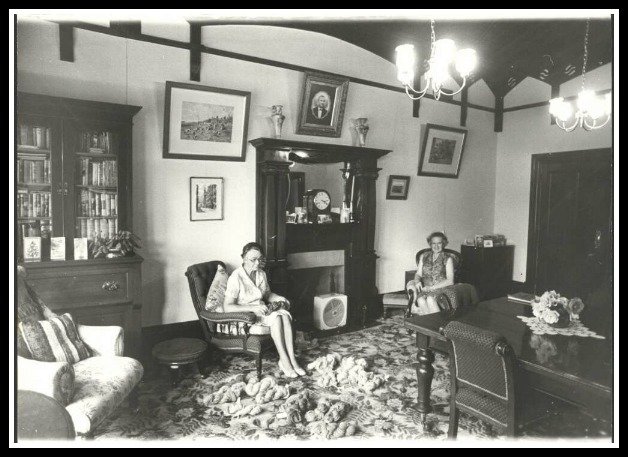
Gwen, left, and Edna Jones in the lounge and dining room of The Union Station, Woolsthorpe, circa 1975. Image: Copyright National Library of Australia. Object No: 147727624.
It is partly because of Marilla’s quiet patience and good humour, no doubt, that the Foundation board has been able to continue its stonewalling.
Having spoken to her several times now, Marilla strikes me as someone who has enjoyed a simple, hard-working life (she pursued a nursing career) and is not interested in engaging lawyers, publicly challenging authority, or making a fuss.
She lost her partner early, to cancer, and never had children, so her retired life is one of community work, golf and travelling with friends.
As the years tick past, however, neither Marilla nor Janet, who is now in her 80s, can afford to show endless patience.
“Here we are, 22 years on from when all of this came to light, and we are no closer to a resolution, really,” Marilla says.
“I am experiencing what a lot of adopted people experience when they find their birth parents…but what every adopted person really wants to know is that at least they were wanted”.
As Janet’s chapter outlines, Marilla was denied the opportunity to reconnect with Edna, even though she was alive when Marilla had confirmation that Edna was her birth mother.
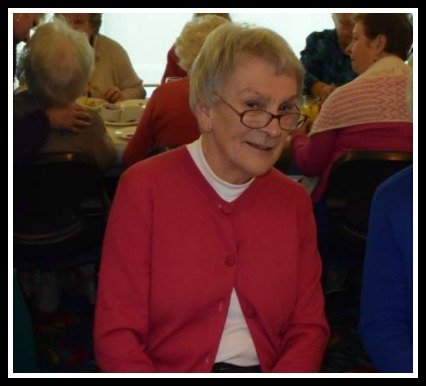
Marilla Lenne pictured at a Legacy social lunch in 2015. Image: Merimbula News Weekly.
Shortly after tracking down her birth certificate in early 1995, Marilla wrote Edna a letter c/o The Union, Woolsthorpe.
Gwen Jones replied on her sister’s behalf, saying it was best if Marilla did not see her mother, who by then was in the late stages of dementia, saying it would be upsetting. She enclosed an earlier photograph of Edna.
“I got the sense that Gwen did not want to have any involvement whatsoever,” Marilla said.
Edna died in June 1995.
“If I had been able to see her, I would have just thanked her for my life and set her free,” Marilla tells me.
Reading Janet’s book about the Jones’, there is a pervading sense that the fun-loving Edna got to make very few decisions about her life, but was instead guided by her older sister who promised their father, Robert, that she would always take care of her.
And so it makes sense that even though Edna may have gone along with the decision to give up her baby in 1940, she never forgot her.
As Edna developed dementia in the years before her death at the age of 85, those long-buried emotions around Marilla’s birth were no longer constrained.
She was sometimes seen searching the shelves of Swinton’s supermarket for “the baby”, or would follow a mother pushing a young child in a supermarket trolley, or, as one woman told me, she would “come alive” when talking about babies or if a baby was brought into the room.
Despite these very public displays of grief and confusion, Edna’s “baby” was thought by most people to be purely imaginary.
Even Janet, a relative of the family, didn’t know the truth about Marilla until after Gwen’s death in 2000.
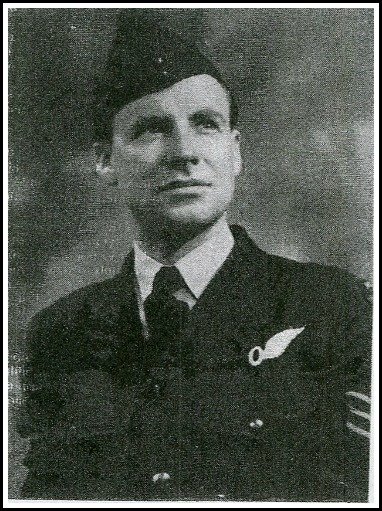
The formerly “unknown” father of Marilla Lenne: his identity and the story behind how Marilla met his family is contained in Janet Paisley’s chapter. Image: Grasmere Presbyterian Church newsletter, supplied.
It is since Gwen’s death that Marilla has been given certain access into the Jones’ world, but still not a seat at the main table, so to speak.
In 2001, Marilla was invited by the Foundation to look over The Union before the sale of its contents which were, at the time, being sorted and packed by staff from Coffey Hunt in preparation for one of the most highly anticipated auctions in years.
A few small items that belonged to her mother have since been passed on to Marilla – a cup, saucer and plate – and connections made to lost cousins.
Another particularly poignant moment came in 2011 when Marilla was invited to visit The Unionfor afternoon tea by Colin McKenna and his partner, Janice, who, Marilla says, “was delightful and very welcoming”. How strange it must have been, however, for Marilla to sit in the historic, blue-chip property that was once half-owned by her birth mother, but to which she had no claim.
In Australia, adopted children have no legal right to the estates of their birth parents, but for Marilla, it has never been about estates.
Instead, her gentle persistence has been driven by the desire to be recognised and have her story – and therefore Edna’s story – brought out of the shadows and into the light.
There was to be no more shame.
Until now, such a wish depended on the decisions of the Foundation, but both Janet and Marilla have now given me permission to publish the draft chapter here, see the link at the end of this story.
This “missing chapter” also reveals the identity of Marilla’s father and the incredible story about how she connected to his family in the south-west.
I thank Janet and Marilla for trusting me with their story and words.
How the proposed milk processing factory at Merrivale would have appeared on the skyline near the Warrnambool Showgrounds. Image: Warrnambool City Council.
The Terrier – Carol Altmann
[dropcap style=”font-size: 35px; color: #8cc7d0;”] T [/dropcap]wo of the most controversial projects to be approved in Warrnambool in recent times – the milk processing factory in Merrivale and a nine-storey apartment block on Merri St – have been put on the backburner by their developer, the Midfield Group.
It is now two years since both projects received planning approval, but not much has happened at either site since.
The milk factory was expected to be up and running within 12 to 18 months of being given the green light from an independent planning panel in May 2015.
It is a similar story with the proposed nine-storey apartment block on the corner of Merri and Gillies streets, which – despite arguments to save it – saw the 1940s Madden’s/Sandilands building demolished within weeks after the development was approved in early 2015.
When the planning application was lodged by Tract Consultants, acting on behalf of Baybern Developments/Midfield, it urged the Warrnambool City Council to approve the project as quickly as possible because its client was keen to get started.
The prominent corner block remains vacant and wire fenced, joining the Criterion Hotel site, the former Caltex petrol station on Raglan Parade, and the former Warrnambool gas works near Harris Reserve as “frozen” projects that have sat untouched.
The proposed nine-storey apartment block on the corner of Gilles and Merri streets, Warrnambool. While approved in early 2015, little has happened.
[dropcap style=”font-size: 35px; color: #8cc7d0;”] T [/dropcap]
he Midfield Group and Baybern Developments are owned by one of Warrnambool’s most successful businessmen, Colin McKenna.
A spokesman for Midfield and Baybern, Daniel Aarons, said today that the company’s priorities had changed for both projects since it bought a former potato processing plant in Penola, South Australia, that it is now converting into a $60 million milk processing plant.
On the Merrivale milk processing plant:
“Our intention is to still build in Warrnambool, but works have commenced in Penola and that is our priority at the moment,” he said.
The South Australian Government gave Midfield a $2 million grant toward the $60 million Penola project, which is close to completion.
“Penola needs to be completed, commissioned, bedded down and we need to learn how to run the plant and that is all going to come on line in the next couple of months,” Mr Aarons said.
“Penola takes precedence and then we will focus on Warrnambool,” he said.
When asked if a start on the Warrnambool plant was at least two years away, Mr Aarons said it was more likely to be 12 months.
A fenced, vacant block is what remains after the original 1940s building was demolished to make way for the apartment complex.
On the Merri St apartments:
“There is not much to say, but it is still our intention to proceed,” Mr Aarons said.
“Things are moving, things are progressing, admittedly they are progressing slowly, but they are moving”.
While potential buyers can still lodge expressions of interest with Wilson Real Estate, Mr Aarons said it was not known when construction would actually begin.
I know of at least one potential investor who lodged an expression of interest, but then heard nothing more. They have since invested elsewhere in Warrnambool.
“We haven’t confirmed a start date, but we are moving along gently, gently. It is not something we need to push quickly, but it is progressing,” Mr Aarons said.
“We have our hands full with multiple projects at the moment and we have to get a couple of key priorities out of the way.”
The former Madden’s building, once the Sandilands guest house, was demolished within weeks of the planning approval being granted for a nine-storey apartment block.
[dropcap style=”font-size: 35px; color: #8cc7d0;”] T [/dropcap]
he slow-down on the Merrivale milk plant, if it goes ahead at all, will be a sigh of relief to those who fought passionately to stop a project that would be 35m in height and operate 24 hours a day, seven days a week.
The Scott St plant, unlike the Penola plant which is several miles out of town, is in the heart of Merrivale and would be less than 100m from houses.
At the time of the approval process, the Midfield Group said the processing plant and an adjacent cold storage facility would create up to 200 jobs, but this was later wound back to 22 full time jobs.
The $70 million project received a $1.5 million grant from the former Napthine State Government and the Warrnambool City Council also sold a portion of its depot land to Midfield for the expansion.
One question I did not get time to ask the council today is how long planning permits are valid for before they need to be updated or expire?
I will let you know the answer as soon as I do.
[box]I work as a freelance journalist, without advertising or grants, which allows me to write freely. If you would like to support this site, please make a donation by clicking here. [/box]
The big shed shemozzle: we follow the money
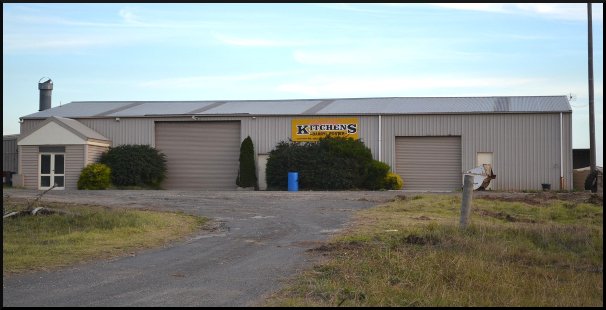
The former Porter’s shed on Wangoom Rd which is at the centre of a deepening and intriguing story about its final costs and the deals being done.
There is an old saying in journalism that you should always follow the money and that is exactly what we have done with the ongoing saga of the Warrnambool City Council’s purchase of the old Porter’s shed and it has led to an intriguing twist.
As those who have been following this story already know, the council paid local developer (and former councillor) Graeme Rodger $40,000 for the shed that sits on the edge of his new residential land project on Wangoom Rd, but shortly after tried to get rid of it via auction.
Unfortunately for the council, auctioneer Brian Hancock couldn’t attract a single bid and the shed was passed in at $20,000.
One reason for the shed’s unpopularity among bidders was the cost of dismantling, relocating, repairing and rebuilding the old shed at a new location, as the council is now discovering, and why it tried to “move it along” without success.
More recently, we have since learned, the council was told by Mr Rodger’s lawyers that the shed had to go: it was supposed to have been moved by mid this year, and each month that has passed since has been a blight on Mr Rodger’s land sales, after all, who wants to buy a block with a derelict shed next door?
In our last piece on this saga, we told you that the council had received a quote of $170,000 to move, relocate and reassemble the shed, making the $40,000 shed now costed at $210,000.
We also told you that the council rejected this quote and instead decided to pay Mr Rodger another $63,000 to dismantle and relocate (but not re-assemble) the shed, but that’s not the full story and herein lies the twist.
Mr Rodger is being paid $63,000, but, as the council is fully aware because it organised the arrangement, he is passing that money on to a third party to actually do the dismantling and relocating.
Why would the WCC want to use Mr Rodger as a go-between and not pay the third party itself?
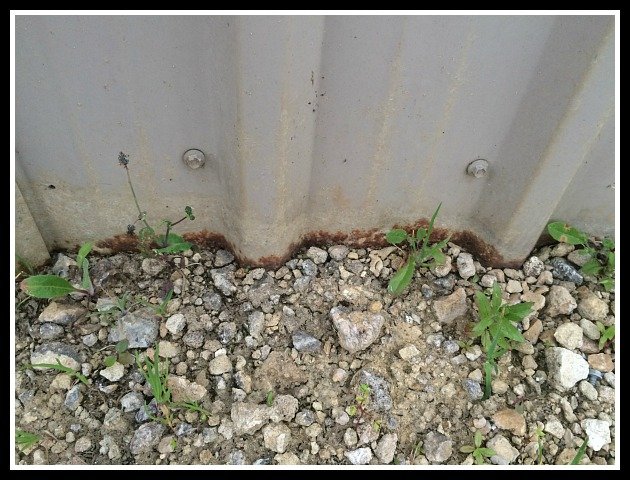
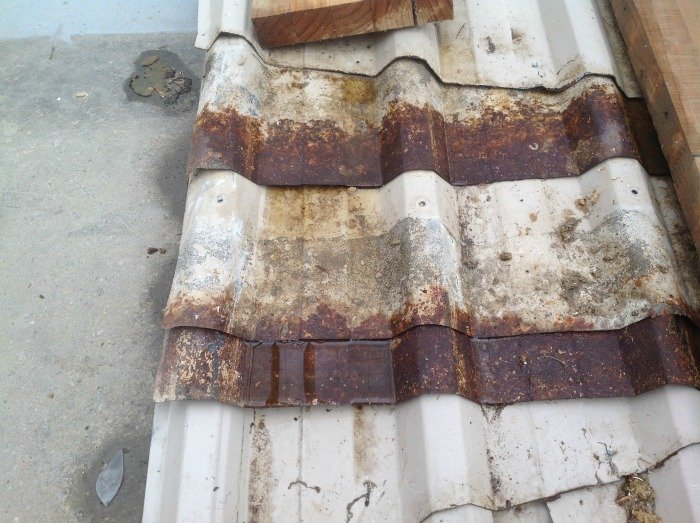
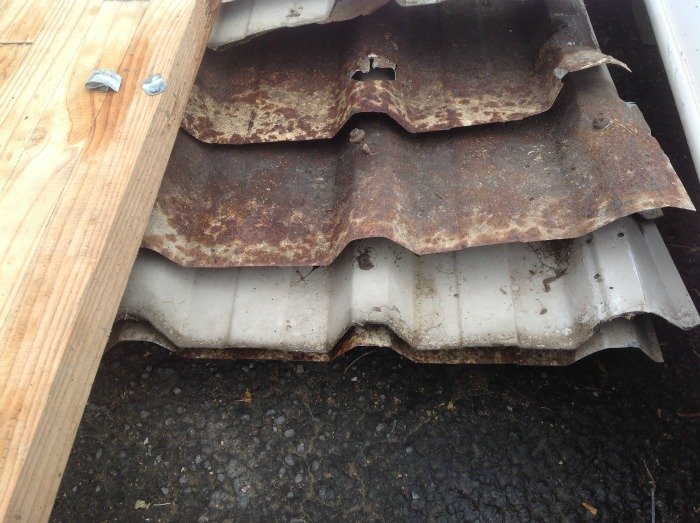
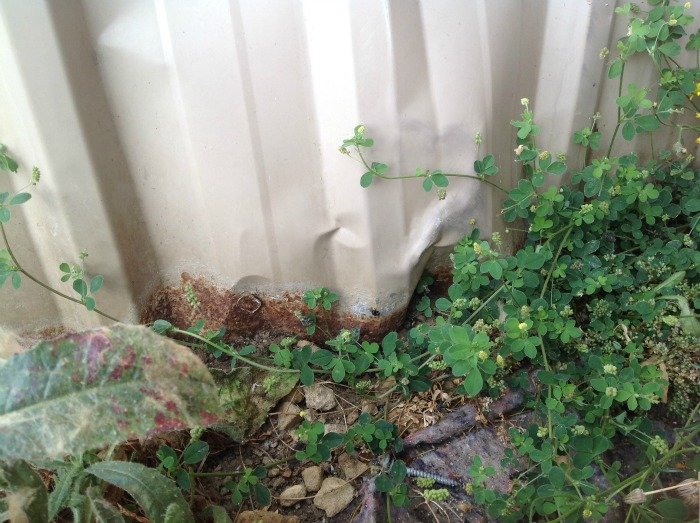
Corrosion along the bottom edge of the Colourbond sheets suggest the shed will require repairs when it is moved to Scott St.
We have pondered this question long and hard and the only possible solution we can come up with is that it is tied up with the council’s procurement policy, in other words, the rules around how it spends money.
These rules are quite complex, but include that any spending on services between $15,000 and $74,999 requires at least three written quotes. Perhaps by paying Mr Rodger for the cost of the shed AND its removal, the council could avoid this step and get the shed off the land by the new, mid-January deadline.
Also, under the rules, a council director can only authorise spending of up to $149,000 and anything above that must go to tender.
Director of Infrastructure Peter Robertson has so far spent $100,000 on the shed, but there are still major costs yet to come and that is the reassembly, re-fit and any repair costs for the corrosion. (See images below)
This is almost certain to exceed $40,000, which begs the question of whether this whole mess should have gone to public tender in the first place?
Unfortunately the council’s media manager Nick Higgins is refusing to answer any of our questions on the shed, but it is indicative of a number of things, not least the secrecy surrounding these dealings and the lack of transparency around the use of ratepayers’ money.
Only three councillors – Brian Kelson, Peter Hulin and Peter Sycopoulis – have raised questions about this shed within council and tried to unravel what went wrong.
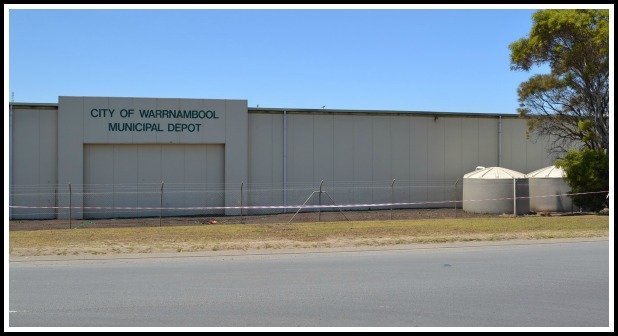
The former council depot building sold to Midfield Meats as part of a controversial land deal.
And where is this shed headed? Here comes the final twist:
The shed is off to the council depot in Scott St where it will – alongside a brand new shed – partly replace the massive storage shed sold to Midfield Meats as part of the controversial land deal to allow the building of its milk processing plant.
That deal was supposed to give the council a $290,000 profit to invest back into the shrunken depot, but it appears that Porter’s shed alone will now soak up most of that “windfall”.
Huge apartments will set ugly precedent
The proposed nine-storey apartment complex on Gilles St/Merri St, Warrnambool, is at odds with the council’s recommendation for medium density housing of no more than five storeys in this area. Image: Tract Consultants.
ANALYSIS – Carol Altmann
[box]Update: a recommendation for a permit to be issued, subject to conditions, will go before the Warrnambool City Council on Tuesday, April 7. If you wish to have a say, contact the councillors directly.[/box]
[dropcap style=”font-size: 60px; color: #DC943C;”] A [/dropcap] quick quiz: how tall is the Warrnambool War Memorial? And how many storeys is the Lady Bay Resort?
The answers will follow shortly, but you can rest assured that neither are as high as the monolithic, nine-storey apartment complex proposed for a small, prime piece of land on the corner of Merri and Gilles streets that takes in views right across Lake Pertobe, Lady Bay, and beyond.
The $20 million project by Baybern Developments, whose director is the founder of Midfield Meats, Colin McKenna, intends to squeeze 51 apartments – including three exclusive penthouses – into a complex that will tower almost 30m (28.6m) in to the air.
By way of contrast, the war memorial angel stands 10.9m, the townhouses opposite Cannon Hill are about 12m (three storeys) and the Lady Bay Resort, which some of us are still recovering from, is around 20m (five storeys).
This proposal, if approved, will leave them all in the shade.
And while Tract Consultants*, who are acting on behalf of Baybern, keep referring in their application to a seven-storey complex, it is quite clearly a total of nine-storeys (including two ‘basement’ levels), that will be hard to miss.
This is high-density housing on a scale never before seen in Warrnambool, let alone in an area that is a stone’s throw from the heritage precinct of the former court house, post office and police station. Even the house right next door to the development, Colern, has been recommended for heritage protection.
The proposed development would transform the view approaching the war memorial angel, which stands at 10.3m compared to the 28.6m complex. Image: Tract Consultants.
[dropcap style=”font-size: 60px; color: #DC943C;”] T [/dropcap]he Warrnambool City Council is acutely aware of the need to get city planning right, not just for the citizens of today, but to ensure we don’t screw it up for those who will call Warrnambool home in the future.
As such, it has invested a huge amount of time, energy and money (on consultants and in public consultation) on creating a roadmap known as the Warrnambool City Revitalisation Structure Plan 2012 which, in theory, sets out guidelines for how the city centre should develop over the next 20-25 years.
It is an inspiring document, full of wonderful images and packed with possibilities to again make the CBD the beating heart of our great, seaside city while also maintaining its unique character.
But the Warrnambool Apartments project, as it is known, is the first real test of whether this plan is worth the paper it is written on, and the signs are not encouraging.
Here are just a few examples:
Firstly, the plan recommends a limit of five storeys for this particular part of Merri St, provided it can also “suitably transition” with what is already in the area and doesn’t “prejudice the established scale and character”.
Despite this, the revised project recently submitted by Tract in response to feedback from council officers and objectors remains at nine-storeys, while also wrongly claiming that the nearby TAFE building is four storeys (it is three).
Second, the council plan lists as a key objective its support for “medium density” housing in the CBD. By its own admission, Tract describes the Warrnambool Apartments as high density.
And lastly, but no less importantly, the council plan highlights the beautiful Norfolk pines around our city centre, describing them as “iconic” and “unique”, yet the Warrnambool Apartments will involve ripping out two semi-mature Norfolk pine growing on and near the Gilles St/Merri corner. (In an Orwellian-twist, Tract promises one tree will be replaced with another Norfolk pine or a similar species.)
The revised plans reveal a different colour scheme and more detailed landscaping among the minor changes. Image: Tract Consultants.
[dropcap style=”font-size: 60px; color: #DC943C;”] W [/dropcap]e are not privy to the discussions between Tract and the council’s officers, but surely – if the council is serious about its strategic plan – it would have run a red line right through the initial proposal and sent Tract back to the drawing board.
But no. Not only did the nine-storey plan make it to first base, it has made it to second, with the revised plans showing very few, significant changes at all.
Yes, some balconies have been removed, and there has been a lightening of the colour scheme, but whether it is painted blue, grey or gold, it is still almost double the number of storeys of what should be there.
And let’s be clear: the reason it has remained this way is the penthouses.
Levels 5 and 6 are “sub penthouse” levels, each of five, no-doubt-spectacular, apartments.
Level 7 – the top floor – is the cream of the crop with just three, exclusive penthouses.
So the top three levels will provide 13 dwellings for the 13 couples or individuals who can afford them, while another 38 apartments will be clustered below.
It is enough to make any council salivate – the thought of having dozens of rateable properties where previously there was only one – but this is where good planning must prevail.
Nobody is arguing against more inner-city housing, but this monumental over-development – if approved – will set a dangerous precedent for Warrnambool that will destroy the very things the council’s plan is designed to protect.
*As an aside, “tract housing” – which has nothing to do with Tract Consultants – is a style of housing known for its cookie-cutter approach in which “multiple identical or nearly-identical homes are built to create a community”. It is particularly prevalent in parts of the US.
How the development appeared in its initial plan, since revised. Image: Tract Consultants.
[box]Disclaimer: Mine is among the seven objections lodged for this proposal. References used for this piece include the planning application lodged by Tract (PP2014-0162) and the Warrnambool City Revitalisation Structure Plan 2012 which can be downloaded here. [/box]
[button link=”http://the-terrier.com.au/subscribe-2/” type=”icon” icon=”heart” newwindow=”yes”]Bluestone subscribers – this is your subscription fee at work. If you are not a subscriber, but enjoy reading us, please become one by clicking here.[/button]






 You can find more Analysis pieces here…