The community is knocking, but will Lyndoch open the gate?
Carol Altmann – The Terrier
More than 100 membership applications* for Lyndoch Living will be hand-delivered to Lyndoch on Friday by Jim Burke, thanks to those who have stepped forward and signed up.
The next step is for the Lyndoch board to decide who from the community, if anyone, is accepted.
This is an opportunity for the board to right a wrong, because surely it is wrong that there is not one single member of the general community among Lyndoch’s current membership. Not one.
And, as far as I know, Lyndoch’s membership still doesn’t include any residents, or family of residents.
This means that aside from a handful of executive staff (about six) and the seven people on its board, Lyndoch doesn’t have any other members.
If that situation has changed in recent times, we don’t know about it.
The situation at Lyndoch is very different to other community owned, not-for-profit residential homes like, for example, Boandik in Mt Gambier.
Members of Boandik (which is about half the size of Lyndoch) are those who have donated to its work in the past fin year, or are a resident.
In theory, you can apply to become a member of Lyndoch if you are over 18, of sound mind, and agree to its main objectives.
In practice – for the last couple of years – anyone who has applied without being invited has been rejected.
Lyndoch now has 100-plus chances to change that.
[*The final figure will be known by Friday when last-minute forms roll in. What a great effort by everyone who has been involved.]
Why is Lyndoch Living so scared of the community?
In recent years, Lyndoch Living aged care has increasingly cut itself off from community scrutiny. Original photo: CuriousMax
Carol Altmann – The Terrier
A simple but unsettling question underpins this Sunday’s membership drive for Lyndoch Living: why is Lyndoch so scared of the community it serves?
Why has it not allowed one single person from outside Lyndoch to join its membership ranks in the past two years, if not longer?
A not-for-profit, community owned organisation is normally hunting like a hungry Scottie for members who care enough to at least, on a good day, turn up to the AGM.
And why, in the past two years, has Lyndoch not advertised to fill any board vacancies as they arise?
Every single vacancy has been filled by invitation only.
Is it you?
Is it, gulp, me?
Are we so terrifying that we must be kept at arm’s length from poking around and tearing a hole in the delicate fabric of the Lyndoch Living image?
Surely the community is not that scary, after all, we are talking about the same people whose parents, aunts, uncles, friends and families helped to create Lyndoch in the first place.
Without the community, there would be no Lyndoch.
Believe it or not, the community still owns it.
Admittedly, I don’t expect to be on Lyndoch’s Christmas drinks list. I have never met the CEO and I have never received, like one journo, a string of love hearts on Facebook from a board member. I get that I am never going to be allowed in.
But YOU – as a member of the wider Warrnambool community – YOU should be welcomed with open arms.
So why has Lyndoch – metaphorically – gone and changed the locks while you weren’t looking?
Perhaps, and this is only a theory, Lyndoch is nervous of the potential power of members.
Under its constitution, members can, if they like, ask questions.
Maybe Lyndoch is also twitchy about members being able to call general meetings, where they can pass resolutions, like, say, a vote of no confidence.
Members don’t have to do these things…but they can.
Members, as a group, can be powerful.
Perhaps that’s why Lyndoch is so scared of the community it serves, because its comfort zone has become a place of total control and losing control is, well, terrifying.
If you apply to become a member of Lyndoch on Sunday, and I really hope you will, this theory will be tested.
Applying to become a member does not mean you will be accepted, and therein lies the challenge.
We shall see how many, if any, make it through.
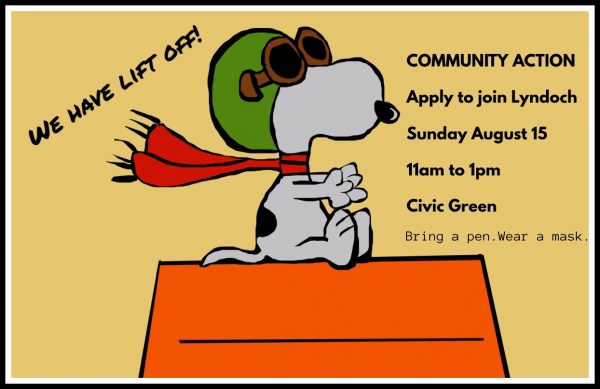
[The sign-up will be held this Sunday, August 15, Civic Green, 11am to 1pm. No fee required. Forms provided. Bring a pen, wear a mask. You can find a membership form in advance here, and the Lyndoch constitution here.]
Community sign-up action for Lyndoch this weekend
Carol Altmann – The Terrier
Picking up where we left off, we now have lift off! Come and sign up this Sunday Aug 15, Civic Green, (11am – 1pm) to show your support for putting the community back into the heart of Lyndoch.
This is a show of solidarity for the staff and residents. It’s a chance to say that we want a reality check around what is happening with Lyndoch, beyond the spin and the silence and the puffy stories.
So many people have worked so hard these past years to raise the issues that are now coming home to roost at Lyndoch. For me, the string of failures in care recorded by the ACQSC is the final straw.
We can either walk away, or we can walk up on Sunday and say, “Sign me up”.
Wear a mask, bring a pen and bring your resolve.
[If you would like to fill out your form before you arrive, you can do so here. If you can’t make it Sunday, but would like to sign up, send me a message.]
Testing the gate: launching a Lyndoch membership drive
Carol Altmann – The Terrier
Time to get busy: the Lyndoch Living AGM is coming up in October, so next Sunday I am running a “sign up” for Lyndoch membership day.
The plan is to collect as many applications as we can – 20? 50? – to try and put the “c” (community) back into the heart of Lyndoch.
As I have written before, Lyndoch has no general members who come from outside Lyndoch.
All of the general members – around six or seven – are employees of Lyndoch.
In the past 18 months, a string of applications from the public have been flatly rejected by the board with no reasons given.
Who would have thought our aged care home would become such an exclusive club?
And speaking of the board, Lyndoch has had two board vacancies since May, but there has been no call for nominations – the spots remain empty. (The nine board members are separate to general members.)
It’s all very strange and completely at odds with what has been the community spirit of Lyndoch for the past 60 years.
This gatekeeping also removes a grassroots layer of scrutiny because members can – if they want to – do a number of things, including ask questions at the AGM, call general meetings, pass resolutions, run for the board, and vote on board nominations.
With the AGM now on the horizon, I believe the time is right to “test the gate” and see if it remains firmly locked to the uninvited.
Prof James Dunbar and Jim Burke, from the “Keep Lyndoch living” group, will be helping me out next Sunday.
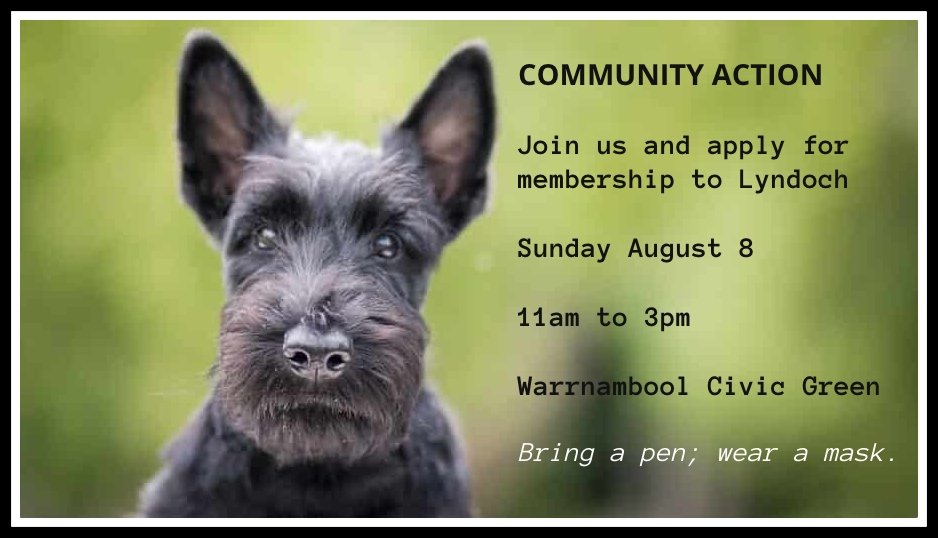
If you would like to be a part of this push, pop down to the Warrnambool Civic Green between 11am and 3pm and look for the not-very-fancy terrier table.
I will have membership forms ready to go, it’s free to apply, and I will deliver them all to Lyndoch once we are done.
We will then wait and see how many people, if any, make it through.
[Sunday August 8, Civic Green, 11am to 3pm. Covid-safe protocols will apply. Please BYO pen and wear a mask. If you would like to bring your membership form already filled out, you can download it here].
Roma Britnell: law reform needed to better protect women
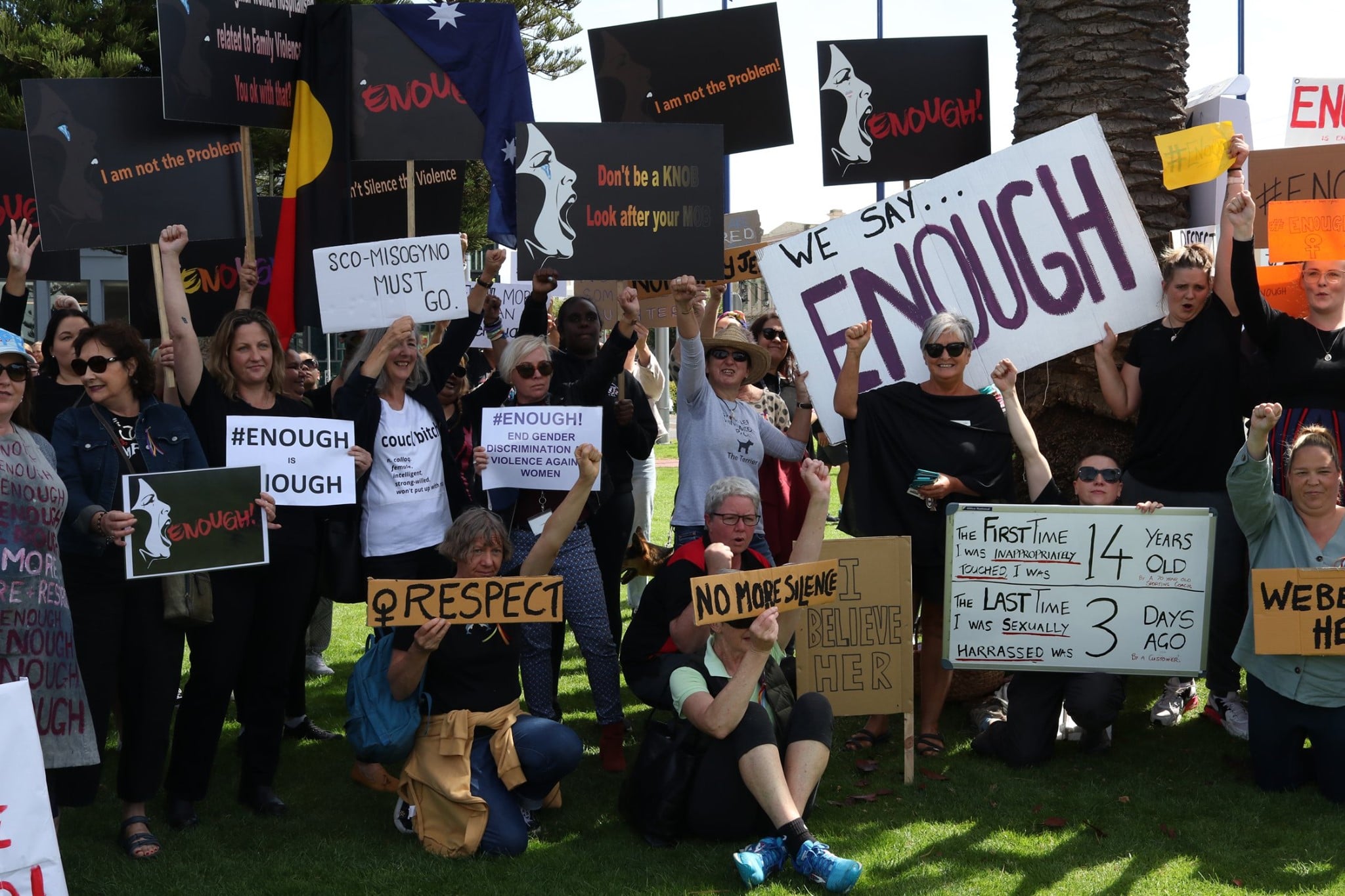
Hundreds of people turned out for the March4Justice gathering on the Warrnambool Civic Green. Image: Emily Bissland/ABC South-West Victoria.
This is a slightly edited version (for brevity) of South West Victoria MP Roma Britnell’s speech to State Parliament on 18 March 2021, following the March4Justice rally:
Ms BRITNELL (South-West Coast) (14:44): I rise to speak on the Cemeteries and Crematoria Amendment Bill 2021. The purpose of this bill is to protect affected persons against further significant harm, pain or suffering that may be caused as a result of the exercise of a right of interment…
This bill effectively has come about as a result of a shocking case of the murder of a woman by her husband. A headstone was placed on her grave which had ‘In loving memory’ or words to the effect that her husband was respectful, and there was nothing further from the truth. It was upsetting for her children, her family, her brothers, her sisters. Obviously it was completely inappropriate.
Not only that, but the man who murdered her, her husband, had the right to in time, when he died, lie beside her. So it makes complete and utter sense to change that for those who have been, like in this case, murdered, harmed, and in some cases it even applies to a victim of sexual assault, where a family member may be able to lie beside them. That is completely wrong, and this bill goes exactly to where that needs to be changed. This discussion actually happened before Karen’s death. In 2016 the Victorian Law Reform Commission made a recommendation. That was five years ago, so it is a real shame that it has taken the government this long to fully adopt—which is what we are doing here—those recommendations. It is simple, and it has been far too long coming.
This makes me think about what we are really doing to support women. Are we doing enough? Clearly we are not.
Not when you see the figures that my colleague the member for Lowan just raised in her speech around the people who are victims of family violence. They are on the increase. Violent crime stats just out today demonstrate the increase in family violence, not decrease, of those cases that are being reported to police. It is just not okay. Women have the right to feel safe. They have the right to feel safe wherever they are, be it at work, be it on the street or be it at home. Are we doing enough? Clearly we are not.
I was at the March 4 Justice just this week with my colleagues, and I back the fact that we as a group of community members, as females together—both sides of this house—must work together. Colleagues—be it my male colleagues, my female colleagues—we can all do so much more…
There was a real white-hot anger at that rally, and I could feel the women just so intent on making a change. You can understand the anger, particularly from women who were present who have been abused. Sexual assault is a really serious crime, and we are not seeing the results in convictions that we see in other serious crimes like murder. Why is that?
I am reminded of when I was at school in year 11 studying legal studies, and I remember learning about momentous change that was happening in the legal system where, for the first time—and I learned this I reckon in 1983—women, instead of being in the box facing their perpetrator, could actually do what was called a hand-up brief. The very fact that it was called a hand-up brief or is still called a hand-up brief—I know it is a fairly common legal term still; I am not sure if it is the right one anymore—is kind of bizarre in itself.
What it means is that women, instead of facing their perpetrator, could write their report and hand it in as a written format rather than as a verbal format in front of the perpetrator—a great and momentous change. But it made me think: have we done enough? I know we have got the Royal Commission into Family Violence results and we have had 227 recommendations, 64 of which are still to be implemented, but have we really actually looked at what we can do?
I suggest we get the legal minds of this state and perhaps this country together—the brightest and best—and look at the meaningful reform we really need to have so that we get the convictions just like we get in other serious crimes. Because it makes no sense that we are not getting the same level of convictions. It is not that the women are making it up, it is not that it is not true; it is that we need to find ways to support them.
There must be an opportunity for us to look around the Western world and see how other nations are perhaps doing it better. I am not saying we should undo the very important rules of law that we have in place, the foundation of our very democracy, but I am wondering: have we really put those minds together and formed a panel that can actually do that review?
I think it is time we made a difference, and I believe that meaningful reform is absolutely possible. I had in my office just a few weeks ago a woman who was terrified for her safety. The intervention order that she had out on her husband was coming to an end. I do not want to give any more details than that, but it struck me as strange that she was relying on that IVO. She was terrified for her life and she gave me lots of reasons and stories that made me also very concerned about her life. The very fact that she was being put into such a fearful place really sent a chill down my spine. I wrote to the minister that day with a sense of urgency, via email, which obviously is instant. I am actually still waiting to hear back, and I think it was three weeks ago. So we must be able to do better.
I know we have got to support our women, and sexual abuse, murder and being treated like this woman was—with absolute fear—is no way for any human being to live.
I think the bill does do one thing that will help change what has happened to Karen, and I pay my respects to the family for the pain and suffering that they have gone through, which no family should have to go through. But it is time, well and truly past time in fact, to make these changes. I hope that we do more than make these changes in this legislation, but we look at the figures today of 1800-plus people being treated by ambulance call-outs in the 2019–20 year that are victims of family violence where 30 per cent of children are actually witnessing these events.
We need to support women so they can call these situations out early, know that they will get help and not be like another woman who came to my office having left a marriage situation where there was a lot of emotional violence and withdrawing of ability to see friends and withdrawing of finances. Four years later she said to me, ‘I’m couch surfing and I really did think, given all the support they talk about for women, that I would at least be supported with a home’. After 3½ years of couch surfing, for the last six months she has joined up with her friend, pooling their funds and living in motels. But she is on a national disability insurance scheme package. She cannot drive. She has to walk to services that do a great job, she said, supporting her. She cannot move out of the area because those support services are critical for her disability. But come May when we have the May races in Warrnambool, when the motels are full, she is out on the street.
And that is just last week’s story.
How many stories do we get in our offices where we are just not doing enough? She left her husband in that abusive situation—it was not physical abuse, it was emotional abuse but fairly significant—believing that she would be supported, because that is what we say to women these days. But it is not; it is just not happening enough and that was why the rally occurred.
We can do more, and my suggestion is we get the best legal minds in our nation together, particularly in the state of Victoria, and lead the way of finding better ways to support women. That hand-up brief, the example that I spoke about, was 35 years ago at least. So I think it is time for change, and there are ways to do that.
[Note, this is an uncorrected proof from Hansard, so may have minor changes in the final published version.]