[dropcap style=”font-size: 35px; color: #8cc7d0;”] M [/dropcap]ost of you will remember Bluestone Magazine, a small start-up that brought an online, fully independent magazine to south-west Victoria in 2013.
By the time it closed in late 2016, Bluestone Magazine was making a name for itself as a place where you could enjoy a quality read about people within your community and also find out what was really going on, as we were not afraid to dig deeper into local issues.
Sticking your neck out in a small community is not an easy thing to do, but I think it is something that journalists and writers have to do if they are true to their profession, so I am sticking my neck out again. (You can find out more about my background here.)
This website is an experiment to see if south-west Victoria still wants an independent voice.
I have been lucky to harness some great writers to help me out, including experienced former Fairfax and Crikey journalist Lee Nicholson who will specialise in writing about the local live music scene (picking up where she left off more than 20 years ago when she started a music column with the local newspaper).
Former Fairfax and Crikey.com journalist Lee Nicholson has recently returned to Warrnambool and will write about the local live music scene.
Local identity and passionate op-shopper Bill Abrahams will write an occasional, humorous column on the world of collecting, op-shops and the joys of finding that irresistible bargain.
I will also be bringing you stories about people, politics and guest writers who will air their spleen on all manner of topics. Yep, I like a bit of variety!
There will be no ‘editions’ as such, instead I will publish small batches of fresh stories as they are written.
So here we go, starting again, stretching the arms, legs and heart.
I hope you enjoy it.
Inside the home of ‘Bluestone Magazine’
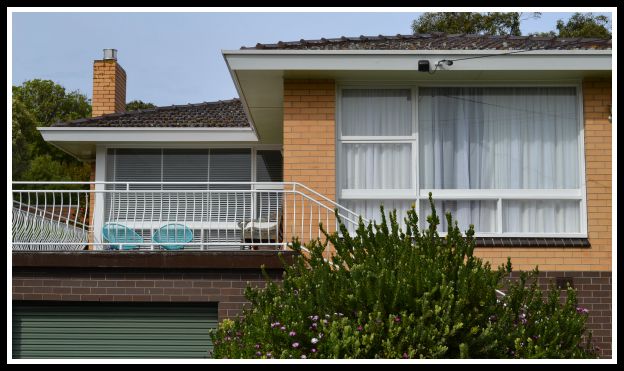
So very Warrnambool: the classic, double-fronted late 50s brick veneer with plenty of glazing and a sunny patio. Image: Clinton Krause.
Bluestone columnist and architect CLINTON KRAUSE previously worked in Daylesford before relocating his business to Warrnambool. Clinton explores the architectural styles that gives our region so much character. Visit his website here.
I thought for my column this month I would keep it a little in-house and stroll a few doors down the street from my home to the home of editors and founders of Bluestone Magazine – Carol Altmann and Louise North.
Since buying the home in late 2013, there has been little change to the property’s original street facade – a gracious and well-proportioned double fronted late 1950’s brick veneer with oodles of north facing glazing.
But a steady stream of tradesmen over the last year hints at the ongoing improvements that Carol and Louise have embarked upon.
A new home for Tipsy Glass studio (Louise’s other identity) has emerged from within the original garage, and paving to the elevated terrace and a capacious covered entertainment area are just a few of the home improvements that have raised the bar for other neighbours in the street.
Art and quirky collectables feature throughout the home, including these retro genie bottles and works by Sue Ferrari, Peter Clayfield and Jan Allen. Image: Clinton Krause.
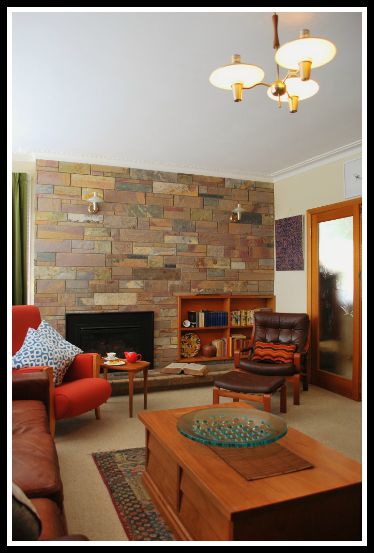
Sitting in their light-filled and airy loungeroom for our interview, I am struck by the predominant ambience of casual and inviting comfort that the interior décor exudes.
Surprisingly, both women laugh at my suggestion that the spaces have been styled with a solicitous artistic eye. But I am sure that visitors and Bluestone readers would support my observation.
Indeed, it is the conception and ongoing dedication to Bluestone that has spawned a direct and rapid connection for the couple to the arts and cultural community of the south-west and, as I look around the home, I recognise the work of many of the artists, sculptors and craftspeople that have featured in previous editions.
“Occupational hazard!” quips Louise and as we tour the home, she points out various pieces that have been seconded during their interviews with artists.
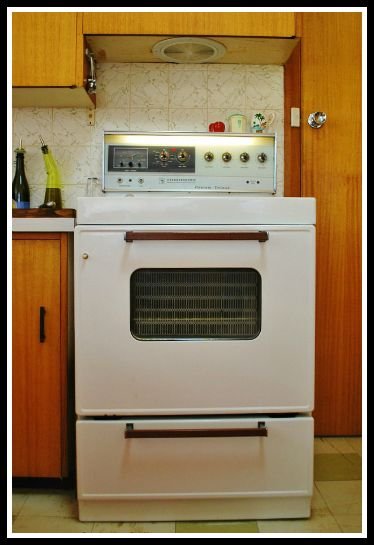
The original General Motors Holden ‘Frigidaire’ free-standing oven which has so many miles under the hood, but is still cookin’ (but not with gas). Image: Clinton Krause.
Every wall and room is adorned with both new and quirky retro art, sculpture or objects arranged with an intuitive and deft understanding of balance, colour and proportion.
The original features of the house have been retained and are cherished for their authenticity and domestic vibe – the crazy stone fireplace with spun aluminium wall lights reminiscent of Star Trek’s ‘Starship Enterprise’, the bespoke pink bathroom complete with sunken bath and jaunty angled laminex cabinetry, period wallpapers and light fittings, and the piece de’ resistance – an imposing 1960s Frigidaire upright cooker in the kitchen.
In its day, this was a top-of-the-line model, complete with inbuilt fluorescent task lighting, onboard power points and a commodious oven capable of dealing with even the largest side of mutton or Christmas turkey.
Carol demonstrates an unexpected feature of this domestic wonder (proudly emblazoned with a badge that states “made by General Motors Holden” ) – with the quick release of a concealed catch, the top panel swings up like a car bonnet for access to the inner workings of the hotplates. Looks like an oil change and tune up would be “easy as pie” too!
The light-filled lounge with original light fittings and crazy-stone feature wall. Image: Clinton Krause.
We return to the loungeroom to enjoy a cuppa and discuss the philosophical concepts of “home” for our generation living in Australia.
With perhaps “rose-tinted” retrospection, the three of us recall our childhood experiences of living in neighborhoods filled with double and triple fronted brick veneers, gaggles of kids streaming in and out of each others homes, out on the bike all day (but home by 5) and commandeering the street for games of ballsports or hopscotch.
With the realities of a changing world increasingly imposing itself on the Australian ‘way of life ’ and challenging our sublime naivety, perhaps it understandable that today more than ever we seek refuge and sanctuary within the comforts of these mid-century homes and the happy memories of an innocent youth they evoke.
Are missing Loch Ard ingots the tip of the iceberg?
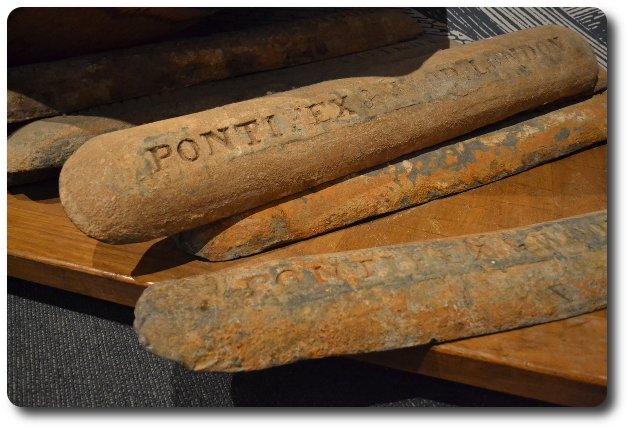
Ten of the original 872 lead ingot weights from the Loch Ard that were loaned to Flagstaff Hill by the Federal Government in 1984: more than 200 have since gone missing. Image: Bluestone Magazine
OPINION– Carol Altmann
[dropcap style=”font-size: 60px; color: #5C747D;”] H [/dropcap]ow did Warrnambool’s Flagstaff Hill Maritime Villagelose track of more than 200 lead ingots that were part of the most famous shipwreck in Australia – the Loch Ard – given to it by the Federal Government for safe keeping?
This is a question that has the Warrnambool City Council scrambling for answers but – so far – the explanations have only raised even more questions about how the maritime collection has been managed and whether more irreplaceable items may have fallen through the gaps. (*Update: Flagstaff Hill has since confirmed more than 130 items are missing from its collection, including the Newfield bell from 1892.)
Cr Brian Kelson started asking about the location of all the Loch Ard (1878) ingots late last year and the information that has been provided since has been surprising, in terms of how loose the record keeping and storage has been around relics that should be considered precious.
In a written report to council at its December 1 meeting, the Flagstaff Hill advisory committee revealed that 872 lead ingots and 10 copper sheets from the Loch Ard were loaned to the village by the Federal Government in 1984.
They have a written agreement to prove it, but unfortunately it would be almost 30 years – yes, 30 years – before Flagstaff Hill did a full count of the ingots, each of which weighs around 60kg but, because of their French-stick shape, can be carried by two people.
That count was in 2012 and they could only find 728 of the 872, meaning 144 had somehow vanished, which is not surprising given there was no proper audit for almost three decades.
Some of the Loch Ard ingots stacked alongside the lake at Flagstaff Hill in Warrnambool. Image: Bluestone Magazine
[dropcap style=”font-size: 60px; color: #5C747D;”] T [/dropcap]he advisory committee admits that this number – 728 – wasn’t cross-checked, but it was still added to the Flagstaff Hill database.
Another count was done in 2014 and could only locate 652 of the 728, meaning another 76 ingots were added to the already missing 144, bringing the total now missing to 220.
Oddly, however, Flagstaff Hill has brushed off the missing 144, saying it could have been an error in the original loan agreement, which I would say is unlikely, given it was an official government document that was dealing with maritime treasures. (Update: see former FHMV director Peter Ronald’s comment at the end of this piece, confirming the initial intake.)
There has also been no mention of the 10 copper sheets – does Flagstaff Hill still have them?
The copper sheets were listed as item no. 3078 on its public database – that was until last November, when the listing disappeared. (Update: the copper sheet listing has been reinstated, together with a copy of the federal loan agreement. You can see both here.)
The council’s focus has been narrowed to finding the 76 ingots missing from the 2012 count, and this is where things have become quite bizarre.
Some of the 286 ingots that are stored inside the Reginald M moored on the lake at Flagstaff Hill. Image: Bluestone Magazine
[dropcap style=”font-size: 60px; color: #5C747D;”] F [/dropcap]irst, at the same December 1 council meeting, council CEO Bruce Anson gave a verbal update to Cr Kelson in which he said that another count had been taken and 64 of the missing ingots had been found in a false floor of the Reginald M: one of two boats in the Flagstaff Hill lake.
A false floor? We took a look inside the Reginald M at the weekend and counted 286 ingots – the same number in the advisory committee report – and there were no signs of any ingots in a false floor (but, as an aside, plenty of signs of a rotting floor filling up with water).
Mr Anson went on to say that any remaining missing ingots were inside the hull of the nearby derelict Rowitta.
This reassurance was repeated in the local newspaper on December 23, although Flagstaff Hill manager Peter Abbott said it was too unsafe to actually count the ingots in the Rowitta, but his people could “peer in”.
Mr Abbott then revealed that some ingots could also be in the mud at the bottom of the lake, thrown there by night-time intruders. What? When did this happen and were police notified of a break-in at Flagstaff Hill?
A close-up of the Loch Ard ingots, each of which bear the maker’s mark. These are among 10 on display in the Great Circle Gallery at Flagstaff Hill in Warrnambool. Image: Bluestone Magazine
[dropcap style=”font-size: 60px; color: #5C747D;”] S [/dropcap]o how many Loch Ard ingots have we actually got on display, in storage and in the mud at Flagstaff Hill?
I don’t know, I am lost, but I counted a total of 647 when I was there on Saturday.
To throw a final curve ball into the mix, the council’s director of city growth, Bill Millard, who sits on the Flagstaff Hill advisory committee, sent a memo to all councillors on December 10 saying that “the most recent count” identified the location of 802 ingots and he was “confident” that the ingot collection was intact.
Mr Millard may be confident, but the rest of us have a right to be utterly confused.
By any account, the audit of the Loch Ard ingots is an embarrassing mess caused by years of inaction to update the paper-based (yes, paper-based) collection system at Flagstaff Hill.
It is now being left to Peter Abbott – who, in what must be a vast role, is also head of council’s tourism services – and his team of largely volunteers to untangle it.
Perhaps most troubling, however, is how many more precious objects have “gone missing” from the thousands collected by or donated to Flagstaff Hill over the last 40 years?
There are already rumblings about items such as Newfield bell, which once hung in the Great Circle Gallery at Flagstaff Hill, but no longer even appears on its collection database.
While the analogy may be more suited to the Titanic than the Loch Ard, I fear that the missing ingots may prove to be just the tip of the iceberg.
[button link=”http://the-terrier.com.au/subscribe-2/” type=”icon” icon=”heart” newwindow=”yes”]If you would like see Bluestone survive, please subscribe here for just $85 a year.[/button]
[dropcap style=”color: #a5cecd;”] W [/dropcap]hen I first returned to live in my hometown of Warrnambool in early 2013 after being away for more than 20 years, I had a new appreciation for the ties that bind people from this seaside city.
Despite Warrnambool now being a place of 32,000 people, we all feel like we know each other and, if we don’t, we spend a few minutes playing what one friend described to me as “the game”.
This is where you ask each other what school you went to, or the names of your parents/brothers/sisters, or if you knew such-and-such and – usually – within no more than four or five moves, “bingo!” you have made a connection.
But it is also more than that.
It is the environment that also connects us: the wild ocean, the bent trees, the Norfolk pines, the whales, the restless wind…
And it is even more than that.
It is the iconic people and places that are so familiar to us and that we remember so fondly, even nostalgically, as we all age and they start to slip away. Names like Swintons, Kermonds, Macks Snacks, Ryan’s Removals, The Savoy, Rauert’s shoe store, Politis fish and chips, the Materia Brothers and on it goes.
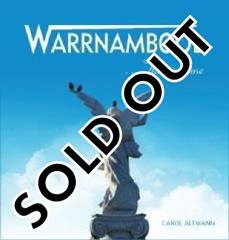
I chose 30 of these icons to photograph and write briefly (snapshots) about – I could have chosen many more – as a small collection of some of the places and faces that connect us as being “from Warrnambool”, even if we live many miles away.
Warrnambool identities: John, Maroulla and Peter Sycopoulis in front of their Kepler St family home. The book is dedicated to Maroulla, who passed away earlier this year.
[dropcap style=”color: #a5cecd;”] A [/dropcap]s the book unfolded, I felt an increasing sense of urgency to capture these special places and faces before it was too late, because there is no doubt Warrnambool is facing unprecedented challenges that are seeing many businesses close and not replaced by others.
In the 16 months since I started this book, the Savoy has closed, the Criterion Hotel building has been pulled down and Lucas Bros butchers was sold out of the family. Just this week it was announced that Capricorn Records would come to an end next month after 35 years.
Warrnambool is changing and, as with any change, there is both an anticipation about what might come and a sadness about what has been lost.
This book is my attempt to preserve some of our shared and precious past.
As I say in the introduction: “Whether you live in Warrnambool, or you simply carry it in your heart, this is a tribute to the place by the sea that no matter how widely we travel, we will always call home”.
* * *
Warrnambool – This is home features the following: Swinton’s Supermarket (Val Grundy/Dot Grauer); Lucas Bros Butchers (Ken Lucas); Materia Bros (Mario,Paul and Mark Materia); the Sycopoulis family home (John, Maroulla and Peter Sycopoulis); Kermond’s Snack Bar (Rob and Bill Kermond); Mack’s Snacks (Graeme, Keith and Paul McLeod); Savoy Restaurant (Alan Tampion); Rauert’s Shoe Store (Ron and Peter Rauert); The Bowl (Lucas Reid and Andrea Occhipinti); Politis Seafood (Helen, George and Chris Politis); Robert Ulmann whale mural (Justy Ulmann); Warrnambool Surf Lifesaving Club (Lisa Logan (Cole), Ben Logan, Ron Cole); The Warrnambool Standard (Peter Collins and Peter Fletcher); The Warrnambool Woollen Mill site (Mary Jackson); Chittick’s Bakery (Ian Robb and John Chittick); Capitol Cinema (Ivan Berndt); Fletcher Jones Gardens (Lex Caldwell); The Quarry/ art collectives (Claire Drylie) Ryan’s Removals (Frank and Graeme Ryan); 3YB radio (Steve Welsh and Lyndsay Hill); W’bool Grand Annual Steeplechase (Brian McIver); W’bool Aquarium (Donna Krebs (Livingston); Timor St Newsagency (Brian Mills); Bojangles Pizza (Simon Mugavin); Isles General Store (Ken Isles); McNeil’s BP Service Station (Noel McNeil); the War Memorial Angel; T&G clocktower (Peter Hogg); The Criterion Hotel.
[box type=”bio”] Warrnambool – This is home will be limited to 500 numbered and signed editions. If you would like to order a copy ($30 plus $8 flat postage if required) from Bluestone Magazine, you can do so here. Books are also on sale at Warrnambool Books. [/box]
[button link=”http://the-terrier.com.au/subscribe-2/” type=”icon” icon=”heart” newwindow=”yes”] Did you enjoy this story? Please subscribe here to help Bluestone thrive.[/button]
[dropcap style=”color: #a5cecd;”] T [/dropcap]his limited edition book is no longer available for general sale.
The last two copies will be offered as a Bluestone Magazine subscriber-only giveaway in February, so if you are a Bluestone subscriber, keep an eye peeled.
Thankyou so much to everyone who has bought this book, read it, loved it and taken the time to write to say how much they enjoyed this small tribute to our hometown.






 You can find more Opinion here…