The Vault: trees, transparency and truth
foreshore trees1
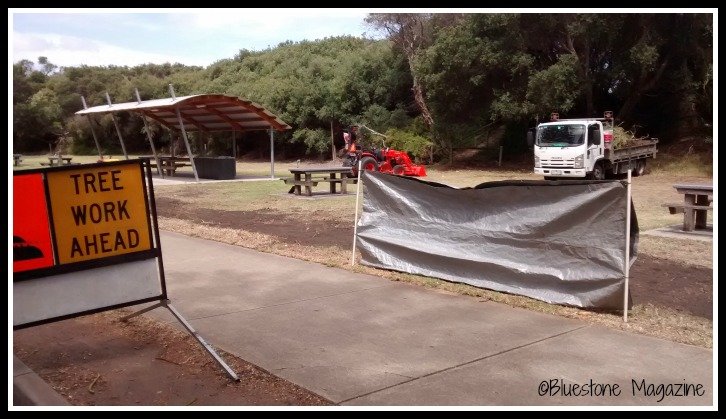
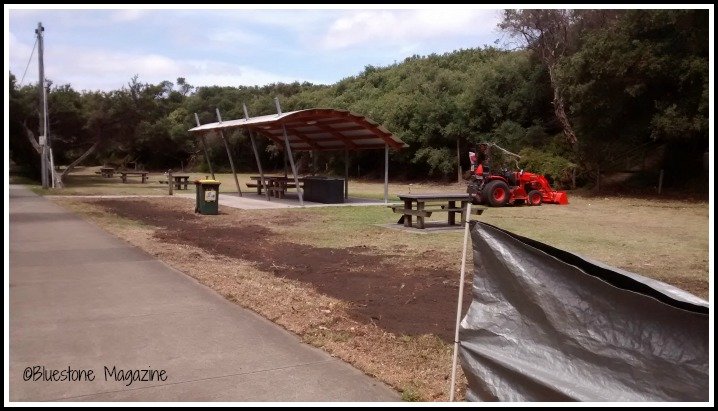
The sudden removal of a row of established tea tree along Pertobe Rd by the W’bool City Council sparked a passionate response from the Warrnambool community.

The Vault – Carol Altmann 

What began as a simple question to the Warrnambool City Council about the removal of some trees has gone on to reveal a much deeper concern that strikes right at the heart of the public’s right to know.

The last 24 hours has confirmed that there is now a two-tier system in place: those people and media organisations who meet the council’s approval and those who don’t. Those who acquiesce will be accommodated and those who dare to dig deeper or question further will be ignored.

In a one-newspaper, regional city with close ties and connections, this is a deeply troubling attack on one of the fundamental parts of a democracy where people have a right to expect an open, transparent and accountable government on all levels. The media, including new media outlets like Bluestone Magazine, are critical to this expectation being met.

First, some brief background for those of you who may not be on Facebook or Twitter, which is where Bluestone revealed the removal of a row of well-established tea-tree from Pertobe Rd this week.

In the scheme of things this might be seen as a small story, but more than 6500 people saw our post and many reacted passionately, asking why the trees had been taken out and that they were saddened, disappointed and even horrified at the loss of this native vegetation.

The WCC issued a tweet to its followers after Bluestone had made public that the trees had been removed, saying: “Old tea trees removed along Pertobe Rd for safety following inspection by arborist. Replacements to be planted in autumn.”

Safety? Inspection by an arborist? We wanted to know more.
tea trees2
The council says the tea tree was removed after an inspection by an arborist, but the arborist’s report is yet to surface.

We emailed WCC communications officer Nick Higgins, Mayor Kylie Gaston and all the councillors to see if we could find out more detail.

Cr Brian Kelson said he was unaware of the removal of the trees, but questioned why the council’s guideline of only removing one-third of the height had not be applied. (note: an earlier version of this story said only Cr Gaston responded to our questions. Cr Kelson also responded.)

Mayor Gaston also responded and the relevant part of her email is here:

“Not all the trees have been removed as people thought may happen this morning which is a good thing.  The young man returned this morning to finish the stumps only.
I believe the trees cut down were assessed as high risk due to cracks and a certain worm being detected in the trees.  
The remaining trees are believed to be fine and will be watched.  No one wishes them to be cut down.
It was recently pointed out to us by our auditor that since the sad accident when the child was killed by a tree in Bendigo this year, councils are being a lot warier of the risk.  This would be a case in point I suppose.”

Leaving the death of the child in Bendigo to one side for a moment (we will get back to that tragedy), we than asked to see the arborist’s report that led to such a dramatic response for a row of worm-infected tea tree.

Mayor Gaston was on the road by this time, so we emailed media manager Mr Higgins yesterday – as is council protocol – and asked directly:

Hello Nick,
As Mayor Gaston is on the road, I am writing to ask you directly if the WCC can forward a copy of the arborist’s report on the tea trees removed from Pertobe Rd.
Regards,
Carol​

Three hours later, having obviously scoured our Facebook page to gauge public feedback on this issue, we received this reply at 5.26pm yesterday:

Hello Carol,

We will decline the invitation to have further input into your commentary.

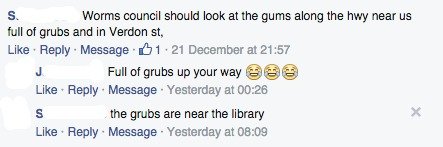
Comments on your Facebook page which describe council staff as “environmental rapists” and “grubs” are offensive.

Actually, what was said on the page was this:

facebook message

And this:

facebook2

Passionate, yes. But no individual WCC staff member was named and certainly not defamed.

While we closely monitor our Facebook page to remove potentially defamatory comments and offensive language, we also believe members of the public who are prepared to express an opinion (however passionately) under their real names is what a free and robust discussion is all about.

We also find the council’s refusal to comment to us on this basis particularly interesting given a senior member of its own staff, tourism manager Peter Abbott, was this year exposed for attacking some councillors under a pseudonym to the local newspaper.

Here is our response to Mr Higgins:

Hello Nick,
It is not an invitation, but a request for information that should be in the public domain, given it was stated as the reason for the removal of the trees.
Just to be clear, are you saying the WCC is with holding this information because of a comment/s by a third party – under their own name/s – on our Facebook page that does not in any way attack an individual but perhaps, instead, expresses the clear frustration and disappointment at the decision to remove this vegetation?
Strong words, certainly, but we believe in allowing people who are brave enough to have a say publicly, under their own name, to actually have a say.
I wish to point out that Bluestone Magazine has made no such comments and has instead raised an issue that was brought to our attention by readers wanting to know why and how the decision was made to remove the tea tree. We also pondered why the council had not chosen to make this information public before the trees were removed, as is recommended in its own tree removal policy.
Despite this, you are saying that this information will not be supplied.
I can only ponder if the same restrictions applied to the Warrnambool Standard when, until recently, it regularly permitted such criticism and attacks on both council and councillors not only on social media, but on its website, including – as you know – comments written by WCC senior staff under pseudonyms.
If this is the chief executive’s ruling, then we will be lodging an FOI for this information, as is becoming the way that the council demands we do business when seeking documents that should and could be in the public domain.
Regards,
Carol

And Mr Higgins’ reply?

I am out of the office from 22/12/2015 05:15 PM until 11/01/2016 08:30 PM.
Hello,
I am on leave from December 23, returning January 11, 2016. If the matter is urgent call 0466 199 511.
banyan trees
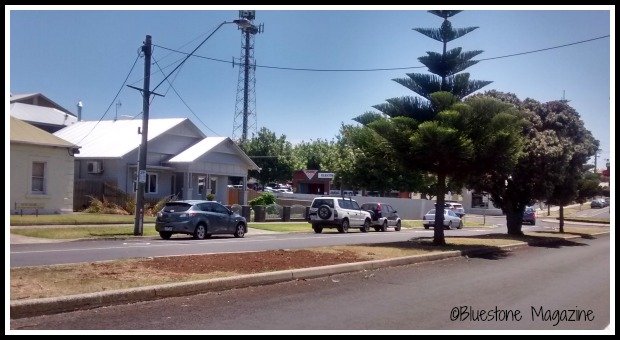
After the removal of the tea trees, a reader contacted us to highlight the removal of several New Zealand Christmas trees along Banyan St, again without public notification.

We are still waiting for the arborist’s report, if in fact one exists. We are, pardon the pun, going out on a limb to say that it doesn’t.

But this is about more than trees.

This is also, in our view, about the council trying to shut down public criticism and scrutiny by scraping social media, and it’s about an attempt to “choke” an organisation like ours that cannot be “media managed”.

You, our followers, will know that this is not the first time. We have still not received answers to our questions on the Porter’s shed, or a copy of the report on the results of the 2015 Fun4Kids festival, or whether, indeed, if all of the missing Loch Ard lead ingots have ever been recovered.

But we will keep asking.

[box]The death of a child from a falling tree limb in Bendigo in 2013 led to a coronial inquiry where the council was found not liable. The tree, in that tragic case, was a 90 year old Grey Box gum and the branch that broke was an 18m long limb that dropped from 4 to 6 metres. The coroner set down eight recommendations about council tree management, including installing a computer based management system detailing what trees it owns, a risk assessment and maintenance schedule; a formalised tree inspection protocol; that all assessments be done by an experienced arborist; and that the assessments include the root system and canopy. There is no suggestion that all damaged trees be removed, but that pruning may also be an option. You can read the full report here. You can also read the WCC tree policy here.[/box]

Meanwhile, on the subject of public liability, click here to see a case that actually is just waiting to happen within the Warrnambool CBD.


How Bruce Anson appears to have a job for life

bruce anson abc
Warrnambool City Council chief executive officer Bruce Anson is poised to be appointed for another three years, without the position being advertised. Image: ABC Radio.

Analysis – Carol Altmann

As anyone who has ever been hired on a contract knows, there is no guarantee you won’t have to compete for your job when that contract ends: except if you happen to be the Chief Executive Officer of the Warrnambool City Council.

As was announced by way of a public notice yesterday (15/8/15) CEO Bruce Anson is set to be reappointed for a third consecutive term on a salary package close to $300,000, although this time it will be for three years from January 2016 rather than the usual four, taking him up to 2019.

All up, Mr Anson will have been CEO for 11 years and employed by the council in various capacities for more than 20 years.

Since Mr Anson took up the CEO’s position in 2008, it has never have been advertised.

While some might argue this gives a council stability, others, like Bluestone, would argue it also stifles any chance of bringing fresh thinking into the council’s top job and ensuring that the city still has the best person in that powerful role.

Mr Anson might well be that person, but surely Warrnambool deserves to be able to throw open the doors and see what other talent might be out there, while also, of course, encouraging Mr Anson to apply.

This happens all the time at the most senior levels of the public service, and at the top level of the higher education sector, so why isn’t it happening here?

The answer is astonishing.

By law, a council can choose to either reappoint its CEO, or re-advertise the position: these two options are always on the table every time a CEO’s contract comes up for renewal.

But Bluestone has learned that the highly secretive review committee that oversees the assessment of the CEO’s performance and recommends what should happen at the end of each contract, has categorically ruled out advertising as an option.

In fact, Bluestone has learned, the performance development review committee says to expect Mr Anson to apply for his own job is an implausible scenario.

The committee also believes that advertising the role would be “a very remote and unlikely possibility” and the only way it could happen is if the council no longer wanted Mr Anson to be in the role.

In other words, under this system, Mr Anson could have a job for life, as long as he wants it.

That is some rare air in today’s world.

The majority of the review committee – made up of Mayor Michael Neoh, Cr Jacinta Ermacora and Cr Kylie Gaston, with Rod Coutts as the independent chair – justifies this approach because, despite what the law says, councils apparently do this all the time: only advertise the CEO’s role if the CEO is leaving.

Maybe they do, but that doesn’t make it right.

Ballarat City Council has this month been grappling with the very same issue, with up to four of the nine councillors in favour of making sure CEO Anthony Schink’s position was advertised.

It wasn’t, and a majority of councillors (although we don’t know how much of a majority) recently voted to sign on Mr Schink on for another three years.

With the way the numbers currently fall at the Warrnambool City Council, the recommendation to reappoint Mr Anson for another three years on around $300,000 a year will also be passed by a narrow majority of 4/3.

It’s great work, if you can get it.


Races, rates and rubbery figures

marquee
Budgets might be tight at the Warrnambool City Council, but there is still room for its annual May Race Carnival marquee. Judging by this shot, however, it was not an overly crowded affair.

Analysis – Carol Altmann

[dropcap style=”font-size: 60px; color: #A5CECD;”] T [/dropcap]here are two things which always go up each May: the Warrnambool City Council rates, and the council’s corporate marquee at the May Racing Carnival.

They make for a painful double.

Painful because ratepayers are again facing a 5.5% increase in their annual rate bill, following on from a 5.5% rise last year, which is more than double the inflation rate and amounts to an 11% increase in two years. (Glenelg Shire Council recently announced a 1.95% rate rise).

This means, for example, if you were paying $1700 in rates in 2013-14, you can expect to pay almost $1900 this financial year.

Cities the size of Warrnambool are not cheap to run and ratepayers collectively contribute around a third of the total $64 million operational budget, with the remainder coming from grants and user fees and charges, so every cent – and how it is spent – counts.

The council reminded us of this at its monthly council meeting (May 4) when it outlined where it had tried to make savings – by trying a different road building method, for example – and how some of the big-ticket items, like the drainage tunnel for Simpson St, were both necessary and costly.

“Times are tough”, “budgets are tight”, “things will only get harder when rates are capped”, are common mantras around the council at the moment, which is why a corporate tent at the May Racing Carnival seems like a complete waste of money and an insult to ratepayers.

Last year, the hospitality tent had a budget of around $25,000, but actually spent $17,000 on the 90 guests who attended out of 168 that were invited.

While $17,000 is small in an operational budget of $64 million, it is the perception that bites: the council’s corporate tent at the races is still considered “non negotiable” when it comes to savings.

(We asked, but have not been told, the budget or guest list for this year. Judging by the photo above, however, it may have at least been scaled back.)

It might be more palatable if the hospitality brought some tangible rewards, but based on last year’s event, the party is largely made up of council staff, councillors and members of the various boards, bodies and legal firms that the council already works with on a regular basis. In other words, it is a junket.

anson car
The “$10,000 car” provided to the council’s chief executive officer as part of a salary package: in reality it is a luxury Hyundai Genesis valued at around $60,000.

[dropcap style=”font-size: 60px; color: #A5CECD;”] P [/dropcap]erception also comes into play when we look at the vehicle provided to the Chief Executive Officer as part of a $288,000 annual salary package.

In the rubbery figure ways of corporate salary packages, this car is valued at $10,000, but don’t expect a car that is actually worth $10,000 – that is a reflection of the annual leasing cost.

In reality, the council provides its CEO with a sleek Hyundai Genesis that is worth around $60,000 and which sucks up 11.2 litres of fuel per 100km. Surely, in these cost-cutting times, something like a Toyota Prius would be a better choice and more environmentally friendly – if not as “corporate” – and send a message to ratepayers that everyone is doing their bit.

On the subject of rubbery figures, given the forensic nature of setting a budget and justifying where and why each dollar should be spent, it was extraordinary to learn earlier this week that some material provided to councillors has been cut and pasted from previous years.

Cr Peter Hulin made the discovery – which he shared at this month’s council meeting – after comparing what are called “service overviews” from previous budget papers to those provided in this year’s papers.

pool-general
Rubbery figures provided to councillors as part of budget papers showed attendance figures at Warrnambool’s Aquazone were exactly the same for three years in a row. Image: sportstock.com

[dropcap style=”font-size: 60px; color: #A5CECD;”] T [/dropcap]hese service overviews detail how an area has performed, and how much money it needs for the coming financial year, so, for example, Aquazone will detail how many people came through its doors, how many people enrolled in learn-to-swim classes etc.

Astonishingly, Cr Hulin found that the service overviews for at least 10 council areas – including Aquazone, Flagstaff Hill, the library, Lighthouse Theatre, art gallery and even environmental health services – had the same figures appearing year after year after year.

In the case of Aquazone, for example, precisely 213,377 people went through the gates and 19,596 people enrolled in learn to swim classes for three years straight.

Let’s be clear: these are figures presented to councillors as part of official budget documents and, irrespective of how much weight they carry in final deliberations, they are simply false. How does this happen?

CEO Bruce Anson could not provide an immediate answer to the meeting, although he did say that he believed the service overview sheets were not updated “for one year”.

“I will have to take the question on notice and get back to you,” he said.

The answer is certain to be interesting and underscores why, when it comes to budgets, it’s always worth reading the fine print.

[box]People can make written submissions on the proposed budget until Wed June 5. The budget will be formally adopted at the WCC meeting on June 22. You can download the draft budget here. [/box]

[button link=”http://the-terrier.com.au/subscribe-2/” type=”icon” icon=”heart” newwindow=”yes”]Bluestone needs at least 500 subscribers in 2015. If you wish to support independent media, please click here to become one.[/button]

Stones Smile newsletterYou can find more analysis here…


Why doesn’t Warrnambool have a major art prize?

W’bool City Council’s big shed shemozzle

Peter Ronald on the destruction of the 100-year-old Rowitta

Silencing councillors tightens grip on public right to know

The thinking behind A Big Life: Michael Barling & Sean Kenny


Heritage Vic to take no action against Flagstaff Hill

Copper Sheets-2
Some of the copper sheets stored at Flagstaff Hill in the Bond Store, including the one showing a severe cut from right to left.

ANALYSIS – Carol Altmann

[dropcap style=”font-size: 60px; color: #A5CECD;”] H[/dropcap]eritage Victoria has finished a three-week investigation into missing and damaged artefacts at Flagstaff Hill Maritime Village in Warrnambool and found it has no case to answer.

Instead, any responsibility for the missing artefacts and damage to relics from the wreck of the Loch Ard (1878), has been sheeted home to former management of the village.

As first reported in Bluestone Magazine, Heritage Victoria launched a formal investigation into the cutting of copper sheets from the Loch Ard, with a 10x10cm piece taken from one, while another had a large slice removed, allegedly for use as a sculpture or trophy.

Such damage to relics is an offence under the Commonwealth Historic Shipwrecks Act.

In addition, Heritage Victoria was investigating how the museum had lost track of at least 129 items from its collection, including the brass ship’s bell from the wreck of the Newfield (1892) that was once displayed in the Great Circle Gallery, and more than 200 lead ingots from the Loch Ard.

A spokesperson for Heritage Victoria today issued a two-sentence statement to Bluestone Magazine, saying the investigation was finished and there would be no further action, as “most” of the issues had happened more than a decade ago.

Here is the statement in full:

“Heritage Victoria has completed its investigation into suggestions of problems with the management of the collection at Flagstaff Hill Maritime Museum and determined that no action is required.

“Heritage Victoria noted that professional systems highlighting collection management and an internal audit process had been instigated under the present management and that most of the issues raised had occurred more than a decade ago under previous management.”

No other information was available and is unlikely to be available in the future, as Heritage Victoria does not reveal the details of its investigations.

1-loch ard ingots_1
The arrival of the Loch Ard ingots and copper sheets was worthy of front page news in 1984.

[dropcap style=”font-size: 60px; color: #A5CECD;”] S[/dropcap]o what happened to the copper sheets and who cut them?

And where is the missing Newfield bell, among other items?

Even after this investigation we are none the wiser and, from the sound of it, probably never will be.

The outcome of the investigation is not a surprise, however, in light of comments by Warrnambool City Council chief executive officer Bruce Anson to the February 2 council meeting.

At that time, and in response to questions from Cr Brian Kelson who first raised concerns about the missing artefacts, Mr Anson said “we are confident that our discussions with Heritage Victoria will not find any significant issues at all.”

“We have an ongoing and very positive relationship with Heritage Victoria,” he said.

When asked directly by Cr Kelson who cut the copper sheets, Mr Anson said one had been pierced by a nail, while on loan, and another had a corroded edge from lying in water.

The nailed sheet was in fact a drill hole, added to a sheet now on display at the Port Campbell Tourist Information Centre, so that it could be secured to the wall where it was formerly housed (the people responsible apologised to Flagstaff Hill in 1993 for their mistake.)

Mr Anson made no mention of the sheet that has had a large slice removed, or the sheet with a missing 10x10cm piece, but did say some of the cuts were “hearsay”.

Perhaps more will be ultimately revealed by the council, with Mayor Michael Neoh telling the same meeting that he would be happy for Director City Growth Bill Millard to do a full and formal report back to the council on these issues.

Let’s hope so, because as it stands we still don’t know what happened to precious artefacts that were given to our city by the Federal Government for safe keeping.

subscribe

 Stones Smile newsletter More Analysis can be found here…

Veil of secrecy over salary of the WCC’s top job

The changing landscape under Midfield Meats

Abbott actions reveal toxic culture in council

Investigation launched into Flagstaff Hill

When scrutiny is sub-standard, democracy suffers


Veil of secrecy over salary of the WCC’s top job

bruce anson abc
Warrnambool City Council chief executive Bruce Anson. Image: ABC South-west Victoria.

ANALYSIS – Carol Altmann

Exactly how much do we pay the Chief Executive Officer of the Warrnambool City Council, Bruce Anson?

And what does his salary package include?

A fortnight after Cr Peter Hulin stood up at the first council meeting of the year and stated that it was “about $1000 a day”, we still don’t know.

This is despite Mayor Michael Neoh telling ABC radio two days after Cr Hulin’s comment that he could give an exact figure and “it’s no secret”, when it appears that it is, in fact, very secret.

The closest you can get to a figure is to delve deep into the council’s annual reports – and I mean deep – where there is a listing of salary packages for “responsible persons”, of which Mr Anson is one.

In the list for 2013-14, there is a band of $280,000 to $289,999 which one person received and we can of course guess that it must be the chief executive.

So, did Mr Anson receive $280,000 or $289,999 or somewhere in between?

And how much of this is made up of salary, how much is a vehicle allowance and how much is a performance bonus, if any?

Despite the CEO being a public servant and the public being the one that pays the salary, you are not allowed to know.

k-alexander
Former Melbourne City Council chief executive Dr Kathy Alexander’s salary package was specified in annual reports. Image: Australian School of Applied Management.

This level of secrecy is strange on so many levels and here are just two of them:

First, some councils – you might even call them progressive councils – are completely transparent.

Melbourne City Council, for example, not only lists the salary package of its CEO in its annual report, but all of the other senior officers as well.

I can tell you that CEO Dr Kathy Alexander (until she resigned last December) was on a total remuneration package of $460,000 in 2013-14.

The Melbourne City Council Director of City Business Martin Cutter received a total employment package of $346,967 and Director of Community Development Linda Weatherson received $341,231. I could go on, but the point is made.

Second, there is a clause within the Local Government Act which says that if a CEO is reappointed without the position being advertised, then details of the proposed total remuneration package must be made available for public viewing within 14 days.

Mr Anson was first appointed to replace CEO Lindsay Merritt in 2007-08, when the position was advertised, but was then reappointed before the council elections in 2012, without the position being advertised.

A council spokesman said that, as per the Act, full details of the proposed salary package were made available in 2012.

Great, could I see those details now?

anson remuneration
Inside the pink folder: this is all the information that is available to the public about the Warrnambool City Council CEO’s remuneration package. Image: Bluestone Magazine.

After a few more days of too-ing and fro-ing, I was told that the information was available for public viewing at the council, so I visited the council office and asked at the information desk for the documents.

They had no idea what I was talking about, so they called down the council spokesman, who said the document was held in the office of the Chief Executive and I could make an appointment to see it.

Surely, I argued, I could wait in the foyer while he retrieved it?

He obliged and soon returned with a thin, bright-pink manila folder which contained the same list as in the council annual report, stating that up to March last year, the CEO was paid between “$280,000 and $289,999”.

We had gone full circle and there was certainly no breakdown – as is usually provided under the Act – for what part was salary, car, super or bonuses.

What is even more puzzling about this level of secrecy is that Mr Anson’s package is on par with the average for other “large rural” councils with budgets between $60m and $100m, according to an annual remuneration survey produced by McArthur consultants that is used by councils to negotiate their CEO packages.


YEAR WCC CEO PACKAGE % INCREASE LGA AVERAGE*
07-08 $200-209k N/A N/A
08-09 $220-230k 9.5% $253,254
09-10 $240-250k 8.7% $228,621
10-11 $240-250k No increase $251,956
11-12 $250-260k 4% $277,532
12-13 $270-280k 7.6% $283,875
13-14 $280-290k 3.5% Not available

*McArthur National Remuneration Survey, 2012-13, p3.


Having trawled back through the annual reports, I can tell you that since being employed in 2007-08, Mr Anson’s salary bracket has increased by between 3.5% and 9.5% a year, except for one year, when it stayed the same.

And, just by way of comparison, the Warrnambool CEO package for 2013-14 ($280-290k) was higher than that for Ballarat ($270-280k), Shepparton ($260-270k), Glenelg City ($250-260k) and Latrobe Valley ($210-219k).

Why aren’t we told all this as a matter of course?

The second part of the mystery is: who determines the CEO’s final salary package and measures his performance?

Again, this proved extraordinarily difficult to nail down.

The council has a performance development review committee led by an independent chair, but unlike the council’s other advisory committees, I could find no details about it on its website or in the council minutes.

What the council spokesman could reveal was that the committee meets in confidence quarterly, including a main annual review to which all councillors are invited.

“The outcomes of all four stages are formally reported to Council, which provides councillors with further opportunity for input into the committee’s assessment report and to debate any recommendations put to Council,” the spokesman said via email.

phulin
Cr Peter Hulin created gasps in the public gallery when he said Mr Anson earned about $1000 a day. Image: Warrnambool City Council.

From my understanding, the current performance review committee is made up of Mayor Michael Neoh, Cr Jacinta Ermacora and Cr Peter Sycopoulis, but who is the independent chair and how is he/she selected?

“Because the appointment of the independent chair was resolved at a confidential meeting of Council, the appointment is confidential,” the spokesman said.

Why?

We believe the independent chair is retired business academic Rod Coutts who also sits on the council’s Audit and Risk Committee and the Flagstaff Hill Advisory Committee.

While nobody expects the CEO’s performance review to be thrashed out in public, there is room for much more transparency, as happens across the border in South Australia.

In two councils I looked at, Tea Tree Gully and Streaky Bay, the public is notified when the performance review committee will meet, together with the meeting agenda and the minutes of these meetings are released after 12 months (you can read them on the web).

By comparison, the WCC has adopted a bunker mentality, where the letter of the local government laws are upheld, but not the spirit.

In such an environment, it is not surprising that Cr Hulin’s “$1000-a-day” comment brought gasps of disbelief: the ratepayers have never been encouraged to know how much they are paying their chief executive or why.