Investigation launched into Flagstaff Hill

Flagstaff ingots_18
Flagstaff Hill in Warrnambool is under investigation after revelations of missing and lost items, and damage to Loch Ard artefacts. Image: Bluestone Magazine.

EXCLUSIVE: Carol Altmann

[dropcap style=”font-size: 60px; color: #A5CECD;”] T [/dropcap]he Flagstaff Hill Maritime Village in Warrnambool is under formal investigation by Heritage Victoria over missing items from its collection and damage to relics from the wreck of the Loch Ard.

As recently reported in Bluestone Magazine, two of the 10 copper sheets from the Loch Ard (1878) that were loaned to Flagstaff Hill by the Federal Government have been cut.

It is believed that a large slice was taken from one of the sheets in recent years for use as a sculpture or trophy, while the other has had a 10 x 10cm piece removed.

The Loch Ard, arguably Australia’s most famous shipwreck, is listed as a wreck of state and Commonwealth significance.

It is an offence under Section 13 of the Commonwealth Historic Shipwrecks Act to “destroy or cause damage to a historic shipwreck or historic relic” and can lead to a fine of up to $10,000 or imprisonment for an individual, or a $5000 fine for a body corporate.

In addition, Flagstaff Hill manager Peter Abbott recently confirmed in a letter to the local newspaper that the museum had lost track of at least 129 items from its collection, including the brass ship’s bell from the wreck of the Newfield (1892) that was once displayed in the Great Circle Gallery.

Heritage Victoria told Bluestone Magazine late Friday that, as a result of the revelations, it had opened an investigation into the collection practices at Flagstaff Hill.

“Tim Smith, Executive Director, Heritage Victoria confirmed Heritage Victoria is investigating the care and storage of items at Flagstaff Hill Maritime Museum,” a spokeswoman said via email.

Mr Smith was unavailable for further comment.

Heritage Victoria is responsible for the initial investigation into any potential breaches of the federal law governing historic shipwrecks. It is also responsible for investigating if there have been any breaches of the Victorian Heritage Act, which carries its own penalties.

Copper Sheets-2
An image of the copper sheets from the Loch Ard which clearly shows the bottom sheet severed from right to left.

[dropcap style=”font-size: 60px; color: #A5CECD;”] F [/dropcap]lagstaff Hill, which is accredited by the museum governing body, Museums Australia, has had the spotlight turned on its collection management processes after questions late last year by Warrnambool City Councillor Brian Kelson.

Mr Kelson’s probing about gaps in the museum’s online collection database led to revelations that 220 lead ingots from the Loch Ard could not be accounted for.

Flagstaff Hill was given custody of 872 lead ingots in 1984 as part of the same federal loan agreement that governed the copper sheets.

Mr Abbott and council chief executive officer Bruce Anson have both since given assurances that the bulk of the missing ingots are in the hull of the derelict Rowitta ferry, although there has been no official count due to the poor condition of the vessel.

The ferry, which sits on the pond at Flagstaff Hill, is scheduled for demolition later this year.

Mr Abbott has recently been caught up in a separate scandal, after he was named by the local newspaper as the author of several anonymous comments made to its online forums, in which he made personal attacks against Cr Kelson and Cr Peter Hulin.

Cr Hulin has since indicated he will move a motion of no confidence against CEO Mr Anson at the first council meeting of the year on February 2, citing his handling of Mr Abbott’s behaviour as an example of why the Local Government Minister should be asked to intervene.

 [button link=”http://the-terrier.com.au/subscribe-2/” type=”icon” icon=”heart” newwindow=”yes”]Bluestone needs at least 500 subscribers in 2015. If you wish to support independent media, please click here to become one.[/button]

Stones Smile newsletterYou might also enjoy…

Flagstaff Hill: a museum in transition, or a mess?

Are missing Loch Ard ingots the tip of the iceberg?

The changing landscape under Midfield Meats

Sucking the wind out of Portland’s sails

Granny’s Grave buried in bureaucracy

All words, no funding, for Fletcher Jones story


Are missing Loch Ard ingots the tip of the iceberg?

loch ard ingots_3
Ten of the original 872 lead ingot weights from the Loch Ard that were loaned to Flagstaff Hill by the Federal Government in 1984: more than 200 have since gone missing. Image: Bluestone Magazine


OPINION – Carol Altmann

[dropcap style=”font-size: 60px; color: #5C747D;”] H [/dropcap]ow did Warrnambool’s Flagstaff Hill Maritime Village lose track of more than 200 lead ingots that were part of the most famous shipwreck in Australia – the Loch Ard – given to it by the Federal Government for safe keeping?

This is a question that has the Warrnambool City Council scrambling for answers but – so far – the explanations have only raised even more questions about how the maritime collection has been managed and whether more irreplaceable items may have fallen through the gaps. (*Update: Flagstaff Hill has since confirmed more than 130 items are missing from its collection, including the Newfield bell from 1892.)

Cr Brian Kelson started asking about the location of all the Loch Ard (1878) ingots late last year and the information that has been provided since has been surprising, in terms of how loose the record keeping and storage has been around relics that should be considered precious.

In a written report to council at its December 1 meeting, the Flagstaff Hill advisory committee revealed that 872 lead ingots and 10 copper sheets from the Loch Ard were loaned to the village by the Federal Government in 1984.

They have a written agreement to prove it, but unfortunately it would be almost 30 years – yes, 30 years – before Flagstaff Hill did a full count of the ingots, each of which weighs around 60kg but, because of their French-stick shape, can be carried by two people.

That count was in 2012 and they could only find 728 of the 872, meaning 144 had somehow vanished, which is not surprising given there was no proper audit for almost three decades.

Some of the Loch Ard ingots stacked alongside the Flagstaff Hill lake.
Some of the Loch Ard ingots stacked alongside the lake at Flagstaff Hill in Warrnambool. Image: Bluestone Magazine

[dropcap style=”font-size: 60px; color: #5C747D;”] T [/dropcap]he advisory committee admits that this number – 728 – wasn’t cross-checked, but it was still added to the Flagstaff Hill database.

Another count was done in 2014 and could only locate 652 of the 728, meaning another 76 ingots were added to the already missing 144, bringing the total now missing to 220.

Oddly, however, Flagstaff Hill has brushed off the missing 144, saying it could have been an error in the original loan agreement, which I would say is unlikely, given it was an official government document that was dealing with maritime treasures. (Update: see former FHMV director Peter Ronald’s comment at the end of this piece, confirming the initial intake.)

There has also been no mention of the 10 copper sheets – does Flagstaff Hill still have them?

The copper sheets were listed as item no. 3078 on its public database – that was until last November, when the listing disappeared. (Update: the copper sheet listing has been reinstated, together with a copy of the federal loan agreement. You can see both here.)

The council’s focus has been narrowed to finding the 76 ingots missing from the 2012 count, and this is where things have become quite bizarre.

Flagstaff ingots_10
Some of the 286 ingots that are stored inside the Reginald M moored on the lake at Flagstaff Hill. Image: Bluestone Magazine

[dropcap style=”font-size: 60px; color: #5C747D;”] F [/dropcap]irst, at the same December 1 council meeting, council CEO Bruce Anson gave a verbal update to Cr Kelson in which he said that another count had been taken and 64 of the missing ingots had been found in a false floor of the Reginald M: one of two boats in the Flagstaff Hill lake.

A false floor? We took a look inside the Reginald M at the weekend and counted 286 ingots – the same number in the advisory committee report – and there were no signs of any ingots in a false floor (but, as an aside, plenty of signs of a rotting floor filling up with water).

Mr Anson went on to say that any remaining missing ingots were inside the hull of the nearby derelict Rowitta.

This reassurance was repeated in the local newspaper on December 23, although Flagstaff Hill manager Peter Abbott said it was too unsafe to actually count the ingots in the Rowitta, but his people could “peer in”.

Mr Abbott then revealed that some ingots could also be in the mud at the bottom of the lake, thrown there by night-time intruders. What? When did this happen and were police notified of a break-in at Flagstaff Hill?

More slivers of the puzzle came to light at the weekend when the local newspaper reported that some ingots were being used in Port Fairy while another, not necessarily from Flagstaff Hill, may have been sold at a local clearing sale.

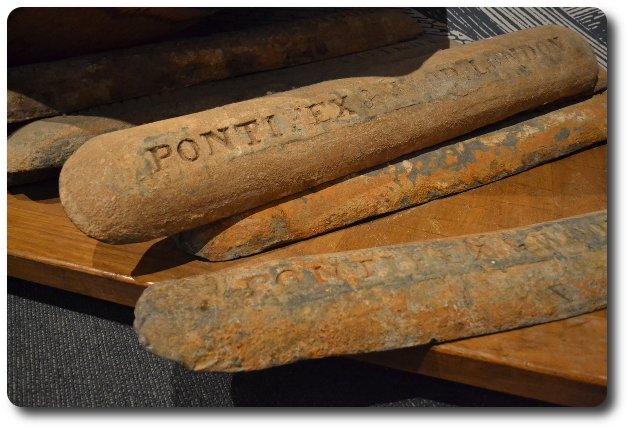
A close-up of the Loch Ard ingots, each of which bear the maker's mark.
A close-up of the Loch Ard ingots, each of which bear the maker’s mark. These are among 10 on display in the Great Circle Gallery at Flagstaff Hill in Warrnambool. Image: Bluestone Magazine

[dropcap style=”font-size: 60px; color: #5C747D;”] S [/dropcap]o how many Loch Ard ingots have we actually got on display, in storage and in the mud at Flagstaff Hill?

I don’t know, I am lost, but I counted a total of 647 when I was there on Saturday.

To throw a final curve ball into the mix, the council’s director of city growth, Bill Millard, who sits on the Flagstaff Hill advisory committee, sent a memo to all councillors on December 10 saying that “the most recent count” identified the location of 802 ingots and he was “confident” that the ingot collection was intact.

Mr Millard may be confident, but the rest of us have a right to be utterly confused.

By any account, the audit of the Loch Ard ingots is an embarrassing mess caused by years of inaction to update the paper-based (yes, paper-based) collection system at Flagstaff Hill.

It is now being left to Peter Abbott – who, in what must be a vast role, is also head of council’s tourism services – and his team of largely volunteers to untangle it.

Perhaps most troubling, however, is how many more precious objects have “gone missing” from the thousands collected by or donated to Flagstaff Hill over the last 40 years?

There are already rumblings about items such as Newfield bell, which once hung in the Great Circle Gallery at Flagstaff Hill, but no longer even appears on its collection database.

While the analogy may be more suited to the Titanic  than the Loch Ard, I fear that the missing ingots may prove to be just the tip of the iceberg.

[button link=”http://the-terrier.com.au/subscribe-2/” type=”icon” icon=”heart” newwindow=”yes”]If you would like see Bluestone survive, please subscribe here for just $85 a year.[/button]

Stones Smile newsletterYou can find more Opinion here…


The changing landscape under Midfield Meats

Street artist secures W’bool mural project

Sucking the wind out of Portland’s sails

Granny’s Grave buried in bureaucracy

All words, no funding, for Fletcher Jones story


Council’s racing hospitality bill hard to swallow


Warrnambool+May+Racing+Carnival+oR6W9T2D91Ql
Revelations that the Warrnambool City Council spent $17,000 on a corporate hospitality tent at the May Races are hard to digest. Image source: Source: Vince Caligiuri/Getty Images AsiaPac 

OPINION

As Warrnambool ratepayers prepare to swallow a 5.5 per cent rate rise this year, revelations that the Warrnambool City Council spent $17,000 on a hospitality tent at the May Races will be hard to digest.

A request by Cr Peter Hulin for more information about the council’s marquee at the 2014 May Races has revealed that $17,036 was spent on wining, dining and entertaining 90 guests.

The breakdown includes $3762 for food, $1489 for drinks, $4950 for members reserve tickets and wristbands, $6610 for the marquee (including staff, decorations, chairs etc) and $225 for racebooks.

And the potential cost could have been as much as $25,000, as 168 invitations were issued but only 90 accepted.

The WCC’s policy on the event, which has been included in this week’s meeting agenda, says the hospitality is intended to show the council’s support for the May Racing Carnival, while also promoting the 142-year-old event to politicians, key bureaucrats and regional leaders.

It is also, apparently, a great place to do business: to discuss “strategic projects” (presumably in-between races), and to develop “organisation to organisation” relationships, whatever that might mean.

red wine flowing
Just weeks before the WCC passed a budget that included a 5.5% rate rise, the wine was flowing in its corporate hospitality tent at the May Racing Carnival.

I don’t know if you received an invitation to the marquee , but those who did included:

  • 24 members of council and their partners (including each councillor, the CEO, Mayor and directors);
  • 12 state and federal MPs,
  • 9 senior government bureaucrats,
  • 65 regional leaders (including South Coast Board members, Wannon Water executives, senior police, senior health executives, the Deakin University Vice-Chancellor and South-West TAFE CEO);
  • and two of Cr Brian Kelson’s business associates.

Another 56 people described as “groups and individuals working closely with council” were also extended the opportunity to enjoy a day by the track.

This group included representatives of Maddocks Lawyers, a Melbourne-based legal firm that describes itself as one of the top 20 law firms in Australia and who, presumably, represents the council. I am not sure why top-of-the-town lawyers need to be wined and dined as part of developing “organisation to organisation” relationships.

This final group also included the President of Commerce Warrnambool, a position currently held by Tony Herbert.

I find this intriguing for two reasons: first, that Commerce Warrnambool – at the time of the May Race Carnival – was deep in discussions with the council about its proposal to hit traders with a new compulsory levy to raise $3 million over five years to fund its activities. Indeed, the motion to set the levy in train was passed by the council just a fortnight later.

Being invited into the WCC hospitality marquee in the lead-up to that decision is the sort of access that traders fighting against the levy can only dream about.

Second, Commerce Warrnambool has argued that it needs funds from the levy to, among other things, act as a lobby group to council, but it appears that it is already well and truly “inside the tent”.

tighten belt


We don’t know, as yet, who actually made up the 90 people who attended the marquee and if they included Mr Herbert, who yesterday declined to say whether he accepted the invitation or not, or Cr Kelson’s two unnamed business associates.

But what we do know is that such corporate largesse is difficult to justify when so many people in the south-west are struggling to make ends meet.

And it is even harder to justify when rates are rising at almost double the rate of inflation and double the interest rate on most savings accounts.

Wining and dining has long been a part of how business operates, but we are not talking here about a commercial company like Coles, or Telstra or McDonalds: we are talking about a local council that has you as it shareholders (ratepayers) and which should be leading by example.

I find this sort of corporate partying (aka “networking”) particularly galling when, at the same time as the council’s guests are sipping champagne and nibbling on canapes, there are literacy programs, arts projects, history projects, health projects, environmental projects and many other small, but important community projects all struggling to secure funding from an ever-shrinking pool.

While it must be easy to lose perspective when you are dealing with tens of millions of dollars, as the council does, to each and every one of these community projects, $17,000 is still a lot of money.

No doubt those people who attended the race day had a marvellous time and perhaps even came away feeling a little more connected, inspired and ready to do business with the council, if they weren’t already.

But to me, the corporate marquee revelations are cause for a very bad case of indigestion.