Harbour plan needs cool heads and caution: Peter Ronald
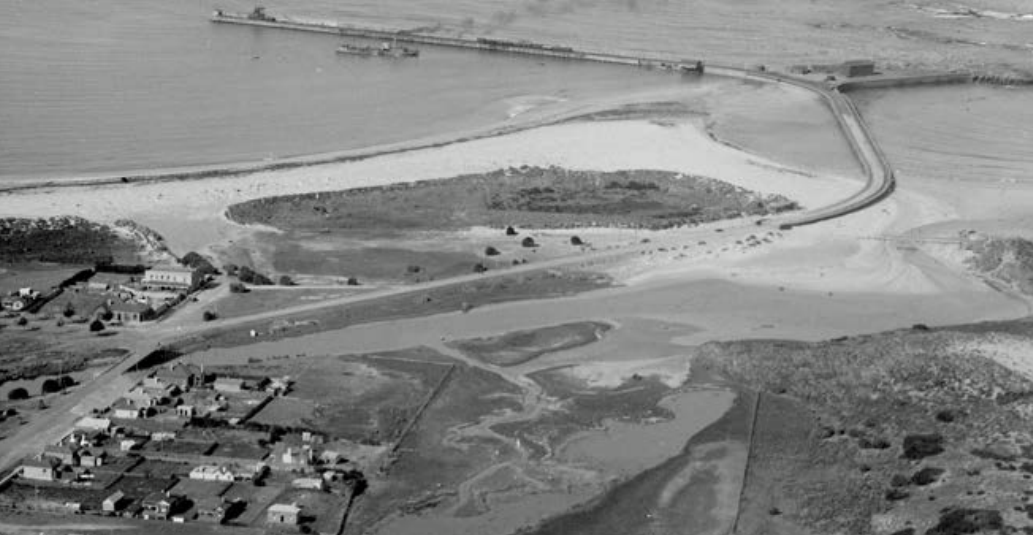
Lady Bay and the mouth of the Merri River, circa 1920s, when the viaduct was open between Stingray Bay and Lady Bay. Image: Lost Warrnambool/State Library.

Terrier guest writer – Peter Ronald*

The future of Warrnambool’s harbour has attracted growing interest recently and that is good to see, but it’s important that raw enthusiasm does not drown out sound judgement.

Good decision making on the harbours’s future will depend upon cool heads, questioning popular assumptions, and proceeding with great caution.

In the historical context, Lady Bay was never a great location for a port. The fact that European settlement occurred first in Portland, followed by Port Fairy then Warrnambool, is not accidental.

That chronology simply follows the relative suitability of each location as a serviceable port.

The lack of depth and associated siltation problems of Lady Bay were observed in the earliest days (well before the breakwater was constructed) and dredging was always going to be a necessary function. A greater limitation though, was/is Warrnambool’s exposure to the extremes of the Southern ocean.

Conditions beyond the breakwater can be, and frequently are, simply horrendous for boating.

In the days of coastal steamers, Warrnambool’s Harbour Master had the authority to close the port to all shipping movements, not because of conditions within the harbour, but because conditions across the open-ocean approach were too dangerous.

In spite of these things, it should be remembered that the breakwater has actually served its purpose.

The huge tonnage of cargo through the port was only possible through the construction of the breakwater and through the essential dredging within its lee. Nothing has changed. The depth and location of the entrance channel remain the same, sea conditions have the same degree of variability, the breakwater stands as it always has.

The key variable at play in the functionality of the port has been the extent and frequency of dredging.

The late Tom Wicking used to joke that when the old steam dredge would to go well out to sea to dump its spoil, the sand would make it back in before the dredge did!

A humorous exaggeration of course, but it served to emphasise the ongoing need for maintenance dredging. Maintenance is the operative word; the port continued to serve the needs of quite large ships for as long as the maintenance dredging was carried out.
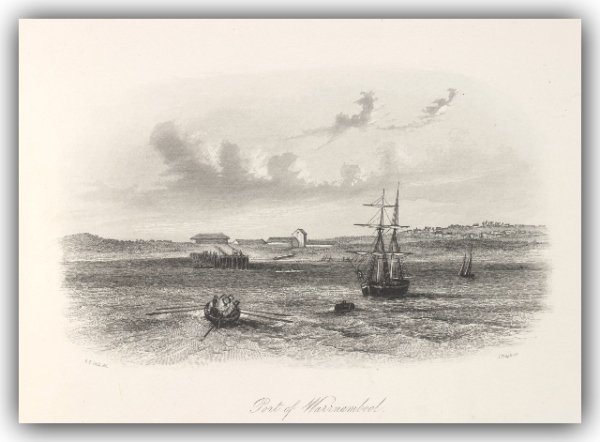
Port of Warrnambool, engraved picture by J. Tingle. Published by Sands & Kenny 1857. Image via State Library Victoria.

Just as we paint houses and mow lawns, we don’t shy away from these tasks just because they will need to be done again. The key point is this; no matter what level of port infrastructure we might like to add or subtract from Lady Bay, some level of maintenance dredging will still be needed.

As the late Edmund Gill explained; turbulent water carries sand and silt, but when that water is calmed the “cargo” is simply dropped. This truth is unalterable.

The primary interest in the port these days is for recreational boating via the boat ramp. I have about 50 years practical experience in boat launch and retrieval from Lady Bay and I refute the claim that the existing launch facility is unacceptably dangerous.

I have successfully launched a wide variety of craft over the years and never encountered a problem that was not of my own making. I have no doubt that the inexperienced, the bold and the stupid, will encounter difficulties!

This is particularly true when trying to launch in unsuitable conditions (as the inexperienced the bold and the stupid are prone to do). Given the frequently dangerous conditions beyond the breakwater, the key to safe seamanship around Lady Bay is simply knowing when to stay at home. It is not just a matter of inconvenience, the dangers are very real.

No other boat ramp facility in Victoria offers such immediate access to life threatening conditions. The total loss of life (drownings) within a 2km radius of the breakwater is probably unequalled anywhere in Australia.

In poor sea conditions it is true that the existing launch facilities are very difficult and risky. I would argue however, that this actually protects people from themselves.

The creation of an all-weather launch facility in Lady Bay would inevitably result in loss of life, simply by enabling people to put to sea when they shouldn’t.

This should not be interpreted as an argument to do nothing, but rather to illustrate the importance of fully exploring the consequences of any action.

There seems to be a popular view that, if only the launching and harbour facilities were improved, Warrnambool would become some sort of mecca for recreational (and even commercial) fishers. This is frankly a pipe dream.
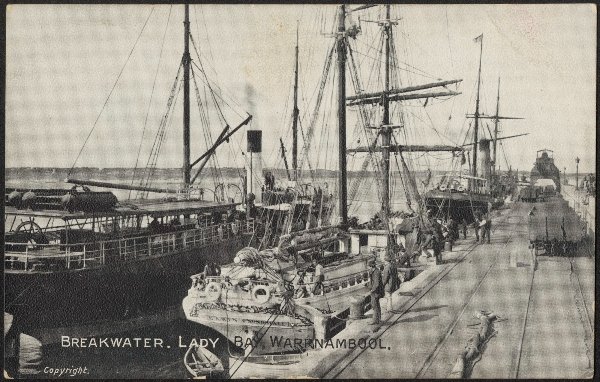
The Warrnambool breakwater in its heyday, circa 1907, when tall ships and steamers would frequent the port. Image: State Library Victoria.

Warrnambool’s true limitation in this regard remains the exposure to the elements beyond the breakwater, not inside it.

Given the comparatively tranquil waters in the lee at Portland and Port Fairy, Warrnambool will never be as attractive to recreational fishers as these other locations, no matter what launch facilities are on offer.

It is true that there is a large group of itinerant anglers eager to access blue fin tuna if and when that species comes within reach. It is also true, that a massive infrastructure overhaul of Lady Bay might just induce some of these anglers too choose to launch at Warrnambool. The question is at what cost?

Not just the budget necessary to completely overhaul our port, but also the cost to the people of Warrnambool through, for example, the aesthetic change that a fully enclosed harbour might bring, not to mention the potential of further traffic congestion and parking overflow.

Given the uncertain hope of attracting some short term visitors to spend a few days of the year in Warrnambool chasing tuna, the true cost/benefit of that endeavour requires some VERY close scrutiny.

Concerns have been expressed about the potential loss of our Lady Bay and its beaches through recent erosion and sand movement.

Certainly there are climate change considerations to be alert to, but it would be unwise to jump to conclusions just based on recent storm events. There are two things of note from the historical record.

Firstly, as previously mentioned, the navigational channel (found by aligning the two lighthouses at Flagstaff Hill) has remained unchanged in both depth and location since the 1840s. This confirms that whatever is occurring inside the breakwater and around the perimeter of the bay is having no impact on the vast bulk of Lady Bay.

Secondly, the beach shoreline has changed over the past 180 years through a cycle of erosion and deposition. Again however, from the historical record, we can see that the cumulative result has been a very substantial net gain.

The most recent erosion is exposing some interesting dating evidence; aluminium beer cans deep in the cut for example. This identifies very recent deposition of sand and dune formation.

No, we are not in imminent danger of losing our precious beach and no-one should panic, yet.

So, where to from here? Like everyone else, I have some ideas, but I don’t pretend to know the answers.

At a minimum, the ramps and associated boating facilities should be maintained, refined, and modernised where appropriate. The new fish cleaning station is a good example of what can and should be done.

In relation to dredging, surely there is room for some creative thought. A market for the dredged material, or even just a practical use for it, could help the cost benefit analysis considerably. Using the breakwater as the platform for dredging operations can significantly reduce costs and down time.

This was actually trialed once but the limitation was the reach of the equipment used. Perhaps some thinking outside the square might find some solutions to that.

If there is a problem of siltation in the immediate vicinity of the ramps, this could be easily dealt by prop blasting (using a boats propellor as an underwater “leaf blower”). It is a very simple technique  and has been successfully used in maritime archaeology and harbour maintenance for decades.

The technique is sometimes overlooked because of its simplicity but it works a treat; the bigger the boat(s) the more sand can be shifted, and very quickly.

In the final analysis, maybe some form of modest additional sea barrier will be appropriate.

In any case, however, the most important thing is to proceed with caution; unbridled enthusiasm can be a dangerous thing in relation to boating in general, and also in relation to harbour improvements in particular.

* Peter Ronald is a former director of Flagstaff Hill and a diver who specialised in shipwrecks.


Racing offers $267k sweetener for early access to Levy’s Beach

Warrnambool Racing Club has offered a nice little sweetener to the Warrnambool City Council as part of discussions to get racehorses back on Levy’s Beach by December. Image: Love Backyards.

By Carol Altmann

There is an update to this story: the council is now seeking $400k from the WRC for the carpark in exchange for approval to run horses on Levy’s and Lady Bay. It is now listed for a decision at next Monday’s council meeting (1/10/18). You can read the full documents from page 335 onward here.

——

The W’bool Racing Club is offering the W’bool City Council a big lump of sugar as part of its push to have racehorses back at Levy’s Beach by December: a $267,000 “bespoke” carpark at Lady Bay, no less.

Under a proposal put forward by the WRC, it will pay for a $267,000 upgrade to build the “bespoke” carpark at the Lady Bay breakwater, next to the existing carpark at the Pavilion cafe, specifically for use by horse trainers.

A specialist horse training carpark with proper wash-down facilities was part of the masterplan prepared for the breakwater.

It is understood the WRC hopes the State Government will chip in at least some of the $267,000 for the carpark but, if not, the racing industry will fund the carpark anyway.

The sweetener comes as the WRC seeks to have some horse training back on to Levy’s Beach in time for the all-important Spring racing carnival that includes the Melbourne Cup on November 6.

A temporary training arrangement at Levy’s Beach ended on September 14, pending the full implementation of the new Belfast Coastal Reserve Management Plan.

Under the controversial management plan, up to 120 racehorses a day will be allowed to train on the beach and up to 40 a day in the dunes.

The new, temporary arrangement, however, would allow up to 6o horses a day on Levy’s Beach and 40 a day in the dunes between now and December.

For the arrangement to go ahead, the WRC must get the approval of council, Parks Victoria and the Dept of Environment, Land, Water and Planning.

As such, gaining the Warrnambool City Council’s approval is an important step.

Another part of the deal is a reduction in the number of racehorses training on Lady Bay beach.

As the council knows, people are less enthusiastic about the damage done to the foreshore from hundreds of hooves, than they are about watching the horses swimming.

Under the new proposal, the number of horses along Lady Bay beach would be almost halved – from a maximum of 96 to 50 per day – and up to 116 per day swimming, with a combined total of no more than 116 horses either on sand or in the water.

The council is expected to make a decision on all of the proposals shortly, but given its previous support (the vote was 6/1) for racehorses training at Levy’s Beach, it is unlikely to turn such a deal down.

If you would like to keep seeing more pieces like this about local issues, please consider making a small contribution below.

Donate


Remembering the art of Robert Ulmann

Robert_Ulmann__Tawny_Frogmouth
The late Robert Ulmann was one of Warrnambool’s best known artists – and one of the city’s great characters – after making the south-west his home in 1969. Image: Visit Warrnambool.

[dropcap style=”color: #abccab;”] O[/dropcap]ur campaign to restore the Robert Ulmann whale mural in Warrnambool has provided an opportunity to remember one of south-west Victoria’s most prolific artists, who died 15 years ago this November.

Despite Robert’s enormous contribution to the local art scene as a painter and sculptor during the 30 years that he lived in and around Warrnambool, it is quite difficult to find any formal, public recognition of his work, beyond that which he created himself.

This includes his studio and gallery overlooking the ocean on Hopkins Point Road, Warrnambool, which is still managed by his wife, Helen and daughter Justine, and was built after their Naringal property (and Robert’s studio) was completely destroyed in the devastating Ash Wednesday fires of 1983.

It also includes Robert’s contribution to Warrnambool’s public artworks, which is arguably greater than any other single artist.

There are four Ulmann sculptures dotted in high-profile locations around Warrnambool and two privately commissioned murals that are also in very public spaces, but a search of the Warrnambool Art Gallery website reveals very little about the man or his work.

As an aside, do you know where to find the Ulmann sculptures and murals in Warrnambool?

[learn_more caption=”Click here to find an Ulmann work:”] 1. Fletcher Jones Gardens, basalt sculpture, Memorial to Sir David Fletcher Jones.

2. Warrnambool breakwater, basalt sculpture, The Breakwater Centenary Sculpture.

3. Flagstaff Hill, lake side, The Lady in the Wind, Mt Gambier stone.

4. Warrnambool Art Gallery, exterior, The Australian Fur Seal, basalt sculpture

5. Bojangles Restaurant, Warrnambool, mural

6. Flaxman St milk bar, Warrnambool, mural [/learn_more]

ulmann stones
The Breakwater Centenary Sculpture, Warrnambool, created by Ulmann in 1990.


[dropcap style=”color: #abccab;”] R [/dropcap]obert, who was born in Switzerland, was a larger-than-life character who created an impression on all those he met, even if it was one of slight terror at the sight of what has been described as his “fierce” beard which would bob up and down during his highly animated way of talking.

His arrival in south-west Victoria in 1969 made the local news at the time and Warrnambool historian, Jenny Fawcett, has kept a copy of the clipping from The Warrnambool Standard in which it was reported that “an interesting personality” was visiting the district with his locally born wife, Helen (Goldstraw).

Robert, it said, “has had an adventurous life, painting and drawing his way through 21 countries,” that included Canada, where he first met Helen, who was working as a school teacher at Coppermine in the Canadian Arctic. It was here that Robert worked closely with the Canadian first peoples, the Inuit.

The Ulmann’s spent two years criss-crossing North and South America and then wended their way down through the Pacific Islands before finally reaching Australia. They settled in Naringal in 1972, having first spent a couple of years working in indigenous communities in the Northern Territory.

With all of that experience, and all of that adventure, no wonder Warrnambool – at times – would have struggled to contain a personality as large and dynamic as Robert’s, but he came to call the seaside town his home.

fletcher-gardens_29
The basalt “Memorial to Sir David Fletcher Jones”, created by Ulmann in 1978 and part of the Fletcher Jones Gardens in Warrnambool.


[dropcap style=”color: #abccab;”] A [/dropcap]uthor Penny Olsen dedicated her 2001 book, Feather and Brush: Three Centuries of Australia Bird Art (2001), to Robert Ulmann, who passed away during its production. In it, she describes how Robert worked “from nature, fast and with gusto”.

Robert loved to capture the energy of both animals and people as he saw them in the moment, not after the fact. It was not unusual to be talking to Robert and find that, halfway through a conversation, he would start sketching a portrait of you.

It was Robert’s passion for Australian wildlife, however, that won the hearts of so many of his followers.

He not only painted, sketched and photographed the beautiful creatures around him, he often invited them into his home which became a refuge for homeless and abandoned birds, mammals and marsupials.

In 1980, The Age newspaper ran a page 3 story about the Ulmann’s being the first people in Australia – and most likely the world – to hand-raise a baby echidna that developed a fondness for crawling up Robert’s trouser leg.

When asked why he loved to work on Australian animals, Robert told the reporter in typical style:

“You know why? They’re bloody hard to get hold of, specially the marsupials. They’re all nocturnal. That’s what makes the challenge…and people love furry things – specially the ladies.”

Robert died suddenly at the age of 71 on November 1, 1999.

bojangles_1
A portion of the colourful – and cheeky – Mr Bojangles murals in the Bojangles restaurant, Warrnambool, painted by Ulmann in the 1980s.

[box type=”bio”] The Robert Ulmann studio is at 440 Hopkins Point Rd, Warrnambool ph: 03 5565 1444 or email: eubalena@westvic.com.au. Free entry.[/box]

[button link=”http://the-terrier.com.au/subscribe-2/” type=”icon” icon=”heart” newwindow=”yes”] Did you enjoy this story? Please subscribe here to help Bluestone thrive.[/button]

newsletter Art Music StonesYou might also enjoy…


Glenn Morgan back in the saddle for retrospective

2014 Art Environment Award SCOPE Galleries

Questions and stories arising from clay

Recycled timber shapes a new life: Sarah Carrucun