Confronting our bloody past: The Missing, by artist Julie Gough, Bett Gallery, Hobart.
Carol Altmann – The Terrier
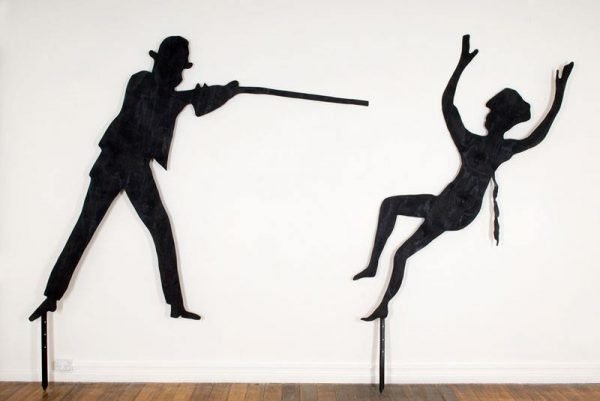
I wasn’t planning a post tonight, but today I saw an exhibition by Tasmanian-based artist Julie Gough about the attempted annihilation of Aboriginal Tasmanians/Palawa – an attempt which, as we know, was carried across Bass Strait to the colonial invasion of south-west Victoria, our home.
The murders. The kidnaps. The thefts. The near annihilation. Julie’s work is sobering and absolutely heartbreaking.
And I came away with one repetitive thought: what can I do?
What can I do?
One thing I can do is to use what I know best – words – to tell indigenous stories from south-west Victoria and to help illuminate our real history, not the white-washed version I grew up with.
South-west Victoria is saturated with rich indigenous stories, both contemporary and past.
I recently applied for some funding to help me do this by bringing others into The Terrier to help tell these stories.
I am still waiting to hear how my application has gone – fingers crossed – but with or without this support, this is one path The Terrier will be taking as it heads into its second year.
On we go.
Drifting on a dream to the Drift House
[printfriendly]
Drifting down to Port Fairy: former Melbourne couple John Watkinson and Colleen Guiney are the creative minds behind the transformation of an old Port Fairy landmark into the Drift House.
By Carol Altmann
[dropcap style=”font-size: 60px; color: #8F9F59;”] W [/dropcap]e have all done it: browsed the property pages and found a renovator’s delight that prompts you to dream and ask “what if….?”
Except Melbourne couple John Watkinson and Colleen Guiney didn’t just close off their dream by closing the newspaper – and it was only the newspaper then – but took the next, huge step of actually buying the place.
“We had been looking at a couple of properties with a view to setting up luxury accommodation, and this ended up being the right one,” Colleen explains.
That property was the prominent, two-storey, historic home (b:1875) on the corner of Gipps and Regent streets, Port Fairy, a once majestic, white-washed stone building that had fallen into disrepair, but has since been spectacularly transformed into the Drift House.
A new life begins: the former ‘Riverdale’ building, built in 1875, has gone from being derelict to the top luxury accommodation in the south-west. Image: supplied.
[dropcap style=”font-size: 60px; color: #8F9F59;”] T[/dropcap]he house formerly known as “Riverdale”, for its proximity to the Moyne River, was owned at that time by well-known locals Tom and Irene Bartlett who at one stage operated a gallery on site.
“Tom was a bit of a collector, to say the least, and when we came to look at the place, even though it had been unoccupied for about five years, it was absolutely full of every conceivable thing you could imagine and multiples of those things,” John recalls, smiling.
That was eight years ago and when John and Colleen began the slow process of renovating, rebuilding and restoring the house, many of these things came in handy before they were relegated to the skip.
“We would come down on weekends from our place in Richmond and camp out here in the backyard and our boys (Milo, now 10, and Toby, 8) loved it. There were old kettles and toasters, about 14 chairs, six spring base bed sets…and it became their adventure playground,” Colleen laughs at the memory.
Looking remarkably like one of Colleen’s art works, the restoration of the ‘Riverdale’ building revealed its many layers from the past 130 years. Image: Supplied.
[dropcap style=”font-size: 60px; color: #8F9F59;”] F [/dropcap]ortunately there was also a working shower and flushing toilet, so the family set up a temporary kitchen in what was a brick double garage and spent the next six and a half years developing their dream.
The planning approvals alone through Moyne Shire Council took three years to finalise as it grappled with the contemporary-meets-historic design by Melbourne architects, Multiplicity, who also transformed the double garage into a small residence for the family.
And then there were the inevitable delays and cost blow-outs that come with any grand design.
“I must admit there was a couple of times when I wanted to give up,” Colleen says.
“There is no doubt it ended up costing a lot more money than we anticipated and also took a lot more time..but it has been worth it,” John adds.
Son Toby enjoys a bit of time out on one of the make-shift lounge chairs during the six year restoration and renovation project. Image: Supplied
[dropcap style=”font-size: 60px; color: #8F9F59;”] T [/dropcap]he Drift House was finally launched as boutique, luxury accommodation in December 2013 and combines the skills of both John and Colleen perfectly.
While both had only limited experience in running accommodation (“John’s parents had a B&B in the UK and we looked after that for a little while when we were in our 20s,” says Colleen), they have a sharp eye for what works.
John was previously a marketing executive, while Colleen, who is also a practicing artist, worked as a visual merchandiser – a person who styles products to make them appealing if not irresistible.
This potent combination explains why Drift House hit the ground running and has attracted awards, attention and accolades from around Australia and internationally since virtually the day it opened.
It was named best luxury accommodation in the Qantas 2014 Tourism Awards and recently took out the RACV Victorian Tourism Award for Luxury Accommodation for the second year running. It also made the finalist list in the prestigious Smith Hotel Awards 2014.
Colleen and John inside the lounge of the renovated double garage that now serves as their home behind the Drift House.
[dropcap style=”font-size: 60px; color: #8F9F59;”] S [/dropcap]uch was the enormous interest in the building, John and Colleen held an open home so that locals could wander through and take a look at the transformation.
The gold-coin-entry event was so popular, it raised $3000 for the Port Fairy rail trail.
Its appeal lies not only its funky design (such as slices of retro carpet on doors and fence railings as door handles) and its luxurious interiors, but its walking proximity to all the unique bits of Port Fairy, including the Merrijig Inn, Blarney Books & Art, the Whale Bone gallery, the Stag restaurant and on it goes.
‘Deer’: one of Colleen’s art works that features in her home. Colleen’s art is also displayed in parts of the Drift House. Image: Supplied.
[dropcap style=”font-size: 60px; color: #8F9F59;”] T [/dropcap]hese are the very parts of Port Fairy which Colleen and John have come to love and neither misses Melbourne.
“We work seven days a week, and sometimes late hours, but I still get to swim at the beach every day, do yoga or get down to my studio in Port Fairy, and John gets to cycle without having to get up at 5.30am to miss the traffic,” Colleen laughs.
Award-winning sculptor Jon Dixon has spent 20 years creating the Lyons Sculpture Park, near Heywood, in an organic and creative project that has no end.
[dropcap style=”font-size: 60px; color: #A02F2F;”] I [/dropcap]f sculptor Jon Dixon had his way, this story would contain only a single sentence: “art is important”.
“That’s all you need to write,” he says, as we start our tour of the 15-acre Lyons Sculpture Park that he and his wife, Chris, have created on their bush property 21km west of Heywood.
After walking just two or three minutes through what is a combination of sculpture, gardens, raw bush, and farmland it is patently clear, however, that one sentence is not going to cut it. Sorry Jon.
Indeed it is difficult to describe the park, because it refuses to slot into any simple category.
It is a “park”, but not a manicured one. It is a gallery, but without an entry fee or labels on any of the works. And it is full of stone, wood and metal sculptures, some of which are obvious to the eye, but also others that are tucked in nooks and crannies: up a tree, behind a bush, attached to a fallen log.
The natural bush on the 15 acre property is studded with gorgeous sculptures, including this one from pink dolomite.
[dropcap style=”font-size: 60px; color: #A02F2F;”] T [/dropcap]he sculpture park – and the Dixon home – sits on what was once the township of Lyons and covers 30 individual titles: all half acre blocks that were once occupied by the small community built around the timber industry.
Jon and Chris bought the property 20 years ago, after Jon decided to quit his executive lifestyle and return to his first love of art.
“I was running my own industrial door company (in Melbourne) and I watched all of the company executives I knew climbing up the corporate ladder, stepping on heads along the way, burning people off along the way…and they were all miserable,” he said.
Once Jon and Chris, who is a secondary school English teacher, found the Lyons property, they knew it was the perfect place to stretch out and exercise their creativity.
Born in England, but raised in working-class New Zealand, Jon was immersed in the artistic and cultural symbols of the Maori people and this influence is clear in his style today.
[dropcap style=”font-size: 60px; color: #A02F2F;”] M [/dropcap]ost of Jon’s sculptures are worked from local limestone and bluestone, sometimes paired with “found” objects such as a recycled milk vat or a cemetery headstone, or the remnants of industrial farm machinery, equipment or tools. He also creates large metal sculptures, the most striking of which is a life-size silhouette of a rearing horse placed among the tall, yellowing grass of the property.
[box] Jon has generously donated a gorgeous sculpture valued at $600 to be given away to one lucky paid subscriber. Click here for details on how to win this wonderful piece.[/box]
One of the engaging things about the park is that there is no particular theme and it moves easily from the abstract – an overgrown field full of female torsos – to the spiritual, such as the “Stonehenge” style installation in a perfectly mown circle of a grass, to the political. The lack of labels or interpretive notes lets the viewer see what they want to see.
The raw bush, which Jon clearly loves and is slowly restoring to its native state, also contains a range of works, including a simple stone disc punctured with numerous holes.
Jon tells the story of a visiting Asian family who were captivated by this piece after he invited them to find “the most beautiful leaf” from the many gum leaves on the ground and place it into a hole.
“This was a family that, at home, had to drive two hours to find open space and here we have beautiful, natural bush. They stood here for a long time, just picking up leaves – dead ones, green ones – and placing them into the holes,” he said.
You are right, Jon. Art is (so) important.
[box type=”bio”] Jon Dixon has received numerous accolades for his work, including winning the prestigious Montalto Sculpture Prize in 2003. You can see more of Jon’s work at his website here and find him on Facebook here. The Lyons Sculpture Park is at 4143 Princes Highway, Lyons. Ph: 0437 000 433. Open daily 9am – 5pm. Free.[/box]
Warrnambool artist Glenn Morgan has inspired many students to explore their creativity.
AS one of South-West Victoria’s most successful and prolific artists, Glenn Morgan could have easily become pompous and aloof, but instead he remains refreshingly down to earth and committed to his home town.
Glenn’s quirky style is instantly recognisable, with many of his paintings and sculptures exuding a whimsical, cartoon-like quality that belies the often serious political or social message within.
Others capture our national obsession with sport – an obsession Glenn shares when it comes to the Geelong Football Club – and many are witty or off-beat, like Glenn himself. But while Glenn’s talent has been well documented, Bluestone wanted to ask him about the importance of inspiring and supporting emerging artists.
Sport features in many of Morgan’s works, including this piece: ‘Black Caviar’s too bloody good’ (2013).
It is a topic for which he is well qualified, as in addition to his own art career, Glenn taught art at both secondary school and tertiary level in Warrnambool and encouraged dozens of students to develop their artistic talents.
As a result, rarely do you meet an artist from South-West Victoria who has not been taught by Glenn, knows him as a friend, or used his story as inspiration.
“I have always considered teaching to be a privilege. Not just because it was a job – and you can’t take that for granted – but because it sharpens your brain as an artist,” he said.
“When you are working among students, solving problems, it soon makes you realise that you are learning as much from them as they are from you.”
‘Smokers’ (2012) acrylic on board.
Glenn, who was born in Allansford, remembers his own student days at the Warrnambool Institute of Advanced Education (now South-West TAFE) when the art class would do some of their best thinking and sharing of ideas in the pub across the road.
“It is that communal thing. My best classes, as a teacher, were the ones where we were all jammed in a classroom, sharing ideas, talking about ideas: that’s where the good stuff happens.”
Watching students being “bitten on the arse by the art bug” was one of his greatest pleasures as a teacher.
“Art is medicine. It gives people something to do with their head. To work things out.
“I remember my father-in-law would make furniture. He would disappear into the shed and be completely lost in it. We all need something like that.”
‘Australia Turning Its Back on the Needy’, (2013) Tin, wood, wire and enamel paint.
One of the critical elements of Glenn’s teaching was to urge students to step out into the world and take a show to Melbourne.
“By getting out there and seeing that your work is just as good, if not better, than anybody else’s…it makes a huge difference. I wanted my students to see Melbourne as just another place.”
Glenn lived in Melbourne for three years, as a post-grad student, but secured his first teaching post back in Warrnambool and has never left. He loves the lifestyle and the friendliness of the community.
The community, in turn, loves him back.
In 2009, one of Glenn’s favourite works – Banjo’s Funeral, which captured the funeral of local Aboriginal elder Banjo Clarke – was being sold by a Queensland couple who had bought it several years earlier.
A public fundraiser was held to try and buy the piece for the community and so many people made donations, some of the money had to be returned. The work is now held by the Warrnambool Art Gallery.


 You might also enjoy…


 You might also enjoy…


