Lyndoch Living pulling down the shutters on scrutiny
Lyndoch Living can’t wait to talk about all the good stuff happening, but digging into the financials is getting harder.

Carol Altmann – The Terrier

What the heck is happening at Lyndoch?

It’s behaving more and more like a private corporation than a community owned home for our elderly and infirm.

Its unadvertised, annual general meeting held earlier this week was, by all accounts, one big self-congratulatory, PR exercise rather than a critical analysis of the last 12 months.

While it’s terrific to celebrate the good stuff, we also want to know the nitty gritty behind the growing “brand”, because Lyndoch is now very much a brand.

So where are the financials?

How are the Lyndoch board and CEO Doreen Power spending our money, be it via residents’ fees, taxpayer dollars or donations?

Was there a surplus or a deficit like the $1.77 million loss of last year?

How many staff have come and gone?

How much is being spent on food for the residents? On medical and health items? How are the public donations going?

And – I ask, one more time with feeling – where is the $100 million coming from for the eight-year masterplan?

The annual report released this week answers none of these questions, in fact, it deliberately avoids them.

The financial statements have been reduced to three, very basic graphs and about 125 words of text – that’s it – for a multi-million-dollar, publicly funded, not-for-profit organisation that is fully accountable to the public.

Well, it used to be.


Things have changed dramatically since Lyndoch changed its corporate structure late last year.

Now, trying to get any detailed information is like prising open the jaws of Barry the Bull Terrier.

I am still trying to get a copy of Lyndoch’s constitution, which it is zealously guarding like a first-edition copy of Harry Potter.

Even old annual reports that were posted on the Lyndoch website were pulled down yesterday.

Maybe this is because I actually read them and crunched the numbers and found a rather large skeleton lurking in the closest: Lyndoch last year recorded its largest deficit in recent years at $1.77m.

Thankfully I took notes and kept copies of the annual reports that could be downloaded, and took screenshots of those that couldn’t.

Good grief, when did it get this hard to find out basic information about our much-loved aged care home?

What on earth is there to hide?

Perhaps it’s because, as I believe, Lyndoch recorded another deficit in 2019, which would be its fourth deficit in the past five years.


I am not an accountant by any stretch, but using the scant details released this week, and my earlier notes, I think Lyndoch Living recorded another operating deficit, this time of around $750,000 and that’s before any other unusual items – if there were any – are added.

Please, Lyndoch, correct me if I am wrong.
The back page of the Lyndoch annual report for 2019 reflects its growing business model.

Using my same, very high-tech accounting methods, I believe its net assets also dropped by a whopping $11 million in the past year from $62.7 million down to $51.2 million.

Hmm, could that be because Lyndoch just borrowed $11 million from the bank to pay for the first stage of the masterplan?

Please, please, Lyndoch, correct me if I am wrong.

There is no question that Lyndoch needed to freshen up some spaces, try different things, move with the times, but surely when big decisions are made and millions are being spent, it must all be open to rigorous scrutiny?


As it sits, to get even close to the full story, we will have to wait until early next year for the full financial reports and all of the gritty details to be released via a government website that oversees charities.

In the meantime, this Terrier is just going to keep digging. More soon.

If you would like to support the work of The Terrier, please consider throwing something in the tip jar.

Terrier Tip Jar


Where did you go? Crunching the numbers on Lyndoch staff

Foxy takes a close look at the Lyndoch financial reports to flush out what is happening with staffing numbers.

Carol Altmann – The Terrier

I was lucky enough to have my Mum cared for by the fabulous staff of Lyndoch Living for 10 years before she died there in April (at the ripe old age of 94.9), but so many of the faces I used to see during those 10 years are no longer there.

Where did they all go?

One source told me between 70 and 80 people have left Lyndoch in the past couple of years.

Some retired, some retired early, some moved on to other jobs, some now work for themselves, and some, well, some allegedly left for reasons which indicate an “interesting” workplace culture and I have to tread carefully as I slowly unpick that picnic.

But I am unpicking it, piece by piece, having had dozens of people contact me over the past nine months.

Today, as part of my slow, deep dive into the changing world of Lyndoch, I have called on Foxy the Fact checker to crunch the staff numbers.

First, have 70 to 80 staff left Lyndoch in the past few years? I can’t say for sure, but I have sent that figure off to Lyndoch CEO Doreen Power and board president Kerry Nelson for confirmation and will see if a response is forthcoming.

What has definitely happened, however, is the Lyndoch staff mix is changing.

Let’s start at the top.

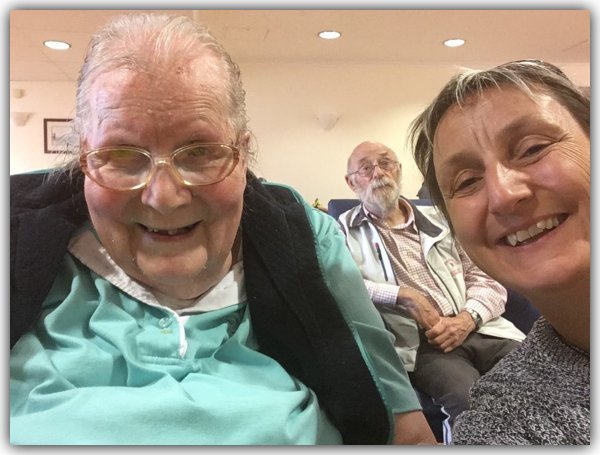
A very random photo of my Mum and I, with a lovely gent in the background, taken at Lake Lodge, Lyndoch in 2018.

The first thing Foxy found was a big jump in Lyndoch administration.

In 2016, there were 37 people in admin, in 2017 there were 41, and by last year it had grown to 59 – 19 more people than in 2016.

At the same time, the cost of “administration and other expenses” jumped by almost $1 million in 12 months, from $2.4m in 2017 to $3.31 million in 2018.

While admin numbers have gone up, the number of allied health workers employed by Lyndoch has gone south. (Q: What’s an allied health worker? A: Clever people who do things like occupational therapy and physiotherapy).

In 2016 there were 28 allied health professionals on staff at Lyndoch, but last year that dropped to just 12.

Allied health has largely been – oh, I dislike this word – “outsourced” and a Melbourne-based agency called Agestrong is the boss of the “outsourced” physio and o/t workers. (Agestrong, by the way, is owned by a private company called Designacare. Good grief.)

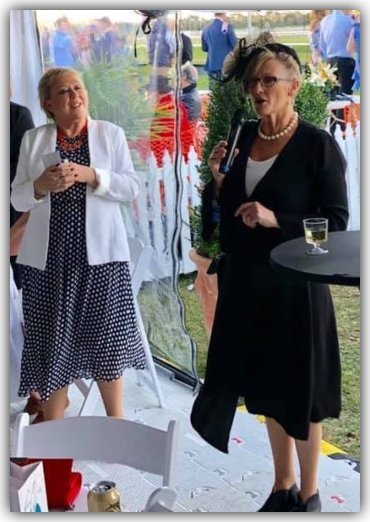
Lyndoch CEO Doreen Power and board chair Kerry Nelson at the 2019 Warrnambool May Racing Carnival. Photo: Lyndoch Living Facebook page.

What about the nursing staff, you ask? What is happening there? After all, these are the hard-working people at the very coalface of feeding, washing, dressing, nursing and cheering up the residents.

Well, using the numbers dug out from Lyndoch financial reports and Lyndoch annual reports, the picture from 2016 to 2018 looks like this:

the number of registered nurses (RN, senior nurses) has flatlined, from 32 in 2016 to 30 in 2018;

the number of enrolled nurses (EN, other qualified nurses) has climbed by 13% from 90 to 102;

the number of personal care workers (PCW) shot up 34% from 109 to 147;

a lot of these staff, especially PCWs, are part-time or casuals;

overall, the number of full-time-equivalent staff took a dive from 280 to 230 between 2017 and 2018.


What does this all say to a humble fact checker like Foxy?

It says that PCWs, the lowest paid workers, are picking up a lot of the workload for what can be a very tough gig.

At the same time, it suggests that the RNs and ENs must be working their backsides off with pretty much the same numbers that they had two years’ ago.

(As we speak, Fair Work Australia is nutting out a dispute between Lyndoch and the nurses’ union over proposed cuts to senior nursing levels.)

To be super clear, I am not suggesting Lyndoch Living is breaking any rules.

Indeed Ms Power told the local paper in July that Lyndoch Living “aligned with the Safe Patient Care Act and nursing ratios” and was working to increase full-time-equivalent numbers.

I also know that all nursing staff work very hard to make the residents’ lives comfortable and enjoyable and that this is their absolute first priority.

But what is filtering down to me from the 30-plus people I have now heard from is that Lyndoch is finding it tough to find and keep senior nursing staff, that there are often roster shortages that need to be filled at short notice, and that many people are starting to feel exhausted.

I take all this as a cry for help.

I am listening.

We, as a community, need to listen because we own and we love Lyndoch.

I have put a series of questions to Ms Power and Ms Nelson for a piece I am planning for Sunday.

See you for the next instalment then.

[The Lyndoch Living AGM is next Tuesday 29 October at 4pm at Lyndoch.]

If you would like to support the work of The Terrier, please consider throwing something in the tip jar.
Terrier Tip Jar