Granny’s Grave buried in bureaucracy

granny grave 1_1
Despite promises of greater recognition for the ‘Granny’ behind Granny’s grave – and the need for restoration – the site remains unchanged and falling into further disrepair.

OPINION

[dropcap style=”font-size: 60px; color: #DC943C;”] T [/dropcap]here are not a lot of memorials to women in Warrnambool: in fact compared to the ovals, parks, plaques, sculptures, plinths and pioneer boards that have been devoted to civic-minded and influential men, there is barely anything at all.

The historic Warrnambool Pioneer Board appears to have set the standard and has become as famous for its omissions as its inclusions.

Put together in 1907, the 3m x 2m board features 204 individual photographs of Warrnambool’s pioneers and not one of them is a woman. In an almost humorous twist, the board itself was assembled and illustrated by a woman, Lillian Foyle, but nobody remembers her name compared to those who feature in the circular frames.

You would think that more than 100 years on things might have changed considerably, but it appears not.

I am happy to stand corrected, but the only high-profile monuments to women that come to my mind easily are the contemporary Val Bertrand Stadium in west Warrnambool and the 110-year-old Granny’s Grave in the sand dunes off the bike/walking track in east Warrnambool.

And the Granny’s Grave site is looking increasingly worse for wear.
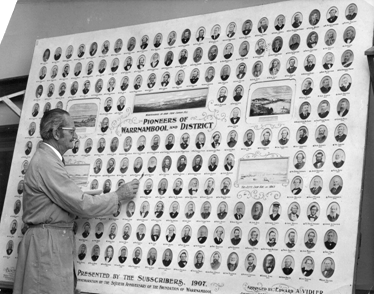
Pioneer Board Welsh, Jack
The Warrnambool Pioneers’ Board, now displayed at Warrnambool’s History House, was made in 1907 and does not feature a single woman. Image: Warrnambool and District Historical Society.

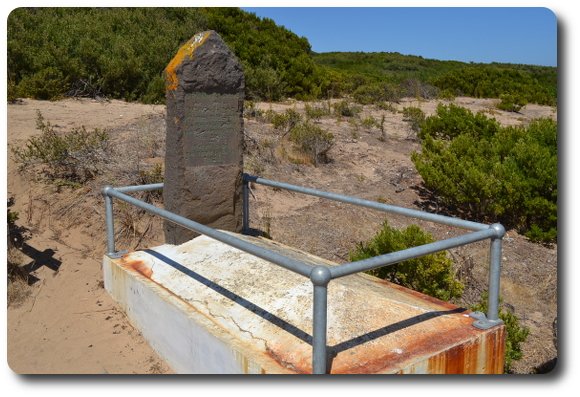
[dropcap style=”font-size: 60px; color: #DC943C;”] D[/dropcap]espite being passed by thousands of people every year, including tourists who are encouraged to visit the grave, the monument is covered in rust stains, the paintwork is peeling and chipped, the metal surround is completely out of character with the grave, and the site is surrounded by weeds.

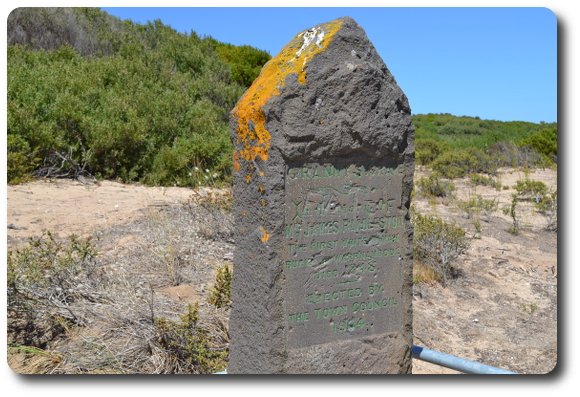
There is also no interpretive plaque or information about “Granny”, other than the few – and as it turns out, incorrect – lines etched into the basalt headstone, even though the Warrnambool City Council announced earlier this year that a plaque would be in place by the end of June.

It is now the middle of October, and I have become tired of asking the council when the plaque might be coming and no doubt they have tired of me too.

Bluestone wrote earlier this year about the fascinating story behind the “Granny” who lies in Granny’s Grave – Agnes Ruttleton – and how she has come to represent all of the faceless and nameless women who were among the very first to come to a scrap of a town called Warrnambool in the hope of a better life.

Agnes was never a rich woman, and she died in poverty at the age of 60 in 1848, but there was something about her indefatigable, pioneering spirit that more successful and wealthy citizens like Richard Osburne thought was worth commemorating. He lobbied for years to have the approximate site of her burial marked by an official grave.

The council knows this is a special site, but the wheels turn extremely slowly when it comes to preserving key elements of our past.

granny grave 1_2
A council report from 2008 first raised the need for significant restoration on the high-profile site, but only the handrail has been replaced.

[dropcap style=”font-size: 60px; color: #DC943C;”] A [/dropcap] 2008 management report into the city’s public art and cultural assets concluded way back then that Granny’s Grave needed “significant restoration”, including replacing the rusted handrail, ongoing weeding and, with the help of expert advice, cleaning the stone surface, removing the rust stains and re-patching and re-coating the concrete as required.

The handrail has been replaced, but that’s where work has stopped.

I wonder if the council – and us, as residents – would be so accepting of the situation if the memorial marked a returned soldier, a famous footballer, or a founding father of the town?

The council recently voted to apply heritage planning controls over the Granny’s Grave site and I was slightly stunned that it hadn’t already been covered.

Councillor Jacinta Ermacora summed it up when she said the heritage protection process not only for Granny’s Grave, but for dozens of other sites around Warrnambool had “taken far too long”. Given the process began in 1983 – when the council first realised its heritage controls were hopelessly out of date – Cr Ermacora is being generous.

Why is it like this?

Why does it take so long for any action to be taken on preserving our heritage and, when it is, it is often half-finished and then abandoned?

It appears that we are so focussed on the “now” that we have lost sight of preserving the characters and essence of our past.

Agnes is certainly a rare character from our past who deserves her proper place in our story.

portland-july14_76
Meanwhile, in Portland, the council is adding contemporary monuments to key women from the city’s past, including this seat in honour of suffragette Vida Goldstein by local artist Carmel Wallace.

 [button link=”http://the-terrier.com.au/subscribe-2/” type=”icon” icon=”heart” newwindow=”yes”]If you would like early access to Opinion pieces, please subscribe to Bluestone.[/button]

newsletter Why Not StonesFind more Opinion here…


All words, no funding, for Fletcher Jones story

Grappling with the work of a predator

Unravelling the mystery of art commissions

Lack of schooling a ticking bomb in south-west
What about more fun for grown-ups?

Council’s racing hospitality bill hard to swallow


Who is the ‘Granny’ behind Granny’s Grave?

granny grave_7
The mystery behind “Granny” of Granny’s Grave has finally been unravelled.

By Carol Altmann

One of Warrnambool’s most enduring mysteries has been the identity of the “Granny” buried at Granny’s Grave high in the sand hills of Lady Bay and now, more than 165 years after her death, she is to finally have due recognition.

The Warrnambool City Council will add a plaque to the grave site by the end of June that will correct a long-standing error that named “Granny” as Mrs James Raddleston – the name inscribed on the headstone – and confirm that she was in fact Agnes Ruttleton.

Very little was known about Agnes Ruttleton beyond the perfunctory details etched into her headstone that told us she died in 1848 and was the “first white woman buried in Warrnambool” which at that time was still part of NSW.

Bluestone, however, has pulled together the threads uncovered by various researchers to tell her full story.

We began with a bunch of history books and a visit to the Warrnambool & District Historical Society that holds a thin manila folder on Granny’s Grave which contains the bare bones of her life and identity.


grannys grave band
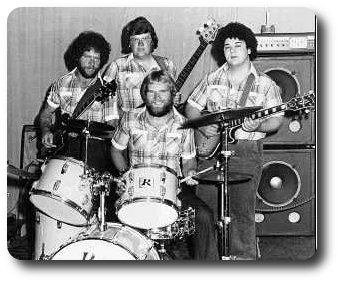
The Granny’s Grave band in the 1980s: Teejay Netherway, (left) Peter ‘Prof Walters, Eric ‘Coogee’ Read (drums) and John ‘Marra’ Maroniti (image: South-West TAFE archive).


The books and clippings reveal that Agnes and her husband – who was incorrectly named as a James Raddleston –  lived in a tent somewhere near Flagstaff Hill in 1847-48 and eked out an existence through odd jobs and selling crayfish. At that time, Warrnambool was just a speck, with the first land sales having been held in 1847 and its population at around 100.

Among the first people to buy land was Richard Osburne, the newspaper publisher and historian, who at the age of 22 bought a block on the corner of Kelp and Merri streets not far from where Agnes and James were living. Richard knew Agnes as “Granny”, probably because of her age (more on that later) and, it appears, became quite emotionally attached to the “old” woman.

When Agnes died in 1848, Osburne is named among a group of men who organised for a coffin and a funeral service to be held at a burial spot in the isolated dunes, as Warrnambool did not yet have a cemetery. A fence was built around her grave but years of scarifying wind, rain and shifting sands saw the fence – and entire gravesite – eventually disappear from view.

Indeed Osburne was mortified when he returned to Warrnambool in 1886 and despite “walking and walking” he was unable to find Granny Raddleston’s final resting place.

“I tired myself from the search,” he wrote in a letter to the local paper.


granny grave_4
Granny’s bluestone headstone was finally erected in 1904 – more than 50 years after her death.


Osburne used his letter to implore the council to erect a proper headstone in honour of one of Warrnambool’s pioneering women, but nothing was done for almost another 20 years when, in 1904, a group of citizens raised funds for the bluestone headstone that stands today.

(In the intervening years, an anonymous resident used a piece from the 1888 wreck of the Edinburgh to mark Granny’s Grave – perhaps as a subtle hint for the council to hurry up.)

When the headstone was finally unveiled, it had Agnes reduced to “Mrs James Raddleston”, a person who did not technically exist, although it was not uncommon for name spellings to be mangled through either mis-spellings, poor handwriting or mispronunciation. Raddleston had been recorded as Rittleton, Ruttleton and Raddlestone.

And this is where Jenny Fawcett, from Warrnambool, comes in.


jenny fawcett_2
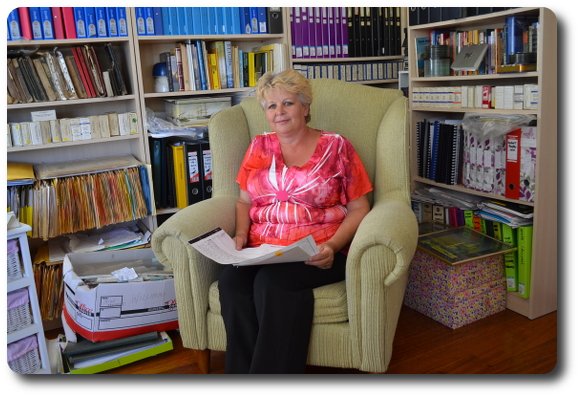
Researcher Jenny Fawcett in her library: she has devoted more than 20 years to uncovering the stories and mysteries of the south-west coast, including that of Granny’s Grave.


To call Jenny an amateur historian is a gross understatement: she is researcher unlike any other we have met before. Jenny has devoted hours of her time, driven by personal passion rather than profit, researching the history and characters of the south-west Victorian coast.

Her files are extraordinary, and her recall of individual details and events is mind-boggling.

It is Jenny who has reached back through time to find that Agnes Raddleston is Agnes Ruttleton and, in so doing, uncovered how James and Agnes came to be in Warrnambool.

“I like unravelling the mystery behind an individual, and Granny’s Grave is one of those stories that just had to be unravelled,” she said.

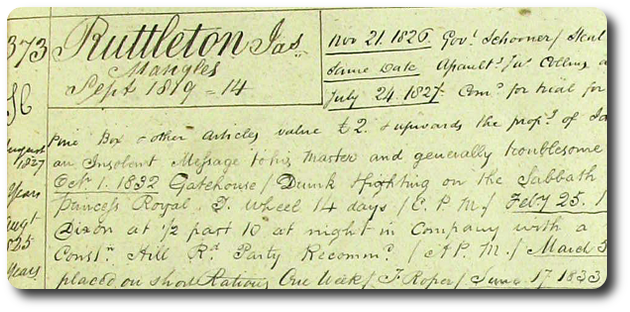
Through meticulous searching of convict records, Jenny traced James Ruttleton as an English boatman who was sentenced to 14 years for stealing and transported to Australia in 1820 – first to NSW, and later, after escaping, to Hobart Town. He was 31 years old.


grannys convict
Tasmanian convict records track the story of James Ruttleton, who was sentenced to 14 years for stealing.


After a variety of indiscretions, James was finally granted his Certificate of Freedom in 1834 and settled into a life in Tasmania.

Somewhere along the way, he met Agnes. Jenny has not been able to uncover her maiden name, or whether she was a convict too, but there is no record of James ever marrying.

“Maybe they were already married when he was sentenced and she joined him in Australia later, which could happen, or perhaps they were never married at all,” Jenny said.

What we do know, thanks to Jenny’s research, is that the pair sailed from Tasmania to Port Fairy on board the Essington in November 1846 and are listed as James and Agnes Ruttleton.

Both were then aged in their late 50s, but Jenny believes James may have been lured by the opportunity of better work. The Geelong and Portland Bay Immigration Society – which included Port Fairy – was keen to bring in labour.


agnes ruttleton list
Shipping records show the Ruttleton’s among the passengers on board the Essington bound for Port Fairy in 1846.


It appears the new opportunity didn’t quite work out, however, with James and Agnes living in virtual poverty for their final years.

Agnes died only 12 months after they arrived, at the age of 60, on December 13, 1848.

Agnes was also not the first white woman to die in the area.

Landholder John Allan (from Allansford fame), lost his first wife Jemima in 1842 and buried her on an island in the Hopkins River. There were most likely other deaths among the original sealers and settlers.

Agnes was, however, perhaps the first white woman to be buried in the newly proclaimed area of Warrnambool.

James Ruttleton died three years after Agnes, on June 15, 1851, and is buried in the Port Fairy cemetery…his death certificate incorrectly names him as John.

While Warrnambool’s infamous “Pioneers Board” (now housed in the library) doesn’t include any female pioneers among its faces, the Granny’s Grave plaque will recognise at least one of the many brave women who ventured to what was then nothing more than a tiny settlement behind the sand dunes.


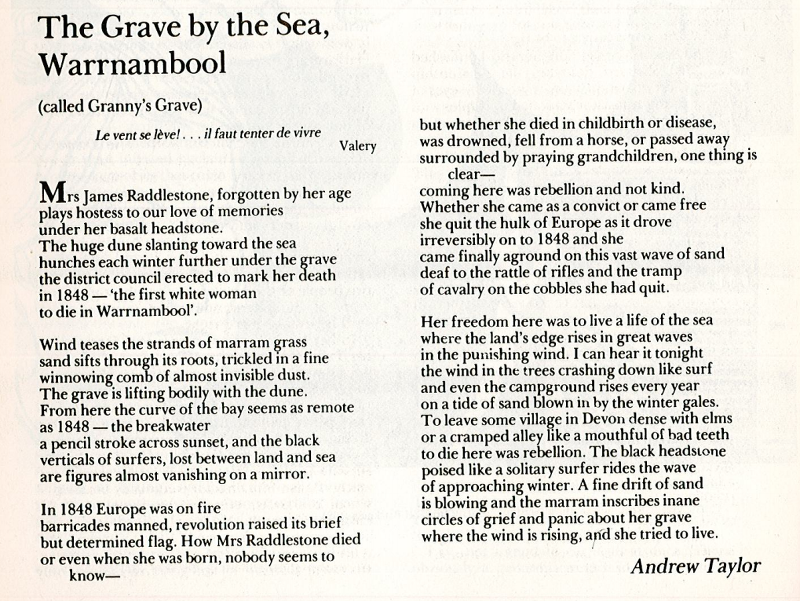
andrew taylor poem

 In researching this story, we uncovered a rare and beautiful poem about Granny’s Grave by Professor Andrew Taylor, who was born in Warrnambool. The Grave by the Sea, Warrnambool was first published in Quadrant Magazine in March 1981. Prof Taylor has kindly granted us permission to reprint his poem in full here. We would also like to thank Dr Simon Cooper for his efforts in finding a copy of the poem that, being written pre-computers, Prof  Taylor did not even have. He does now!