Board silent after Lyndoch Living membership decisions
Carol Altmann – The Terrier
Hear that? Crickets. Not a word. Nada. Nothing. Zip.
A full 48 hours has passed since the much anticipated monthly board meeting of Lyndoch Living where it was decided which members of the community, if any, would be good enough to become members of Lyndoch, which is owned by the community.
Among those who applied, as we know, is Vicki Jellie AM, who was awarded a Member of the Order of Australia for her services to the community for her work with Peter’s Project to build a cancer centre in Warrnambool.
Vicki has been calling Lyndoch these past couple of days to find out if she made the cut. She has not had the courtesy of a call back.
A new board member has also been selected. Who is it?
Who knows? We are the blocked out, shut out, cut off community who spent so many years caring for Lyndoch and we still do.
Warrnambool, at what point do we say, enough?
Emails flying as factional brawl rolls on in Liberal branch
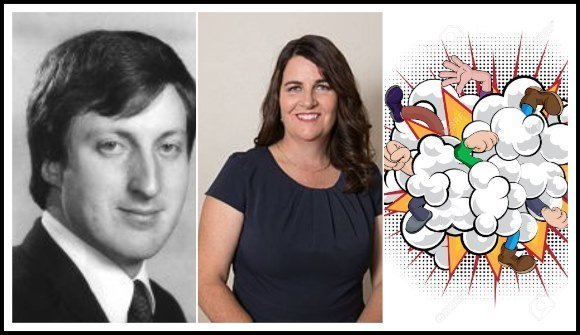
No love lost: Former Liberal MP for south west Victoria, Adam Kempton and current Liberal MP Roma Britnell, are caught in a factional brawl.
Carol Altmann – The Terrier
Meanwhile, over in sideshow alley, former south-west Liberal MP Adam Kempton has been suspended from his own party for conduct unbecoming, or whatever the party might call it, toward sitting south-west Liberal MP Roma Britnell.
Liberal v Liberal = ah, you gotta love politics.
Adam was apparently suspended after circulating an email that contained a less-than-flattering “gif” referring to Ms Britnell’s performance as an MP. Unfortunately the email was also – accidentally – sent to Roma.
Uh oh. (“Back button, back button! Argh!”)
Adam, (lawyer, barrister, Member for Warrnambool 1983-85) declined to comment, or to confirm it was indeed he who had been suspended, but said he may comment “sometime in the near future”.
The local Liberal Party has a thing going on with emails at the moment.
As was reported in the paper this week, a printed-out email, supposedly sent between Roma and her staffer, Jarrod Wooley, was posted to fellow Liberal MP Bev McArthur (Corangamite).
This email contained a low-grade “death threat” toward Bev and her staffer, Jennifer Lowe, so Bev decided it needed investigating by the police.
Roma decided it needed investigating by the police too, to clear her name.
Good grief, you couldn’t make this up.
So senior detectives – no less – are out with magnifying glasses and DNA kits and god knows what else, trying to work out who sent what to whom, when and why.
They admit it is going to be hard to pin anything on anyone.
I am not surprised, because the whole thing sounds like a very bad episode of House of Cards.
Let’s face it, if you are going to be making threats against a Liberal colleague, it’s probably not best to a) be a sitting Liberal MP and b) put it in writing.
I am pretty sure the whole thing is a load of cooked up cods, because the back story to this whole saga is there is a section of the local Liberal branch who dislike Roma very much – she was not their choice to run for the seat when Denis Napthine retired – and would rather see her replaced by former WCC councillor Jennifer Lowe or maybe current mayor Tony Herbert.
Call me conspiratorial, but all of this fake-email-death-threat stuff rose to the surface in the very week that Roma calls on the Local Government Minister to launch an investigation into governance and spending at the Warrnambool City Council.
It is a very popular move. Roma is on a roll.
What surprises me most is that some of the names swirling around this saga are the very people who would – normally – welcome such an investigation with open arms.
And yet, if they know anything at all about this whole ridiculous email caper, they are trying to undermine the very person who could help make that investigation happen.
Work that one out.
In the meantime, I am yet to hear whether the fraud police will investigate the goings on at Warrnambool City Council over the use of a corporate credit card. Stay tuned.
Adam Kempton: 12 reasons why not to break the rate cap
By Adam Kempton
Lawyer, former Liberal MLA for Warrnambool, provocateur, West Highland Terrier
1. Unfair burden: Rates are in essence a regressive tax. That means they affect people with lower incomes greater than high income earners . If you are a pensioner and the rate cost to you increases by one dollar, then the impact on you is greater than the millionaire whose rate increases by one dollar. This means the rate increase imposes a disproportionate tax penalty on low income people.
Does the council want to be a council for the rich?
This, in essence, is stealing from the poor to give to the rich.
2. There has been no increase in pensions or wages for many years, so why should council increase its revenue way ahead of the community?
3. Local council ( and other tiers of govt ) more or less have a guaranteed flow of revenue ( taxes/rates) , unlike other people and sectors of the economy.
4. The new Chief Executive needs to be given a go in finding savings in reforming council so no increase is necessary.
5. The results of the community consultation poll, which strongly opposed the rate increase, were discarded.
6. There is a federal election in May. The council does not know the positive or negative impacts of a change in Federal Government on its rate/revenue position.
7. It will be a massive embarrassment if the Minister or Essential Services Commission – to which the council applies for the increase – rejects your application for the increase.
8. The rate increase sends a bad signal to the community that says the council will always take the soft and easy approach by increasing its revenue, rather than seeking to find efficiencies.
9. Opposing a rate increase signals the council is applying the same principles that the private sector and households impose upon themselves in the same situation.
10. Is there, or has there been, a long-term (say 10 years ) strategy in which this rate increase would fit?
11. What consideration has this proposed rate rise being given in the context of the massive infrastructure proposed spend for this area? And what consideration has been given in the event that infrastructure spend does not occur?
12. What account has been taken of the economic downward pressure on the area through the milk price and cost pressure in the important dairy economy? This has serious effects right through all sectors of the local economy.
The Terrier is taking a closer look at how we went from budget stability to a budget emergency. It is a slog through some pretty dry data, but worth it. Stay tuned for updates.
Opinion: Deakin a casualty of poor leadership
While Deakin has a presence in the Warrnambool CBD, the city has not fully capitalised on the potential of becoming a university town. Image: Deakin University.
OPINION
If Warrnambool wants Deakin to stay, it needs visionary and strong leaders prepared to make it a true university town, argues a former State MP for the south-west, ADAM KEMPTON:
[dropcap style=”font-size: 60px; color: #A02F2F;”] I[/dropcap]t is disappointing that the local leadership are confusing the need for improving educational opportunities with the need to preserve Deakin, Warrnambool campus. These are separate issues.
Clearly educational opportunities need to be improved for all students irrespective of location, economic background, or social circumstances, however that is quite separate from saving Deakin, Warrnambool. The former issue is of great concern to the broader Australian community and the latter is, of course, more parochially of concern to south-west Victoria.
Donate!
To intermingle all these issues is to confuse the situation and distract from achieving outcomes. The debate about the future of Deakin has been far too focused on governance and procedure and not enough on outcomes.
Deakin, Warrnambool grew out of the Warrnambool Institute of Advanced Education, which was elevated to university status. Some question whether these reforms were appropriate. It has since become an important educational, cultural and economic provider in this area.
The significance of each of these components is not to be understated or underestimated. The whole community has benefitted. It has enhanced significantly the local area and contributed much to uplift our community. The question remains whether this has ever been sufficiently capitalised upon.
The future of the Warrnambool campus should not just be about serving local students, but students from everywhere. Image: Deakin University.
[dropcap style=”font-size: 60px; color: #A02F2F;”] S[/dropcap]adly, Australia has lagged behind the British and American traditions of encouraging students to study at tertiary institutions away from where they live. We have no tradition of university towns and certainly this has not been viewed as a priority in Warrnambool.
It appears that once established, little has been done to rigorously promote the relationship between Deakin and the city of Warrnambool and Western Victoria. It has been an approach of set and forget: entirely foolhardy.
In recent times there has been a real attitude of “Deakin is here and therefore it will continue along”.
There was no view that the City of Warrnambool had to continuously develop a dynamic and changing relationship with Deakin to assist Deakin and ensure that it prospered in a changing environment from which the city and the community would benefit.
A progressive view would be to enhance Deakin such that it would maximise its attractiveness to non western-Victorian students, interstate students and international students. Courses need to be targeted to service areas not covered otherwise at any other universities.
Unfortunately there is a certain local complacency, where students attend Warrnambool schools, and rather than attend tertiary institutions appropriate to their attainment levels, go to the local Deakin campus and then remain in Warrnambool for careers.
This does not optimise the situation for all and has become a default position. It has also helped deflect from need to address education disadvantage issues.
Deakin Warrnambool does not exist for Warrnambool: it is a tertiary institution that is part of the national, if not international tertiary sector and needs to be sustainable on that basis. Anything less is not sustainable and is short-sighted and foolhardy.
It is further confusing to talk about profit motive and education.
Tertiary institutions are not charities. They need to be sustainable; they need to attract students; they need to offer skills, training and the experiences that students want. They must recognise a clear demand and act to meet it. Some seem to suggest Deakin should remain in Warrnambool with diminishing student numbers – clearly ridiculous.
Federal MP for Wannon, Dan Tehan, was quoted as saying the uncertain future of Deakin in Warrnambool came as a “complete shock”. Image: Office of Dan Tehan.
[dropcap style=”font-size: 60px; color: #A02F2F;”] A[/dropcap]ll this comes at a time when there are huge shifts in the delivery of learning, largely driven by technology. Many argue there is really no need for bricks and mortar institutions. If there is a need for them – and there needs to be if Deakin Warrnambool is to continue to exist – then they must deliver something that warrants the huge cost of providing them.
It seems there has been a real lack of recognition of this to justify a physical campus in Warrnambool. The advantage of the physical locale of universities is not just what is provided by the university, but relates to the whole living environment around the university.
Government and the community have a responsibility here. It is insufficient for the community not to engage and accommodate and enhance this experience. A real vacuum exists locally in adding to this enhancement.
There is a lazy attitude that south-west Victoria always continues on no matter what immediate crisis occurs and that the south-west always bounces back. That view is complacent and inadequate.
All of this can be summed up in a lack of leadership.
The community entrusts its leaders to be close to community and important sectors, to have a clear vision and strategically act to deal with change and act to mitigate harmful impacts of this change.
The leadership is broad: tiers of government, regional representative groups, education interest groups, business groups, to name a few. There is commonality in membership of such groups.
But worse, the potential loss of Deakin Warrnambool campus is the result of lack of effective leadership across this region.
Chapel Hill, North Carolina, is a typical example of a university town in the United States where the university is central to its existence. Image: University of North Carolina.
[dropcap style=”font-size: 60px; color: #A02F2F;”] T[/dropcap]he leadership needs to be ahead of the game. That means having informed and constructive consultation with the appropriate players in the sector. This must be meaningful and regular. The hands-off approach is simply not good enough.
There should be no surprises if the consultation is effective. Lip service consultation is not enough. The consultation needs to be in-confidence and those being consulted need to have confidence in those to which they are talking.
This whole saga reveals a lack of that confidence and is effectively a vote of no confidence.
The Deakin issue also reveals a scary scenario. It is insightful for similar situations and shows that the leadership is only geared to be reactive. That is not leadership.
The lack of leadership and lack of engagement across the local community means that when crises arise, there is little opportunity to address them strategically in advance. This weakness risks the horse having already bolted.
The community needs to learn lessons from what has happened here: the leadership has been vacant from the field. The next Warrnambool City Council election provides some opportunity to fix the leadership vacuum, but it needs not to stop there: all of the mentioned leadership groups need a radical overhaul.
And the whole community needs to be more the demanding of this leadership to avoid this parlous situation continuing.



 See an earlier Opinion piece by Toni Jenkins here: