Lyndoch Living hostel fails aged care standards after audit

Carol Altmann – The Terrier

The Lyndoch Living hostel area has failed four out of eight national aged care standards following a spot audit in April by the aged care quality watchdog.

It’s the first time the hostel has been found to be non-compliant in multiple areas, following new standards introduced in July 2019.

This means, as of today, all three residential homes of Lyndoch Living  – the lower-needs hostel area, the high-care nursing home area (Lake Lodge and the Audrey Prider dementia wing), and May Noonan Hostel in Terang – have various breaches of the national standards.

The nursing home failed three out of eight standards last September, while May Noonan failed seven of the eight standards in July last year.

A fresh report into the nursing home is expected soon.

The latest Aged Care Quality and Safety Commission report into Lyndoch was released online on Monday, following a four-day audit of the hostel which caters for around 125 residents, and includes the new $13 million Swinton Wing and Riverside.

It found the hostel non-compliant in:

Standard 1: Consumer dignity and choice (failed one of six requirements)

Standard 2: Ongoing assessment and planning with consumers (failed two of five)

Standard 3: Personal Care and Clinical Care (failed two of seven)

Standard 8: Organisational Governance (failed two of five)

The 34-page report details a number of specific concerns, including the use of chemical and environmental constraints, a lack of consent, poor care plans, gaps in risk management and a lack of documentation in critical areas.

Several residents who were subject to environmental and chemical restraint “did not have appropriate documentation completed, nor were there risk assessments documented to guide the delivery of safe and effective care and services” to these residents.

“The service’s process to manage and minimise the use of chemical restraint is not effective,” the report says.

Although there was a “framework that provides guidance to staff in relation to restraint”, the processes also failed to identify a number of residents who were subject to chemical or environmental restraint.

As a result, “there were no authorisations or consents” and the residents “did not have behavioural support plans in place”.

The report also highlighted one incident where a resident was given an “as required” psychotropic medication by a personal care worker for being “agitated, anxious and paranoid”.

There was no record, however, as to whether the PCW had – as they must – consulted a registered nurse prior to giving this medication, or if they had tried other, non-medical methods to calm the resident.

The report found gaps in documentation meant Lyndoch could not always provide evidence of assessment and planning for potential risks to the health and well-being of hostel residents.

In one example, there was no behaviour assessment or management plan in place for a particular resident, despite numerous reports of responsive behaviours, and three incident reports of aggressive behaviour, since January this year.

More broadly, the report found residents (or their representatives) were disconnected from the care plan process, with little or no involvement.

Some had not seen their care plan, or didn’t know they could request a copy, while two residents didn’t have a care plan at all.

The report says Lyndoch has since taken steps to address the various failings, but as these changes were not in place at the time of the audit and their impact has not been fully evaluated, the “non-compliance” ratings would remain.

Interestingly, the hostel – which does not have mandated staff/resident ratios – passed Standard 7 for staffing, despite resident concerns around staff shortages.

The report says residents offered “mixed feedback” in relation to staff numbers, which “at times impacts choice and call bell response times”.

Residents said staff shortages meant “personal care is not being provided as per their preferences or not being assisted at times” while families “commented on the number of experienced staff leaving the service and how they were concerned about the impact” on residents.

The report noted “vacant shifts are covered by staff from other roles or some staff working extra hours” but made no comment on whether this was sustainable.

The commission has set out 15 recommendations for improvement as a result of the audit – you can read those at the end of the report here.

Lyndoch Living is up for re-accreditation in August, following 12-month delay due to Covid.

[Lyndoch Living has been contacted for comment and any response will be published in full.]
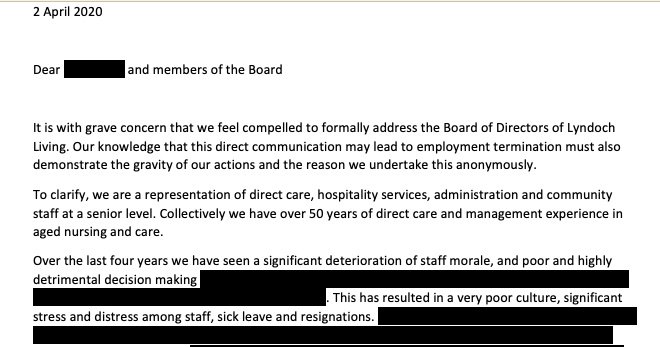


Lyndoch board ignored staff warnings on looming crisis

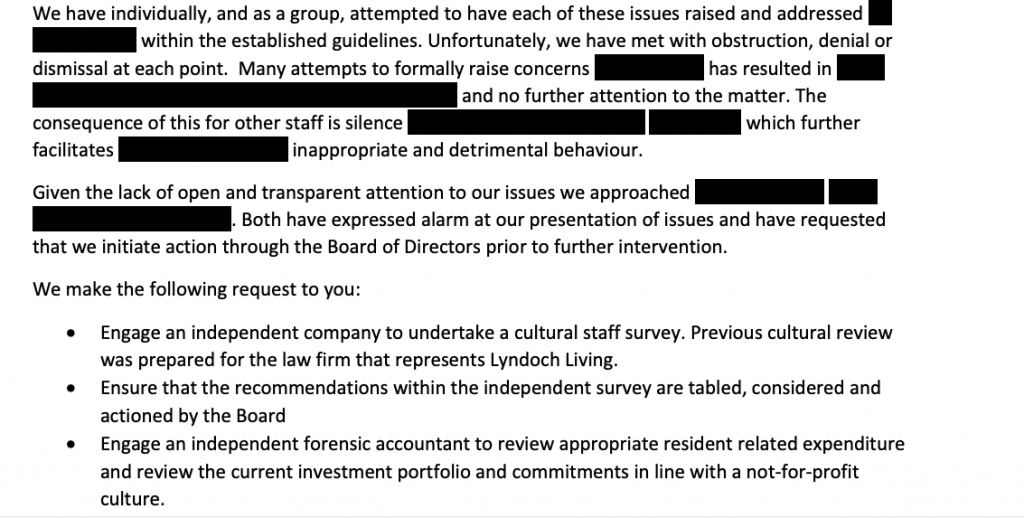
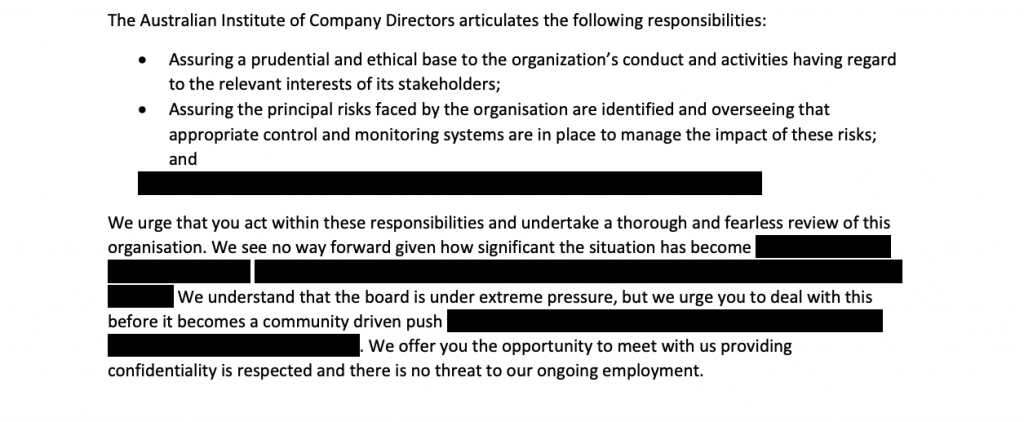
[An edited extract from the letter sent by Lyndoch  staff to the Lyndoch board in April last year.]
 

Carol Altmann – The Terrier

Tonight I can reveal that a group of Lyndoch staff tried to alert the Lyndoch board to a looming staff crisis more than a year ago, but was ignored.

An explosive letter has emerged that was written by a group of experienced staff to the Lyndoch board on 2 April 2020 – 18 months ago.

The letter was delivered to the board via a trusted intermediary, a Warrnambool GP.

Staff are forbidden under Lyndoch policy to approach the board directly, but the authors, who represented a cross-section of Lyndoch, clearly felt they had no choice.

“It is with grave concern that we feel compelled to formally address the Board of Directors of Lyndoch Living,” the letter begins.

“Our knowledge that this direct communication may lead to employment termination must also demonstrate the gravity of our actions and the reason we undertake this anonymously,” it says.

Between them, the letter says, the authors have more than 50 years experience in aged care and they came with a warning:

“Over the last four years we have seen a significant deterioration of staff morale, and poor and highly detrimental decision making…,” they write.

“This has resulted in a very poor culture, significant stress and distress among staff, sick leave and resignations”.

Let’s just stop there for a moment.

I wish I could publish the entire letter, but Lyndoch is too litigious for me to take that risk, so what follows is my edited version of what the authors outline as their issues of major concern, the alleged causes and the request for action.

The staff tell the board that they tried to raise their concerns through the normal channels, but have got nowhere.

In fact the situation only got worse.

“Unfortunately we have met with obstruction, denial or dismissal at each point,” they write.

Either a lack of action or consequences for speaking up, meant other staff remained silent, which led to more “inappropriate and detrimental behaviour”.

The authors say they turned to two politicians for help who were alarmed by their claims and urged the staff to contact the board directly.

So they did, via a letter that could not be more direct.

They urged the board to do a “fearless review” of Lyndoch Living that would include three things:

1. Engage an independent company to undertake a cultural staff survey. (The) previous cultural review was prepared for the law firm that represents Lyndoch Living.

2. Ensure that the recommendations within the independent survey are tabled, considered and actioned by the Board;

3. Engage an independent forensic accountant to review appropriate resident related expenditure and review the current investment portfolio and commitments in line with a not-for-profit culture.

And at the end of the letter came the kicker.

The authors offered to meet with the board, to show their faces, and to step away from anonymity.

They would do this, they said, provided they could be protected from any threat to their jobs, and assured confidentiality.

This is huge.

Anybody who knows a Lyndoch worker who wants to speak up, but doesn’t, knows that the number one reason given is fear of being targeted, or losing their job.

The courageous staff behind this letter swallowed that fear because they believed if they did nothing, the situation would only deteriorate.

They decided to trust the board.

So they wrote their letter, they had it delivered via the GP and they waited for a response via the same intermediary.

And nothing happened.

They didn’t get a reply, much less an invitation to come and talk with the board in confidence.

I know the board received the letter and I know it was discussed, but it went no further.

The board stayed silent.

And the brave staff, their hearts swollen with disbelief and disappointment, felt that they were entirely on their own. They retreated back into the shadows and got on with caring for the elderly and vulnerable residents of Lyndoch.

That was 18 months ago.

I don’t know what has happened to the staff who wrote this letter, but their predicted catastrophe has come to pass.

The steady loss of experienced and dedicated staff from right across Lyndoch over the past five years has, in recent weeks, become a flood.

And still the board says, and does, nothing.

* Board members Percy Eccles and Suzanne Coulson resigned in March and May of this year. They have not been replaced.


Lyndoch board gives short shrift to questions from Roma

Even South West MP Roma Britnell can’t get straight answers from the Lyndoch Living board.

Carol Altmann – The Terrier

Even South West MP Roma Britnell can’t get straight answers from the Lyndoch Living board.

The board has given short shrift to Ms Britnell’s recent questions about its blanket rejection of 115 membership applications from the community.

Its fulsome response to Ms Britnell was, wait for it, that it was “acting within the Lyndoch constitution.

End of conversation.

Ms Britnell was told nothing more.

At least the board is even handed when it comes to answering questions: it ignores everyone.

Ms Britnell, like the rest of us, learned nothing about why the applications were rejected, the criteria used, or the process followed.

We can only surmise, therefore, that there was no process or selection criteria.

It doesn’t matter that Ms Britnell, a State MP and our elected representative, was asking questions on behalf of her local constituents.

She was given zero from the board that, in theory, is also supposed to represent the community.

So if Ms Britnell can’t get an answer, what hope does someone like Warrnambool resident Margy Jackson have?

Margy, a retired school teacher, recently wrote to Lyndoch chair Sue Cassidy expressing her concerns about Lyndoch and the cutting out of the community.

Margy has had no response.

Former Deakin Professor James Dunbar and retired naval officer Jim Burke wrote to the board some months ago expressing their concerns about the viability of the $22m medical clinic being built at Lyndoch.

They have had no response.

It appears that the current board of seven volunteers – Ms Cassidy, Kane Grant, Andrew Paton, Kerry Nelson, Prof Rob Wallis, Lorraine Mielnik and Ron Page – has decided they are answerable only to themselves and the CEO.

Have they lost sight of who built and supported Lyndoch for so many decades?

Why else would the board agree to turn its back on their own community?

And why would these remaining board members (Percy Eccles and Suzanne Coulson quit earlier this year) want to be a part of such a closed shop?

Only they can answer that question.

I don’t expect any answers soon, but with Lyndoch’s staff and residential care – its core business – suffering under the board’s watch, the questions will only keep coming.


MP asks for answers on Lyndoch’s rejection of new members

South West MP Roma Britnell has asked for a “please explain” from Lyndoch Living over its mass rejection of membership applications.

Carol Altmann – The Terrier

South West MP Roma Britnell has asked Lyndoch for an explanation as to why every single membership application from 115 lodged this month was rejected.

“I’ve had contact from a number of people about this issue,” Ms Britnell said.

“I understand that Lyndoch, as a community established and owned service, holds a special place in the heart of the Warrnambool and south west community and I am aware of concerns that some people have raised.

“As such I have made contact with Lyndoch Living asking for advice on the application process and why applications may be rejected.”

Lyndoch is not always rapid in its responses to Ms Britnell, but we can only hope she receives a fulsome answer shortly.

Ms Britnell’s views are shared by other community leaders, including Member for Western Victoria Bev McArthur.

Ms McArthur said she was concerned that so many membership applications had been rejected and “would like to understand why this has happened”. 

“As a community organisation, openness and accessibility to residents should be a high priority,” she said.

“Many of the membership applicants were highly qualified and motivated, and could surely have brought great energy and expertise to Lyndoch.”

Ms McArthur said the current members of Lyndoch should be on the public record, and the criteria for the application process properly explained.

“The existing situation seems needlessly secretive, and does nothing to cement the vital community link.

“I call upon Lyndoch Living to live up to its position as a community asset, and be more open and engaging in matters of ordinary membership, board membership, and AGM participation.”

Wannon MP Dan Tehan was less direct, but said the Federal Government expected “approved providers to select board members with relevant skills and expertise” to ensure “quality of care for senior Australians is prioritised and maintained.”

A good point, Mr Tehan, because as is stands, there is nobody on the Lyndoch board with experience in aged care.

Mayor Vicki Jellie and four other Warrnambool City councillors responded to a request for comment, with each speaking personally rather than on behalf of the council.

Mayor Jellie said Lyndoch Living was a valued and much loved local community facility that was “extremely important to us all”.

“As a community member, I would like to see diversity in the membership of our local community organisations to support strong, effective leadership and oversight.

“I acknowledge and commend all of those within the community who put forward applications to become Lyndoch members.”

Cr Ben Blain said “it would be good to see some new local faces on the board that represent the community” –  a view also shared by Cr Debbie Arnott.

“Lyndoch is a community owned facility and its board and membership should reflect that…I do feel it might be good to see some new faces on the board,” Cr Arnott said.

Cr Angie Paspaliaris said she believed that any community owned organisation should “seek to be as transparent, engaged and communicative as possible with the community they are there to serve.”

“There are many experienced, extremely well qualified people in Warrnambool who would be great members and contributors to the operation of our local aged care facility,” Cr Paspaliaris said.

Lastly, Cr Max Taylor said it was only “logical and permissible” that people from the community be allowed to become members of Lyndoch, and – if they so desired – to nominate for the board.

“I am sure that one of the original Board Presidents for many years in Stan Berlyn would most certainly permit this process,” Cr Taylor said.

The next Lyndoch AGM is on 26 October. Board nominations close on 12 October, but given there are no new members (that we know of), I don’t know who will be nominating for the two board vacancies left by Percy Eccles and Susanne Coulson.

We shall see.See you Sunday.