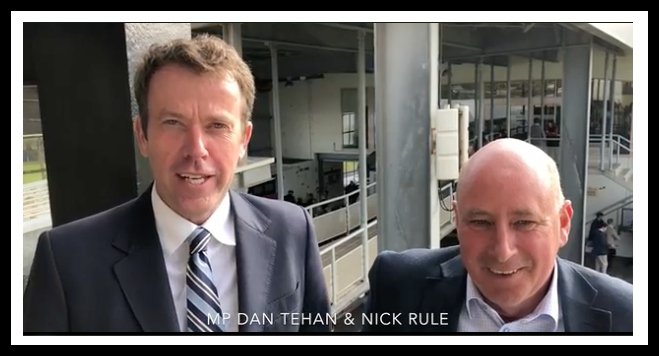
Racehorse co-owners Wannon MP Dan Tehan and Warrnambool Racing Club chairman Nick Rule at the announcement of $1.25m in funds for the WRC. Image via The Warrnambool Standard.
I have tried at least five times to stop writing about local issues so that I can focus on books that I need to write, but each time I try, some frustrated soul contacts me with a story idea or a piece of information that they know will not be investigated or published elsewhere.
So here we go.
Story number one: Dan Tehan’s friends in racing.
A week or so ago, Wannon MP Dan Tehan braved the chill winds at the Warrnambool racecourse to announce a sweet $1.25 million in funds to the Warrnambool Racing Club so it could transform, among other things, its already “first-class” eating and drinking venue into a “world-class” venue.
That little slice of pumped up Trump-speak was from WRC chairman Nick Rule, who told the local paper back in January that: “The club has the support from the Member for Wannon Dan Tehan for the project” aka, he is right behind us on this one.
Dan is a big fan of racing, but more than that, he owns shares in racehorses and, in particular, he owns shares in a racehorse – called Wells – with Nick Rule and others.
That’s right: our local Federal MP shares a horse with the chairman of the WRC and lobbies on behalf of the WRC for public money.
What I don’t understand is why this connection is never mentioned in any media reports?
And why doesn’t Dan Tehan ever mention it in any of his public remarks and Facebook posts?
And why, if it is no big deal, does his staff refuse to answer a simple “yes” when asked if Dan and Nick co-own a racehorse?
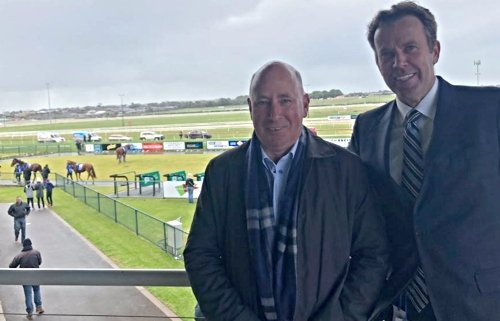
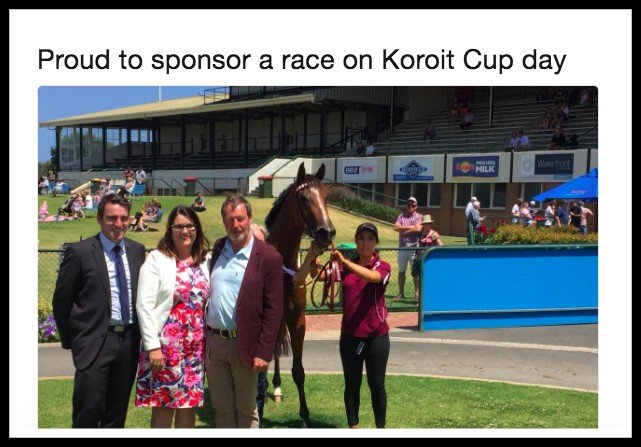
Nick Rule and Dan Tehan at the Warrnambool races. From Dan Tehan’s Facebook page on the day of the funding announcement.
It was the same story a few years ago when Dan Tehan and then Premier Denis Napthine part-owned a racehorse (Spin the Bottle) with Midfield Meats owner and multi-millionaire Colin McKenna who, at the time, was seeking state money to expand his operations in Warrnambool. (He got the money and Denis got a political headache.)
And it is the same story, as I have written about before, every time local MP James Purcell, racehorse owner and father-of-trainer-Aaron Purcell, opens his mouth about anything to do with horse racing and allowing large numbers of racehorses to train on beaches.
Let me shout it out:
THESE MPS OWN RACEHORSES!
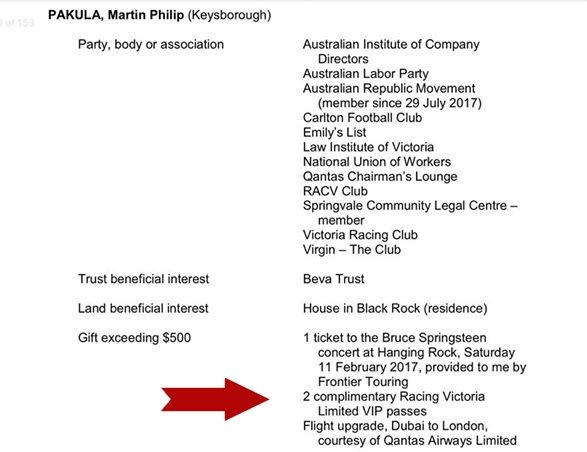
Dan Tehan and James Purcell are not alone. State ministers Lily D’Ambrosio and Martin Pakula, who are among those deciding whether commercial racehorse training should be allowed on our local beaches, have been the recipients of a free annual pass or a VIP pass to Racing Victoria.
Ah, the lure of a ringside seat at the Melbourne Cup.
I am not sure when we started to accept such potential conflicts of interest as normal.
It is difficult to think of another example where an MP would be permitted to be actively involved in any lobbying or decision making when they held such interests but, for some reason, horse racing remains exempt.
I hasten to add, before the lawyers start dictating letters, that there is no suggestion of any impropriety by any of these MPs: they are doing what we allow them to do.
If this is to change, we need to keep calling it out and to keep shining the light into the dim corners, sometimes several times over.
And that is story number one.
How can you dump piles of deadly plastic without detection?
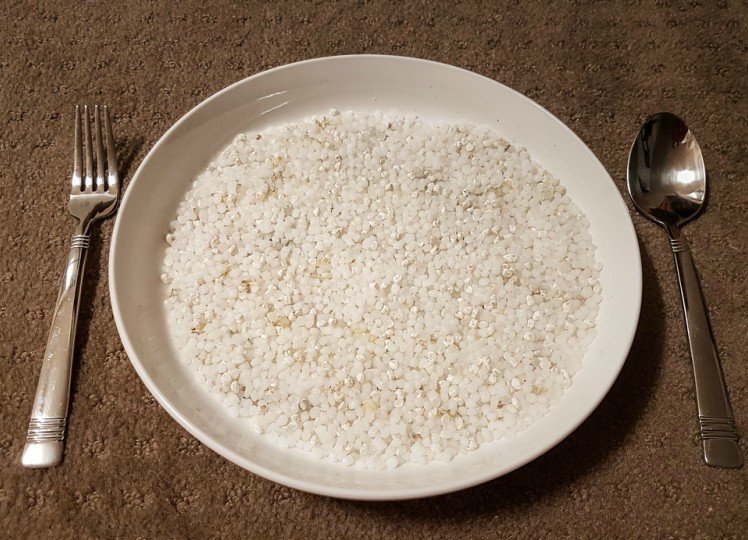
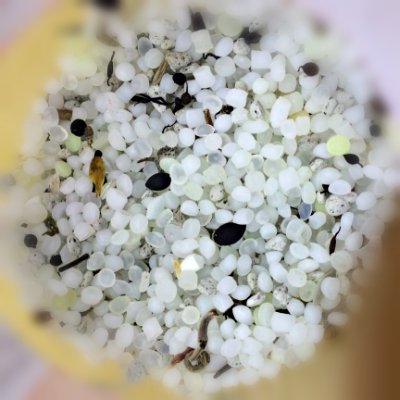
Pollution in disguise: Millions of micro plastic ‘nurdles’ were illegally dumped into the Warrnambool sewerage treatment plant last November. This image by Rosana Sialong shows how easily they can be mistaken by coastal wildlife for food. Image: Good Will Nurdle Hunting.
By Carol Altmann
LAST November, millions of tiny plastic pellets (nurdles) were dumped illegally into Warrnambool’s sewerage treatment system – polluting our beaches all the way from Thunder Point to Yambuk – and still nobody has been found responsible.
How can this be?
This was a criminal act, but as Bob Brown said recently, crimes against the environment don’t attract police cars with their lights flashing and sirens roaring.
It was also, I suspect, one of the largest pollution spills ever recorded in Warrnambool and one from which it will take months if not years to recover.
Even as I write this, the Good Will Nurdle Hunting action group – set up by film maker Colleen Hughson – and others, are still laboriously picking up thousands of nurdles to avoid them getting stuck in a seabird’s gut and killing them.
And yet five months on, Wannon Water, who is responsible for accepting and treating the waste that comes into the Warrnambool plant, appears no closer to finding a culprit.
In these days of swipe cards, security codes, security cameras, trade waste controls, random testing, checklists, computerised logistics and god knows what else, this seems inconceivable, but it is the current reality.
It is also astonishing that Wannon Water didn’t know exactly what was being poured into its treatment plant on or around November 16.
This might be a harsh assessment if we were talking about the general sewerage system that caters for tens of thousands of customers from across the south-west, including those stupid enough to flush all manner of junk down the loo.
But in this case, the search is not a needle-in-a-haystack scenario, but actually quite narrow.
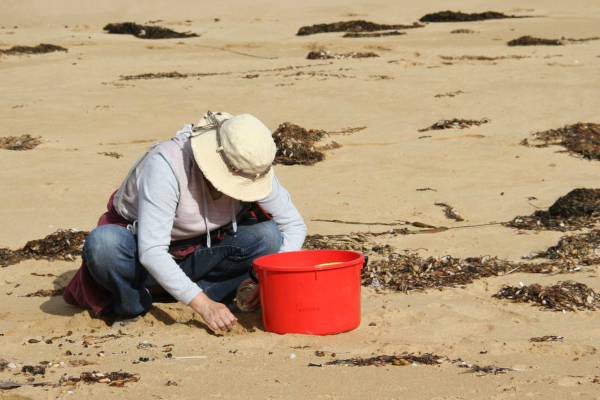
Local artist Megan Nicolson collected almost 2000 nurdles in one sweep around Shelly Beach on April 17, and they just keep coming. Image: Good Will Nurdle Hunting
BEAR with me for a second while I lay this out, because it is critical as to why this spill is considered by many to have been avoidable and why so many people are still angry and demanding answers.
Wannon Water has confirmed that the plastics came into its plant through what is called a Sludge Acceptance Point (SAP). This is where authorised tankers deliver gunk collected from authorised customers. You need a key and a swipe card to get in. In other words, it is not open to just anybody.
As Wannon Water managing director Andrew Jeffers said by email, “WannonWater’s system is secure and only able to be accessed by approved customers. Volumes received at this point are only a very minor proportion of the total volume of sewage treated at the Warrnambool plant.”
Of these SAP customers, Wannon Water has identified 20 sites that were inspected as part of its investigation, including some sites that might use nurdles or raw plastic.
Yet despite nailing it down to just 20 likely sources, none of these inspections, it seems, has come to anything.
Knees down, back bent, nurdle collector Rosana Sialong is one of the many locals still trying to remove the nurdles from the Shelly Beach area. Image: Good Will Nurdle Hunting.
WANNON Water declined to list the 20 sites inspected, or to reveal much of anything about its ongoing investigation, so I asked five local, large industries directly if they had any knowledge of the spill.
Here is what they said:
Midfield Meats: “Midfield doesn’t use nurdles in any processes.”
Murray Goulburn: ‘MG does not use Wannon Water for its effluent disposal. We have our own wastewater treatment system and spray irrigate on to our farmland. In addition, MG does not use a product of this nature in any aspect of its manufacturing.’
Beach Energy: (owners and operators of the Port Campbell gas field, formerly operated by Origin Energy): “No nurdles are used in production on site.”
Fonterra: “I’ve spoken to our site environment manager and can advise that we don’t use nurdles in our production processes”.
Saputo/Warrnambool Cheese and Butter: The questions have been sent to Saputo communications in Canada – still waiting a response.
And what about two of Warrnambool’s septic and trade waste collection services, Berminghams and Sergeants? What do they know?
Sergeants: “As the records would state (we) didn’t dispose of any liquid waste at the Warrnambool facility during the months of October, November or December”.
Berminghams: “We have nothing to tell you about that.” The person said on the end of the phone before ending the call.
Lastly, I called Bartlett’s Environmental in Geelong.
Bartlett’s are contracted to clean the Wannon Water sewer pump stations and truck the sludge to the SAP, so maybe they unknowingly sucked up a load of nurdles around November 16 last year?
At first Barlett’s offered to look into it, and then, a day later, its general manager John McCoy emailed: “For all matters regarding contract work undertaken by Bartlett’s Environmental for Wannon Water, please refer all questions directly to Wannon Water.”
Mr Jeffers, who declined to be interviewed directly for this piece, said via email that Wannon Water had since ruled out the plastics coming in via sludge from a sewer pump station.
So around and around and around we go.
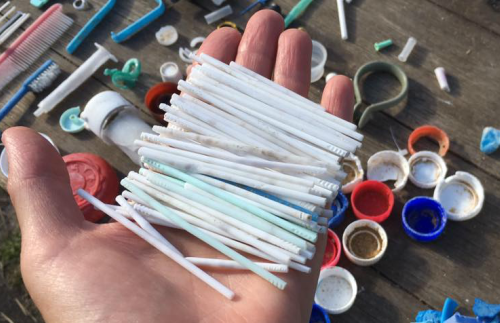
Thousands of cotton ear bud sticks, like these collected on April 20, were considered by many to be the canary in the coal mine on the pollution problem. Image: Pick Up Sticks Facebook Group.
WANNON Water appears keen to find out who has caused it such grief.
It is even using the skills of a private investigator, retired police officer Mick Fennessy, who is a big, no-bullshit kind of guy, to try and flush out the truth.
But what this spill has exposed is not only an environmental vandal in action, but a gaping hole in how the Warrnambool treatment plant has operated – quite legally – to date.
Wannon Water has now realised that its screening systems were not good enough, both before sludge was poured into its plant, and once it passed through.
What has happened since this spill is that two, finer screens have been installed at the treatment plant to catch anything larger than 1.5mm before it reaches the ocean.
Wannon Water is also “now supervising all loads coming in” to the SAP, according to Mr Jeffers.
Both of these are important changes but, some argue, they should have been made immediately when thousands of cotton bud sticks appeared at Shelly Beach en masse in 2015 and turned up in vast numbers again last August.
The slim white sticks were considered to be the canary in the coal mine, sending a highly visual warning that thousands of litres of small plastic could be passing through the Warrnambool treatment plant to the ocean.
Nothing, however, was done, despite Wannon Water being told about the pollution.
“Both the Environmental Protection Authority and Wannon Water were informed by myself and others of the sticks, but they either didn’t believe me or were unwilling to do anything about it,” said Luke Foster, a local plumber and member of Good Will Nurdle Hunting.
If the new 1.5mm screen had been installed before November 16 last year, the argument goes, very few of the millions of dumped nurdles would have made it to the ocean.
“I am happy there is now a 1.5mm screen at the end of the waste water treatment plant to capture these plastics. However, it may be a long time before we are able to remove the majority of plastics that remain in the marine environment from past pollution,” Mr Foster said.
Mr Jeffers, however, has distanced Wannon Water from any responsibility for the cotton bud sticks.
“WannonWater does not believe the cotton buds were related to the current sewage treatment plant nor the nurdle incident,” he wrote.
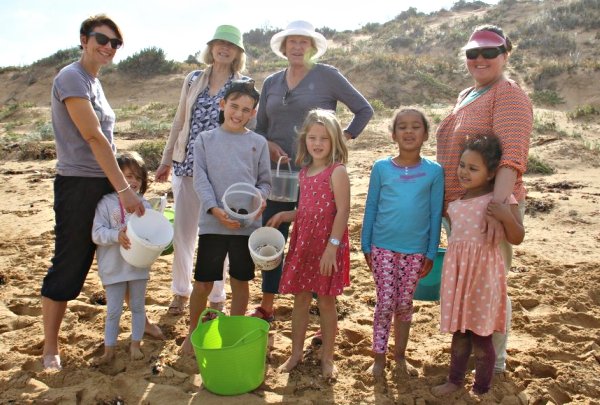
Some of the many Warrnambool locals who have joined he clean up effort at local beaches. Image: Good Will Nurdle Hunting.
THERE is a lot at stake for Wannon Water from this pollution problem, with the EPA continuing its own investigation into potential breaches of the Environment Protection Act by the treatment plant.
As EPA South West manager Carolyn Francis outlined, the maximum penalty through the courts for a breach of an EPA licence is $380,568. The EPA can also directly issue Infringement Notices of $7729.
There is also, of course, the need to reassure the public that Wannon Water is top of its game when it comes to handling pollutants: preventing them from entering the system in the first place and catching them – and the polluters – when they do.
Catching the nurdle culprit so long after the event, however, appears increasingly unlikely and yet time alone, surely, cannot be an excuse to give up the search. We deserve answers.
In the meantime, Colleen Hughson, who really got the ball rolling on the public clean-up, says she has been amazed by the community response.
“The most heartening thing about the nurdles spill is the amount of ‘good will’ the community has shown in coming together to clean the mess up.
“(It) has also highlighted the bigger issue of marine plastic pollution and many people in my community have been inspired to look into ways of curbing their own consumer habits to stop the flow of plastic waste. It’s brought about conversations, generosity and a willingness to take positive action.”
Do you know anything about the illegal dumping of the nurdles? If you do, contact me at altmanncarol@gmail.com
For information on Wannon Water’s response to the nurdle spill, including media releases, clean-up activities and ongoing updates, visit its dedicated webpage here.
Petition launched to advertise CEO position
W’bool City Council CEO Bruce Anson has been in the role for 11 years. Image: WCC.
A petition has been launched asking the W’bool City Council to advertise the position of its CEO for the first time in 11 years*.
As far as I know, it is the first time such a petition has been launched in Warrnambool and it comes from a position of pure frustration.
While some might see it as a direct attack on the sitting CEO Bruce Anson, I see it as a predictable response to the secrecy that surrounds one of the most important and well-paid civic jobs in our city.
As I wrote recently, the WCC last month voted in secret to award Mr Anson a pay rise that increased his salary package to around the equivalent of $6000 a week.
This includes super and a car and doesn’t include tax, but even if we halved that package to $3000 a week, it is still an eye-watering amount to most of us.
Maybe, as I have said before, Mr Anson deserves every dollar that he earns.
And maybe, after 11 years in the job, he is still the best person to lead our city into the future. (The current contract expires next January).
But the bottom line is that Mr Anson works for us – the people of Warrnambool – and we deserve to know far more about the CEO position and his performance than we do now.
All we have been asking for is greater transparency: nothing more, nothing less.
And yet the WCC continues to act as if we have no right – us pesky journalists and annoying ratepayers – to even ask.
The petition now asks the question in a way that can’t be ignored.
It will be revealing to see how the new councillors respond.
* The petition can be signed at 150 Liebig St (next to Kathmandu) from 11am – 2pm Mon-Sat, and is also located in several local business. It is being organised by David Thompson, partner of former WCC election candidate Christine Thompson.
W’bool City Council CEO salary goes higher and higher
W’bool City Council CEO Bruce Anson. (Image: Regional Capitals Australia)
You don’t know it, but the Warrnambool City Council voted to give its CEO, Bruce Anson, a pay rise last week and he now earns a salary package of somewhere between $309,999 and $319,000.
I can’t tell you exactly how much the pay rise is, because the WCC refuses to acknowledge that it even happened.
This is because, as happens in most local councils, it is all negotiated behind closed doors, voted on behind closed doors and the results kept confidential. And because it is confidential, our elected councillors can’t talk about it.
But I can tell you that since Bruce Anson became CEO in 2007, his salary package has increased by 50%, or around $100,000.
This is big money when you live in a place like Warrnambool.
It is the equivalent of around $6000 a week.
$6000 a week…in Warrnambool.
When you think about it, about 300 households in Warrnambool are paying their annual rates just to cover the CEO’s salary package.
The Premier, Daniel Andrews, is paid around $377,000.
In the scheme of things, our CEO is actually not that far behind the Premier.
Maybe our CEO deserves every penny of that package, but who would know? We aren’t allowed to ask how his job skills are measured because that, too, is confidential.
Again, this is how most local councils operate – apart from a few who opt for transparency, like Melbourne City Council.
And, just for the record, Fun4Kids, which was supposed to end two years ago when WCC staff warned it was bleeding money and would continue to do so, has cost us more than $7 million to keep afloat.
In just the past two years – when it should have been cut – it soaked up around another $1 million.
The WCC knew this festival was dead in the water, and finally dropped the axe this month.
But where was the succession plan? What did it think could happen in its place?
Apparently not only are we partly at fault for the festival’s failure because not enough locals attended, we now have to come up with ideas for its replacement.
$7 million….and $6000 a week.
Just some figures for you to ponder as we pay more for parking and more in parking fines and more to get a dog out of the pound and…
[Mr Anson’s contract is due to expire in January 2019. In the 10 years of his tenure, the position has never been advertised.]
Does horse racing rule our town?
Carol Altmann – The Terrier
One of the many things that struck me while working through the plan to allow commercial racehorse training on our wild beaches is that all three of our local MPs – Dan Tehan, James Purcell and Roma Britnell – have strong ties to horse racing.
Federal MP Dan Tehan, although his office was oddly reluctant to make this clear, shares a very successful racehorse with the CEO of the Warrnambool Racing Club, Nick Rule, among others.
Independent MP James Purcell has an interest in numerous racehorses and his son is a professional trainer.
State Liberal MP Roma Britnell, who as far as I know doesn’t own a racehorse, has a horse race named in her honour and holds a Warrnambool Racing Club membership.
Which of our local MPs, then, will argue that our beaches should not be used for racehorse training on an industrial scale?
Which of them will lobby to instead increase protection of the Belfast Coastal Reserve?
None of them.
Instead, all three of our local MPs have started from the point that we need to reach a “compromise”, a “balance”, a “give-and-take” on having thoroughbred racehorses pounding along sections of beach between Killarney and Warrnambool and up and down the dunes at Levy’s Point.
Not one of them has said that large numbers of racehorses should not be in a coastal reserve in the first place.
At least Roma Britnell, in an email to me via her media advisor Jarrod Woolley, said she had “a number of concerns” about the draft management plan for the reserve.
When I asked what those concerns actually were, however, there was no more information forthcoming.
This is why documents released to the Belfast Coastal Reserve Action Group under Freedom of Information make for such a revealing – and depressing – read.
They spell out that commercial, large-scale racehorse training in the Belfast Coastal Reserve is virtually a fait accompli.
The correspondence between the various bodies involved in the draft plan never questions why racehorse training should be allowed, but how it will be managed.
At first I felt like giving up and not even bothering to write a submission. What was the point, the cards were already stacked, right?
But then it occurred to me that this is the very reason why other voices need to be heard, or those with the most power, the most access, and the most influence will simply roll right over the top with impunity.
We elect people to represent our views because we don’t have the time to wade through reports, but this time, I am sorry to say, those of us who want to see this reserve preserved are on our own.
So please make the effort, either by filling out the online survey or emailing a submission, via this link: www.engage.vic.gov.au/belfast