Lady Bay racehorses and beach kids a disaster in waiting
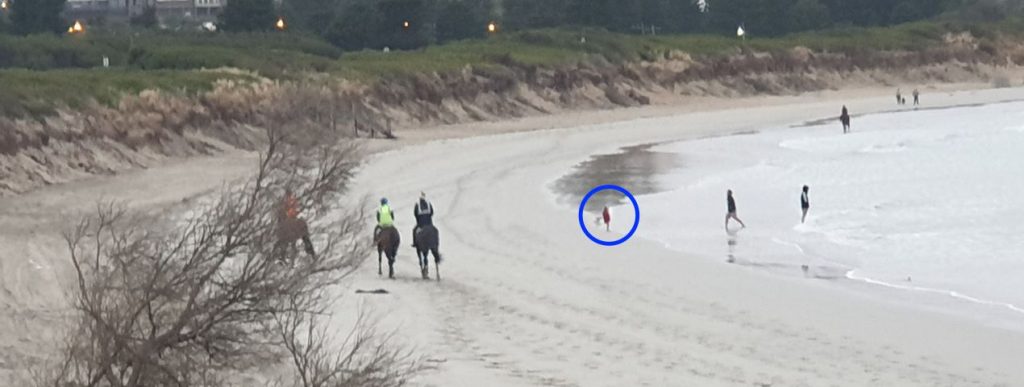
The potentially lethal mix of racehorses and young children came dangerously close at Lady Bay on the long weekend. Images: March 11, 2019.
Carol Altmann – The Terrier
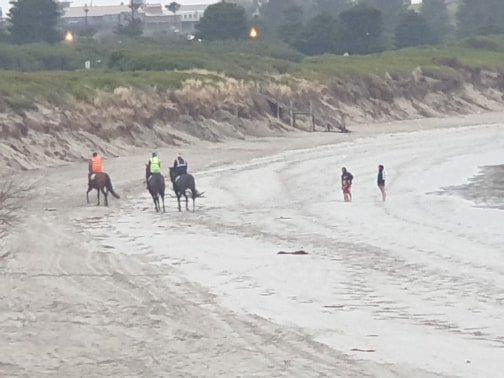
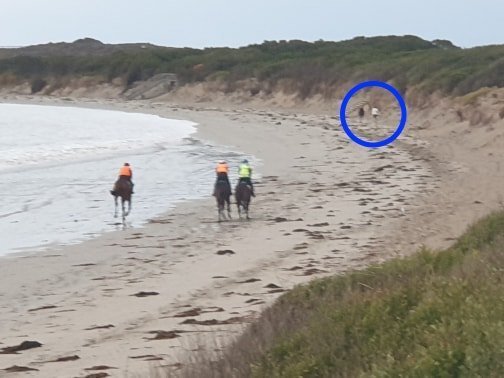
Take a close look at the photos above because they show a terrible accident at Warrnambool’s Lady Bay waiting to happen – and on the Labour Day holiday yesterday, it came close.
The first shows a small child standing at the shoreline near Worm Bay while three powerful racehorses come running along behind.
According to my source for these images, the child turned and began to walk toward the horses before the father – having anticipated the danger – reached his child and held on as the racehorses passed. (In the second shot, they are now standing past the first set of footprints on the sand.)
This mixture of children and racehorses on a main public beach, on a public holiday weekend, is legally sanctioned by the Warrnambool City Council.
From March 1 to November 30, up to 96 racehorses a day, every day, can train along Lady Bay from dawn until 10am, irrespective of whether it is the middle of winter or a major public holiday weekend like that which just passed and saw hundreds of campers staying along the foreshore.
By 10am, many campers have been down to enjoy the beach, as you would expect. What they didn’t expect, perhaps, is to be confronted by racehorses in flight.
This is nothing to do with supporting or not supporting horse racing, but instead an important issue around public safety where, it seems, the council and Warrnambool Racing Club are prepared to take extreme risks. These same risks would be unthinkable at a racecourse.
If you want a clear example of the dangers, watch the video below of an out-of-control racehorse belting along Lady Bay after throwing its rider. This footage was captured in July 2017.
There are rules in place for this strange, legalised game of Russian roulette between the general public and racehorse training, but they are being broken.
Already there have been four breaches recorded since training resumed at Lady Bay on March 1: less than a fortnight ago.
Two of those involved riding three abreast – as is happening in the first photos – with the maximum number of horses in any group set at two, with 50m between them.
Another was a rider training two horses at once, with a second, unidentifiable horse being pulled alongside. Another chose to ride in the soft sand, not the hard sand.
All of these actions are illegal under the rules set down by the WCC and WRC and they are the ones we know about because they have been recorded by the public.
To date, I have not seen one public report by the council or WRC on what breaches have occurred at Lady Bay since 2016 and what has been done about them. We just don’t hear about it and we don’t get told.
I sent several of these images to the council directly more than a week ago for comment on what happens in response to these incidents and have had no reply, other than to check what date the photos were taken. (Glad to be of help.)
A quick hashtag here – #notalltrainers – but there are repeat offenders who know the rules and, it appears, just don’t care.
A trainer with two racehorses in training, including one with no clear identification. Image taken March 1, 2019.
Racehorses again training three abreast, in breach of the rules, while walkers stay out of the way on the high sand. Image March 1, 2019.
In the meantime, is it really the job of the public to police the racing industry at Warrnambool’s main local beach?
If so, no wonder we are all justifiably sceptical that any rules will be followed at Levy’s Beach, which is much further from the public eye, when dozens of racehorses are allowed to move in there later this year.
WorkSafe has a detailed set of guidelines for racehorse training safety at racecourses, but not public beaches. In the case of Lady Bay, which is clearly a “work site” between dawn and 10am, WorkSafe looks to the council and WRC to develop and enforce the rules. (Anyone with safety concerns at Lady Bay can also contact WorkSafe direct on 1800 136 089.)
Many locals are wondering how the public beach at Lady Bay transformed from a place where a few trainers gathered to run and swim their horses, to become a virtual extension of the Warrnambool racecourse, even though that same racecourse has had had millions spent since 2017 to upgrade its on-track facilities.
There was no environmental impact study, no public opinion survey, no broad consultation, no compelling research to justify the move – it just happened.
And, as a result, it is now permissible to have racehorses mixing with children at a beach at 8am, 9am – or whatever time it was – and for a child to no longer be able to run freely without the risk of being trampled.
This is not the beach of my Warrnambool childhood, but it is now, sadly, of theirs.
If you would like to see The Terrier keep digging up, sniffing out and chewing on local issues, please make a small contribution below.
100 dead birds and rising in Lake Pertobe botulism outbreak
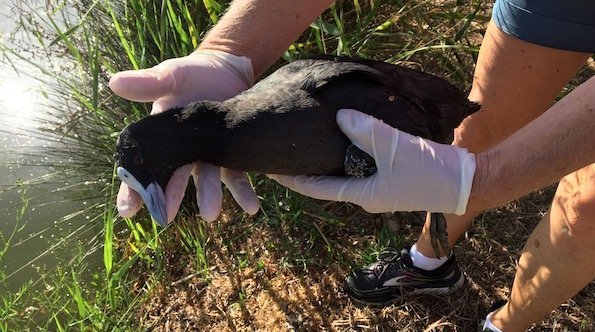
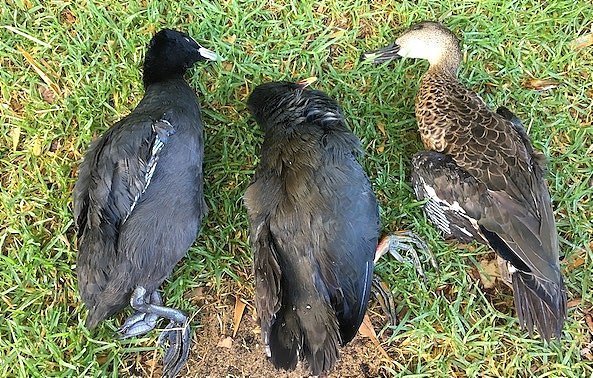
A dead Eurasian coot, one of more than 100 birds that have died at Lake Pertobe in the past five weeks from a botulism outbreak that is rolling on.
Carol Altmann – The Terrier
Within the calm surrounds of Lake Pertobe, there is a mass killing underway and not enough is being done to stop it.
More than 100 birds have been wiped out since an outbreak of avian botulism began to claim the birds of Lake Pertobe five weeks ago – among them ducks, cygnets, moorhens, Eurasian coots, cormorants, swans, seagulls and a crane – and the death toll is still climbing.
Most visitors to Lake Pertobe are blissfully unaware that just metres from where they are enjoying the open spaces, there are native birds unable to hold their necks up from the creeping paralysis of the botulism toxin.
These birds will most certainly drown. (Warning: the video below may be distressing).
Wildlife rescue volunteer Alexis Creed-Sycopoulis has been walking the accessible parts of the lake shore most days, and often twice a day, to collect the carcasses and the stricken, paralysed birds which she takes to the vet to be euthanised.
It is a heartbreaking job, but a critical one, as the science shows that every dead bird left in the water contaminates it only further. The threat is even greater if the carcass has become flyblown.
Three of the four dead birds collected in just half an hour during a morning pick-up this week by wildlife volunteer Alexis Creed Sycopoulis.
I joined Alexis on one of her morning pick ups, during which she found four carcasses within half an hour. Another two would be found when she returned later that night. Last Sunday, the grim count included several birds covered in maggots.
“I shouldn’t have to be doing this. I really shouldn’t have to be out here doing the work of the council to make sure these birds are not left in the water,” Alexis says.
The Warrnambool City Council parks and gardens team at Lake Pertobe also collects the dead and dying birds, but there are just not enough workers allocated to the job.
This was proven last weekend, when Alexis left a bag of dead ducks she had collected on Sunday morning at the small council depot at Lake Pertobe, thinking they would be disposed of by staff when they arrived later that day.
The bag was still there when Alexis returned on Monday morning. So were the flyblown carcasses, still in the water. There had been no council check of Lake Pertobe on Sunday, even after the two-day heatwave.
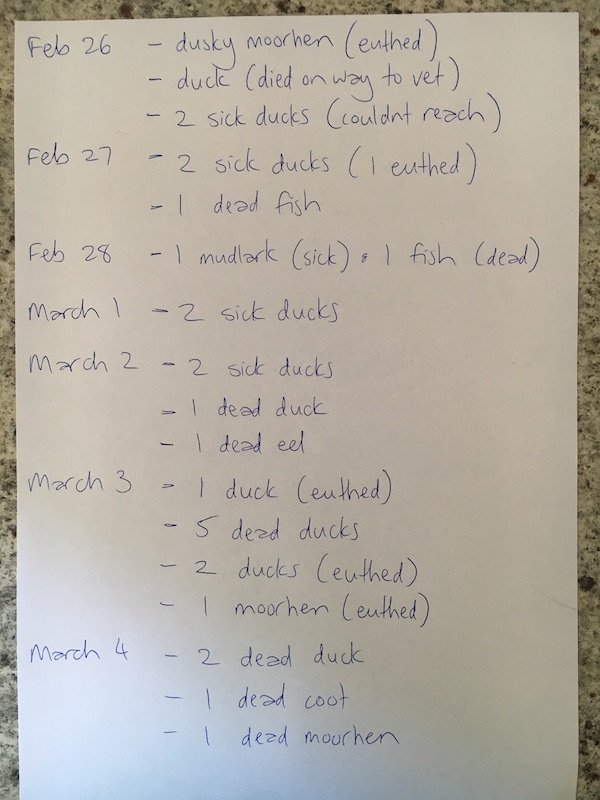
The grim count: the casualties at Lake Pertobe from just the past week, as counted by Alexis Creed Sycopoulis. These figures are added to the council’s tally.
And this morning, Tuesday, Alexis found a dead duck floating in the lake at 10am, hours after the morning pick-up should have started. Meanwhile, up in town, four parks and garden staff were tending to a roundabout.
The council’s small Lake Pertobe team is no doubt trying its best, but they have many tasks, and retrieving dead birds is just one of them. Alexis is also trying her best, but she is a volunteer, with a job and kids.
Meanwhile, the avian botulism continues its deadly march in the warm, soupy conditions of Lake Pertobe that follow days of little rain, hot weather and a build-up of rich nutrients in the water.
While nature controls the first two conditions – heat and no rain – we can reduce the nutrients.
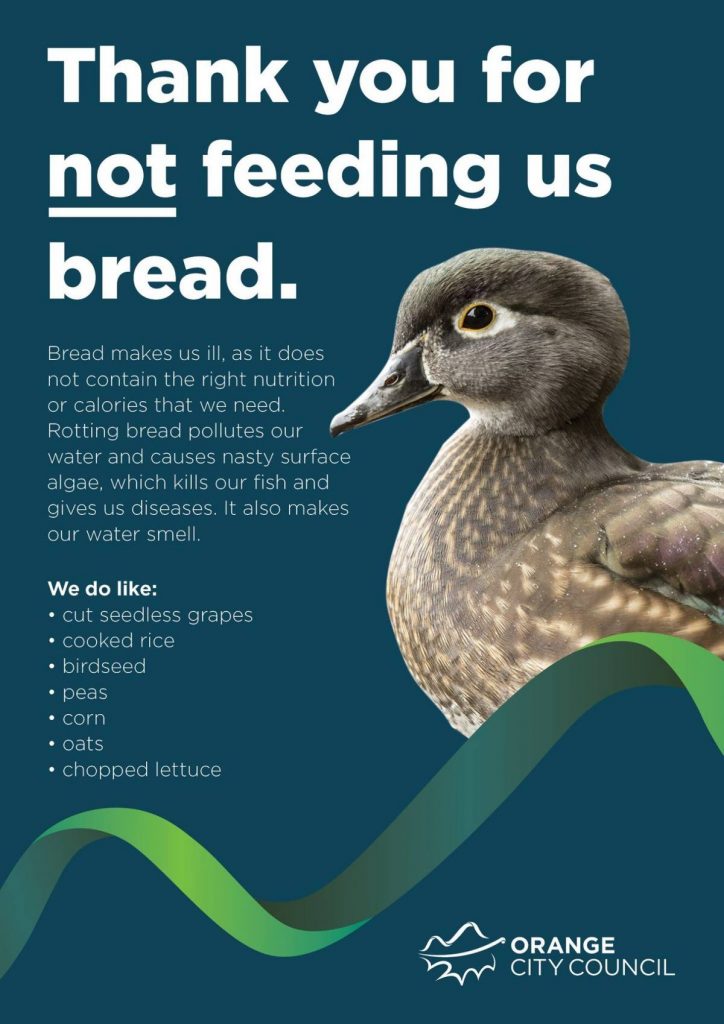
Orange City Council started its a no bread for ducks campaign in 2018, erecting signs like these around its waterways.
It is for this reason that Alexis is also pushing for an immediate council ban on feeding ducks bread within Lake Pertobe and elsewhere, as has been done by other councils.
Bread can be easily replaced by other duck-friendly foods, but so far the council is reluctant to issue such a ban, saying there is no proof that bread kills ducks.
Well, no, bread doesn’t kill ducks – although I am not sure how good processed bread is for them either – but it also doesn’t help Lake Pertobe to get healthy and adds to the conditions that cause avian botulism.
I suspect if the 100 dead birds found so far were all laid out on the Civic Green, we would all be justifiably horrified and asking the council to throw everything it can at the disaster.
For now, however, that burden sits largely on the shoulders of one or two people and the mortality rate grows higher.
(In the time it took me to write this story today, another nine birds were found by Alexis, including four that needed to be euthanised. The total is now 105 110.)
If you would like to see The Terrier keep digging up, sniffing out and chewing on local issues, please make a small contribution below.
Revealing the truth about south-west’s violent past
Carol Altmann – The Terrier
I want to pass this on. This map is so confronting but so necessary to examine.
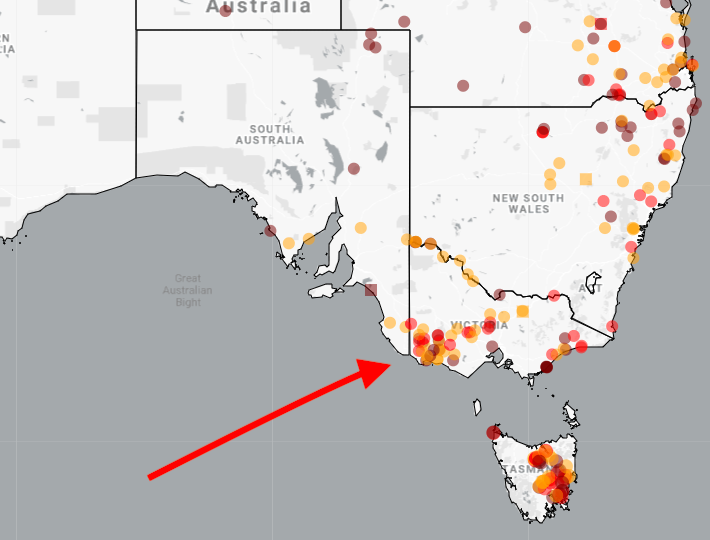
It is a map generated by The Guardian as part of a major project it launched today – The Killing Times – showing massacre sites from the colonisation of Australia until 1928.You can see that south-west Victoria, our home, was a bloodbath.
I learned nothing of this when I was at school. I had never heard of the mass killings of Aboriginal people at places like Crawford River, Murderers Flat, Connells Ford, Apsley, Tarrone, Eumerella, Lake Bolac, Wannon River…
The Guardian, in its forensic analysis of this history, wants to help change that.
It hopes this project will be part of a new way of looking at our past, to finally confront a truth that “has long been hiding in plain sight”, so that the healing of our nation’s heart can begin.
You can find the interactive map and links to the full project here:
I might be getting soft in my old age, but this brought a lump to my throat today (March 3).
So many people from all walks of life across Warrnambool turned out to stand with the environment.
Disappointingly, only one Warrnambool City Councillor – Cr David Owen – was there to witness it.
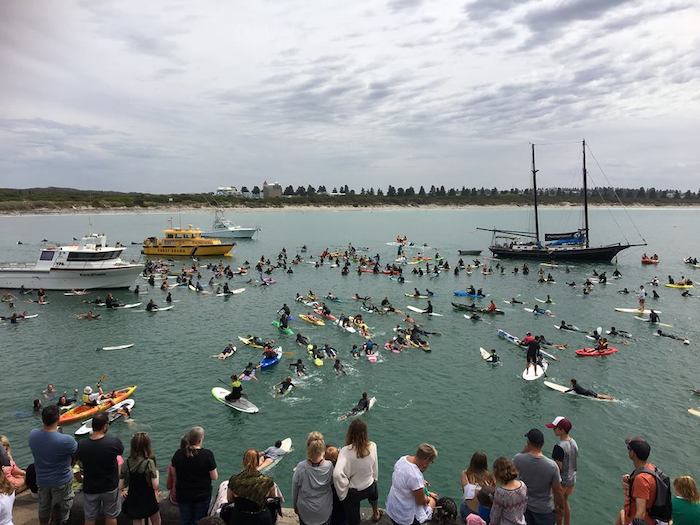
If the WCC really wants us to be a “green city”, it needs to show that it is not scared of the word in practice, because this is what “green” looks like – people coming together to stand up for our natural world.