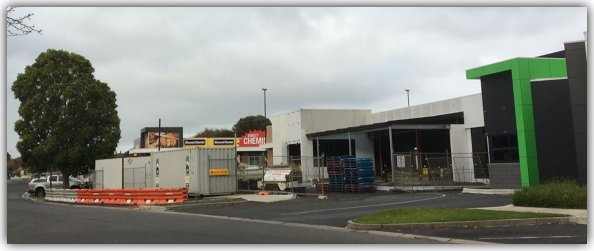
The Northpoint tavern on Hayley Drive off Mortlake Road has been on the drawing board for 12 years and still remains unfinished.
Carol Altmann – The Terrier
Is this Warrnambool’s ugliest building site?
I had no idea, until last night’s Warrnambool City Council meeting, that the poor residents of Hayley Drive, near Northpoint shopping centre on Mortlake Rd, have been looking at this stunning vista of a half-finished building for years.
In fact the planning process for what was going to be a “licensed restaurant” at the back of the bottle shop started in 2006.
That is four councils ago.
Since then the plan has been back to the council eight times for extensions and amendments and more extensions, as the “licensed restaurant” changed and morphed and popped out at the council meeting last night as the Northpoint Hotel, complete with a bar, a bistro and a TAB.
Some residents have had to object EIGHT times to the same project.
One elderly objector, now aged 89 (she was in Year 12 when the project started…okay, maybe not quite, but you get my point), said she always feared the restaurant would morph into a hotel. It looks like she was absolutely right.
I have come to the highly scientific conclusion that the planning laws – local and state – really suck.
How can a project come back to a council eight times over 14 years? How can a building sit half finished for years?
How can prime old Warrnambool buildings be demolished, and their blocks of land sit empty for years and years as what was an “urgent” project becomes suddenly not so urgent?
And why do the goal posts keep moving, so that a licensed restaurant becomes a hotel?
Cr Sue Cassidy was among the councillors last night who were not happy with that change and moved – successfully as part of the planning approval – that the word “hotel” not be used in any signage.
The goal posts must not keep moving, Cr Cassidy said.
I am personally delighted to hear this, as my little street is about to do a David and Goliath by challenging the whiz bang Lyndoch Medical Clinic that was approved in 2017 , “amended” in February this year and approved again last month.
This “amendment” has seen the project double in size. Cr Cassidy, as we know, is both a director of the Lyndoch Medical Clinic and a Lyndoch board member.
From what Cr Cassidy said last night, it looks like my street can count on her support when it rolls onto VCAT.
That is another whole story, for another day.
Crikey! The Terrier springs forth as the paper giants fold
A screenshot from today’s edition of Crikey following the announcement that News Ltd will cut hundreds of jobs from regional newsrooms.
Carol Altmann – The Terrier
[The following piece first appeared in Crikey (www.crikey.com.au) on 28 May 2020. If you are not already a subscriber to Crikey, please give its 21-day free trial a go. Crikey is 20 years young and still a trailblazer in quality, online journalism.]
If the arrival of the internet left regional newspapers staggering and dazed, it will be the fallout from COVID-19 that could finally kill them — after what has already been a long, slow death by a thousand cuts.
And yet there is hope for maintaining a media voice in our country towns and I am proof of that hope.
I returned to my home town of Warrnambool, in south-west Victoria, and started what has since morphed into The Terrier, a wholly online, extremely nimble, one-person operation that I run from the front room of my house.
I use a website and social media to reach my readers, who have grown from a few hundred to more than 4500 followers in a city of 35,000 people, and seen The Terrier move from the periphery to become an influential voice in the community.
The secret to the growing success of The Terrier has been to keep my overheads extremely low and my connection with the readers extremely high.
In so doing, I have had to throw out a lot of my old concepts of what journalism must be and adapt to what the reader now wants it to be, which is to not only tell them what is happening, but why and what — if necessary — we can do about it.
This doesn’t mean throwing out all of the essential skills of journalism — fact gathering, research, interviews, composing well-written pieces without spelling mistakes. What it does mean is no longer being afraid to advocate, or take a side, or express a point of view.
I found this uncomfortable at first, but I have since come to learn that my readers don’t want me to simply repeat what their friends have already “reported” to them on social media about a car accident in the main street; they want me to dig deeper into the power structures of their home town and to be their eyes and ears. To be, in other words, their terrier.
At the same time, I invite the reader in to be part of the chase.
They report to me on what they have found, read, heard and investigated themselves, so that I have not one terrier on the case, but many, with me the ultimate fact checker. We are doing a great job.
In fact two of the biggest stories to come out of Warrnambool in the past 12 months were both products of The Terrier, with one now the subject of an ombudsman’s investigation.
But how do you make any money, I hear you ask? I rely on contributions from readers through my tip jar which has also been gathering strength, but I know such a model needs more than tips to be viable in the longer term.
To me, a combination of dramatically reducing overheads, reader support, government support, tax deductibility and philanthropy holds the key to financial viability.
Resource sharing and collaborations are another critical step that we are yet to take, with old journalistic rivalries given priority over the needs of the readers we purport to serve.
What I have found most interesting through the whole journey of The Terrier, is that the reader doesn’t want more bells and whistles from me in what is already a noisy world.
I don’t use video, I am pondering a podcast, and I don’t even have a regular publishing schedule beyond a loose “two or three times a week”.
The key is that I keep it simple and it works.
This is where regional journalism can go and indeed must go if it’s to survive, and I am loving being a part of it.
Carol Altmann is a journalist and the publisher of The Terrier.
Flushing out the truth about Wannon Water’s fatberg failure
The Shelly Beach rockpools have been the cleanest they have been in years thanks to sustained pressure for better screening at the Wannon Water treatment plant. Image: Pick Up Sticks FB page.
Carol Altmann – The Terrier
That is eco-activist Colleen Hughson’s thumb and that is one very clean rock pool at Shelly Beach, near Thunder Point and both are worth a special mention tonight.
I want to acknowledge a small moral victory by Colleen, (who doesn’t know I am writing this, but who is surely one of the most determined people on this planet), and the diligent beach clean up crew who have been pushing for years for Wannon Water to clean up its act.
Ever since zillions of plastic nurdles landed in the ocean via the sewerage system in 2017 by some assbob who has never been held to account, Colleen and other like-minded souls have been pressing Wannon Water to lift its game.
This is because it wasn’t only nurdles, but a whole pile of other gunk that was making its way through the Wannon Water treatment plant and out into the ocean.
Cotton buds, tossed down the toilet by other, unthinking assbobs, are one major offender.
Another is a delightful thing called a fatberg, which is a stinky, smelly, fatty, hairy blob that forms in the scum of the Wannon Water treatment plant and – if not caught – ends up floating in the rockpools of Shelly Beach.
The Pick Up Sticks and Good Will Nurdle Hunting crew knew this stuff must have been coming via Wannon Water, but Wannon Water ducked and weaved and pretty much denied it was doing anything other than an exemplary job at catching the smelly gunk before it was flushed out to sea.
Wannon Water’s take on it was that fatbergs and any other gunk showing up at Shelly Beach must have been from elsewhere or it was “old” stuff being flushed back to shore. (Spin, rinse, repeat).
Rarely did their screening system fail, they said, when I toured the plant last October.
Except Colleen and the beach clean-up crew knew it was failing.
They could see the screens failed when they became completely blocked and overflowed (just like any sieve or kitchen drain).
And it failed every time the two screens, including a fine screen, had to each be taken out manually, scraped into a wheelbarrow or vacuumed, and put back again.
How such a clunky system involving a wheelbarrow and a vacuum cleaner was ever considered good enough in the 21st century is beyond me, but it was, for years and years.
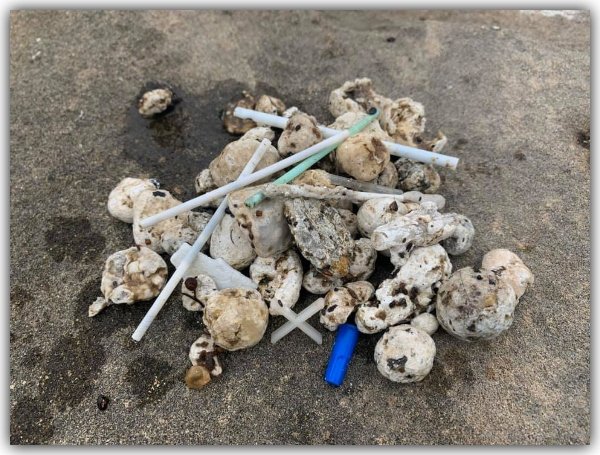
Some of the fatbergs, plastics, cotton buds and other assorted junk collected from Shelly Beach in February this year, before the new screens were added to the Wannon Water plant. Image: Pick up Sticks FB page.
After the nurdle spill in November 2017, Wannon Water announced plans to improve the screening system as part of its plant upgrade, but these changes were slow in coming.
A second, manual fine screen was finally added earlier this year, and a fully automated, $1.1 million screen was installed in April …. and no wonder.
Because what happened in between times was a big, fat pollution abatement notice was issued to Wannon Water by the EPA in February.
This notice confirmed what was always suspected: the manual screens were not always doing their job.
In fact when the EPA visited the treatment plant last November, the screens were 100% blocked and effluent, it said, may have flowed over the top.
Whats more, the EPA went back to the plant in January this year and actually saw the effluent overtopping the screens.
Not only that, the EPA visited the rock pools at Shelly Beach that same day and, guess what?
They found five fat balls and many smaller pieces of fat in just one rockpool: slam dunk proof of a failing system.
This is a story that I wanted to write two months ago, but it got bumped in the Covid 19 news whirl.
But it’s an important vindication of the hard work and pressure and activism by Colleen and the dozens of other activists who form the clean up crews: they were right all along, and now the EPA notice proved it.
The EPA notice ordered Wannon Water to fix its screening system by no later than 15 June this year, which it has done, and the Shelly Beach rockpools are the cleanest they have been in years.
There is no doubt in my mind that the sustained pressure of Colleen and the beach clean up crew has helped this to happen.
And yet, even now, Wannon Water can’t quite bring itself to say just that.
“The manual screening system, installed in November 2017, has performed extremely well and has been very effective,” managing director Andrew Jeffers said to me via email.
No, actually, it didn’t perform “extremely well” and it should have been improved years ago.
The fight to clean up our beaches from plastics and pollution goes on, but the small victories and vindications are worth celebrating and so, as Rod Stewart would say, tonight’s the night.
Time to press the re-set button at the next council election
It has been an interesting four years, to say the least, since the last Warrnambool City Council election. The next election will be held on 24 October.
Carol Altmann – The Terrier
In less than six months, on 24 October, we get to vote on a new Warrnambool City Council: the people who will be our eyes and ears for the next four years.
It is a chance to press the re-set button and, my word, we desperately need a re-set.
I know it’s not easy to put your hand up to be a councillor, but it’s astonishing to watch how quickly some councillors lose sight of why they were elected in the first place.
Self interest, personal ambition, old ties, an unwillingness to challenge “old” Warrnambool …..all of these things combined have crippled our councillors and – collectively – they have lost our trust.
Trust, honesty and openness is all we ask for.
We don’t want councillors who are more concerned about building their profile so they can run for Parliament, which seems to be the case for at least half of the current batch.
Trust, honesty and openness should not be hard…and yet it is.
That’s what we looked for when we all voted in 2016.
But what did we get? We got a council that took its eye off the ball.
We had a city centre upgrade that blew its budget by $5 million. We have parking fees that – until the pandemic – were killing the CBD.
Until the pandemic, our rates were due to increase by almost double the state cap for two years in a row.
We had outright abuse of council credit cards on food and wine, with some councillors sitting right at the table.
We had a Mayor actively discouraging journalists from investigating things like this credit card abuse.
Another four years down and there is still no plan for the bleeding bull of Flagstaff Hill. (Our tourism manager resigned almost a year ago and has still not been replaced.)
Staff morale has been in the toilet, with top level resignations and claims of bullying that just wouldn’t go away. Whistleblowers were not protected, but effectively forced out.
(The councillors may not be able to direct “operational” matters, but they sure as heck have a duty to ask the CEO what is being done about these issues.)
And we have had so many conflicts of interest that would never pass the pub test, I have lost count.
Bringing up any of the above used to be sacrilegious: “you are so negative!” “What about the positives?” “Why don’t you run for council then?”
But the people have since found their voice.
In the past four years, the best performers have been the people of Warrnambool: you have been the bright lights.
I am just now waiting to see which of these lights finds the confidence and courage to run in October – start thinking about it now.
Not drowning, saving: shire councils show the way with C19
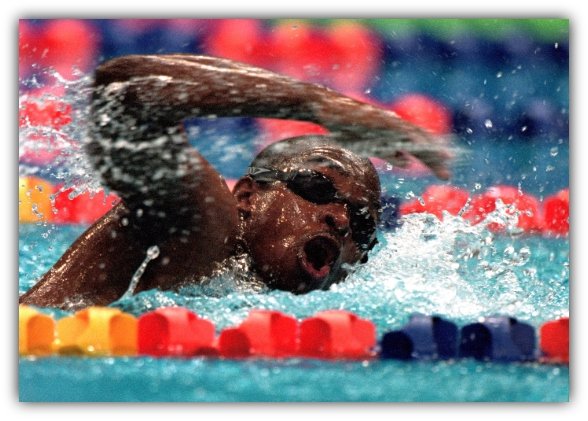
Smaller councils have been doing something of an “Eric the Eel” in response to Covid-19, showing a strong performance compared to their bigger neighbours. Image: Newstatesman.com
Carol Altmann – The Terrier
There’s something very “Eric the Eel” about how well the smaller councils are keeping afloat during the financial fallout of Covid 19.
Do you remember Eric (pictured)? He was an athlete from that great swimming nation of Equatorial Guinea…ahem….and therefore the one least likely to out-swim his fellow competitors in the 100m freestyle heats at the Sydney Olympics.
But – against all odds and with some good luck – he slogged through and won the day.
I feel like I am watching Eric in action when I read that both Corangamite Shire and Moyne Shire are planning a zero per cent rate rise next financial year.
This means nought, nada, nothing will be added to the rate in the dollar amount from this year.
Warrnambool City Council, which has double the population and double the budget, has been kind enough to defer its 4.5 per cent rates wallop for a year and offer us “only” a two per cent hike.
How kind. No wonder almost 200 people have reportedly already applied for help.
WCC expects a total budget of $76.6 million to spend next financial year.
Compared to the “Erics”, Warrnambool is the Ian Thorpe in the public pool: Corangamite will have a total of $49 million to spend and Moyne just a smidge less.
And yet….
And yet Corangamite will spend $14 million on building works, while WCC will spend $18.5m: not that much higher. Moyne will spend $18.1m.
Corangamite expects to record a deficit of just $120,000.
WCC is looking at a deficit of $1.5 million.
And Moyne, just to be totally “Eric”, expects a surplus – a surplus – of $800k.
But here is the real clincher: while the WCC is putting off staff to save money, Corangamite is hiring staff as part of a $5.2 million C19 recovery package.
A $5.2 million package and hiring? How on earth does it do it?
What Corangamite and a lot of other councils did was apply to the State Govt for a thing called the Working for Victoria Grants and it received a sweet $2.3 million smackeroos.
This has allowed Corangamite to create 45 temporary jobs over the next six months. Brilliant move.
WCC has announced a $1.9 million C19 recovery package – less than half of Corangamite – and there has not been a single word about any hirings.
I was going to ask the WCC whether it had applied for a Working for Victoria Grant, but I learned the W’bool Ratepayers’ Association got in before me and has already asked this question.
They have allowed me to share the response from our CEO:
“WCC put in an initial expression of interest and are still working with the fund managers.
No decisions have been made by them and no timeline has been provided on the outcome.”
Uh oh. This gives me a sinking feeling.
I have this terrible sense that when the starter’s gun went off – “go, go, go!” – we were left standing on the blocks.
In the meantime, Eric – little Eric – has just tumble turned and is well and truly into the second lap.