Can W’bool break its coffee cup habit?

The environmental message is clear: we need to ditch paper cups, even recyclable ones. Image: Responsible Cafes.

By Shane Wilson*

Walk down Liebig Street from 8.30am on every weekday, and come to think of it weekends, and you will see the hastened step of the army of coffee addicts. Head down, almost caressing the plastic lid of their disposable coffee cup, infused by caffeine.

I will be clear, this piece is not about bagging out coffee lovers. That would be hypocritical, as I love my morning and lunch time coffee from my favourite café. There’s plenty of vices out there and if yours happens to be coffee, then there is no argument from this corner.

But, and I think this a big BUT, coffee drinkers are becoming an environmental scourge, the equivalent of those despicable nicotine addicts who think it is their right to flick butts on to the footpath and by stubbing it out with their foot, it will disappear.

Former Chaser rascal Craig Reucassel reports in his recent ABC documentary War on Waste that it takes 50,000 coffee cups to fill a Melbourne tram. An interesting stat, but even more so when he makes the point that this is the number of coffee cups Aussies dispose of each half hour.

The cups are typically plastic lined and not bio-degradable: 50,000 every 30 minutes, one billion a year, destined for landfill.
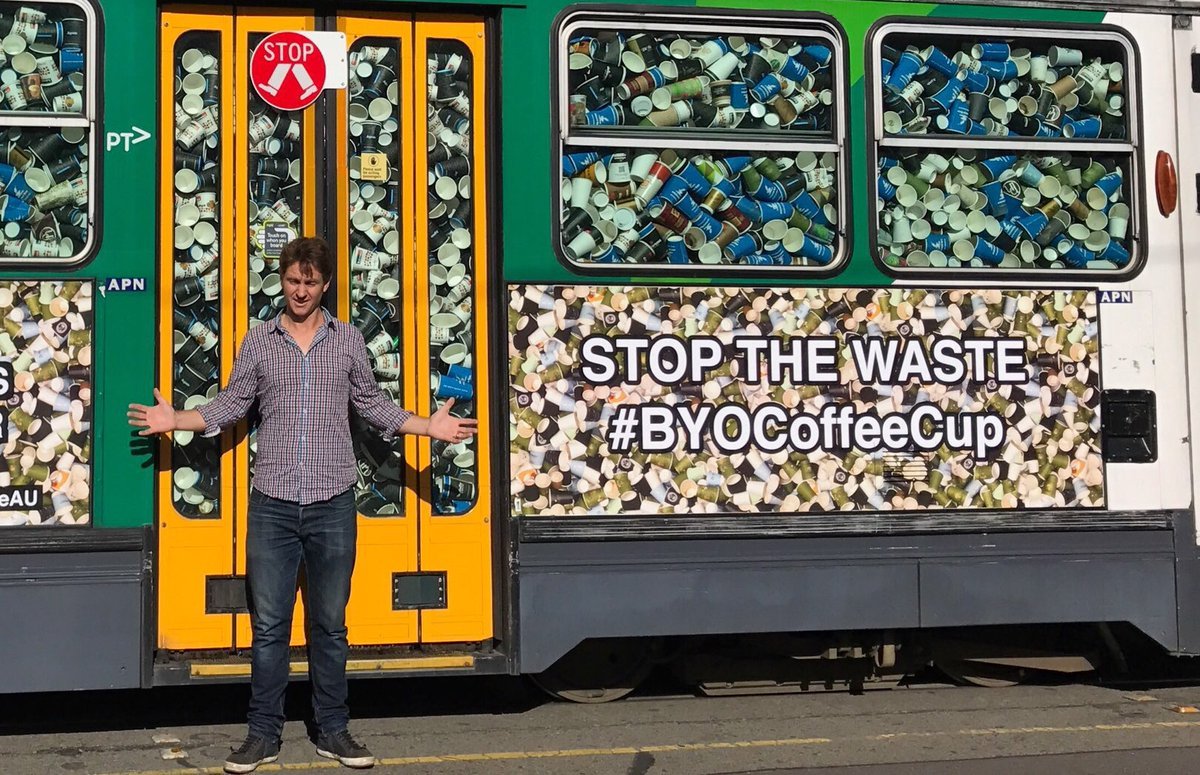
Activist and comedian Craig Reucassel made a strong visual point by filling a Melbourne tram with the number of coffee cups thrown away every half hour in Australia. Image @craigreucassel, Twitter.

[dropcap style=”font-size: 45px; color: #8cc7d0;”] T [/dropcap]his coffee-sipping generation has been hammered in one ear about global warming and in the other about living and eating clean and green.

It’s not as if the environmental message is not being delivered. It’s just that it is not being heard. Or perhaps, Generation Now would rather promote their own immediate needs – a craving for caffeine – over a little bit of social responsibility.

But does it have to be this way.

Our town with a little good fortune (a regular, cleansing sea breeze and frequent rains) presents as a clean tidy green village.

We can build on this.

So let’s all support the push by the Leadership Great South Coast (LGSC) to completely phase out non-reusable coffee cups.

The LGSC has been urging local cafes to join the national Responsible Cafes campaign that goes further than recycling cups.

The campaign suggests, and I agree, that single-use cups be banned altogether and we bring our own, reusable cup.

If this sounds unachievable, just think for a moment on how we now all carry our own shopping bags (unless I leave them in the car!) to reduce the use of plastic bags.

As a city, we can all get behind the byo coffee cup campaign: promote it on the banners at roundabouts in the town. Bang the message out on Facebook. Talk to the schoolkids and let them know why the adults are doing this. For once, our generation can lead by example!

In our town, with leadership and meaningful discussion with our cafes, I am sure we can succeed.

The war on one-use coffee cups is going global – and Warrnambool could lead the way. Image: Beevoz

[dropcap style=”font-size: 45px; color: #8cc7d0;”] S [/dropcap]ome Warrnambool cafes, including Country Life cafe, Brightbird Espresso and Piccolo Coffee Roasters, are already taking on the environmental message by offering bio-degradable cups, selling re-usable cups and offering discounts to those who remember to bring their cup.

Warrnambool City Council is also one of the few councils which recycle coffee cups.

But recycling is not the only answer.

Unless coffee cups are disposed into recycle bins and are then appropriately recycled, it all counts for nought.

Bio-pak, which makes bio-degradable cups, state that if their cups go into landfill, they do not break down. Oxygen is required and unless the cups go into the right bins and the council ensures that the cups are correctly recycled, it’s all just more landfill.

In this day and age, with issues such as Adani’s Carmichael coal mine, the degradation of the Great Barrier Reef, and the enormity of climate change generally, people tune out.

It’s all too hard and such issues are typically outside an individual’s field of influence. On this issue, however, Warrnambool can make a difference and be an example for other towns to aspire to and in the process do good.

Yes, it’s difficult, but let’s cut to the nub of this challenge: no more single-use coffee cups in Warrnambool.

Next time you buy a coffee at your local café, take it with a teaspoon of social responsibility and I bet it will taste even better.

[author] [author_image timthumb=’on’]http://www.the-terrier.com.au/wp-content/uploads/2017/07/wilson.jpg[/author_image] [author_info]Shane Wilson is a Warrnambool solicitor, a cyclist, an activist and a coffee nut. He will write occasionally on local issues that stir discussion.[/author_info] [/author]


Could we play our own Trump card?

US President Donald Trump rose to power largely on the back of shallow slogans and thin policies: could we see a similar ascension here? Image: Business Insider.

By Tom Waterwheel*

Australians seem to view the rise of Trumpist populism with bemusement and alarm.

The daily trainwreck of Donald Trump and his advisors keeps the political junky on high alert.  As if the Trump Bull-in-a-China Shop was not entertaining enough, we now have puppet master Steve Bannon, the anti-intellectualist Sean Spicer and Dial-a-fact Kellyanne Conway sharing the burden of spreading hate, pseudo facts and fear around the globe.

Trump is no lone ranger.  For the price of one, the US, and by extension the world, got Trump and his posse of war-mongering deadbeats, who now occupy the White House because of the collective brain-out of 63 million Americans.  Most may by now regret this, but the race was run and won on November 8, 2016 and on that day, too many Americans put number one next to the man who unashamedly campaigned on lies, sexism, racism, war-mongering and plain dumb economics.

The question is: could it happen here?

Trump tapped into a nationwide attention deficit disorder.  For whatever reason the punters en masse didn’t take the effort to read politics beyond a 140 character tweet.  Those of us left bewildered by what we have seen blame Facebook, Twitter, I’m a Celebrity get me out of here, the media etc..

None of that matters.  Trump and Clinton faced an increasing number of voters who do not do policies.  Instead, they want solutions, quick, easy and on a plate; and on that front Trump was their man.

Where Clinton had thoughtful and considered responses to the challenges facing the USA, Trump had solutions and a little abuse thrown in, 140-characters-or-less.  Few of which made sense.  But at least Joe Punter heard the solution with little effort. (And he is still at it).

In Australia, we have seen politicians tread down this same path.  The 2013 election where Tony Abbott prevailed, was characterised by fear politics.

On the specific policy issues of asylum seekers and climate change, Abbott blazed a trail that Trump made a highway.  Whenever a microphone is close, these ‘leaders’ simply repeated the mantra that progressive policies on asylum seekers and climate change will take jobs away from middle Australia/America.

Trump and Abbott on asylum seekers: “stop the boats”, “build a wall”, “stop the boats”, “build a wall”.

Trump and Abbott on climate change: “great big tax”, “Chinese conspiracy”,  “great big tax”, “Chinese conspiracy”.

Abbott handed the baton to his neo-conservative colleagues across the Pacific, and run with it they did.

But as we witnessed, Abbott’s ill-considered neo-con policies did not wash with everyone in his party and his stay at the Lodge was cut short.  Perhaps Trump’s stay will be short too, however the US political system does not work as does ours, with leaders not so disposable.

Like a phoenix rising from the ashes, Pauline Hanson’s political career has been resurrected. Image: Alchetron.

Our own redhead, Pauline Hanson, is our closest version of Trump and it is when we look to her appeal and increasing popularity that we see Trumpism alive and well in Australia.

What is telling about the Hanson effect, is that she, like Trump, appeals to a scattering of the disaffected across the political spectrum from the far right to the traditional working class left.  She, like Trump, speaks to their frustrations, often to their yearning of the old days, when unskilled jobs were seemingly abundant and Australia was by and large a white, Christian society.

Fear is one of our greatest motivators and Pauline does fear well.  Furthermore, times are tough for many, and as the USA has experienced over the last decade, the winds of global competition can be unforgiving, and we in Australia are now starting to feel its effects.

In a connected world where capital moves freely across the globe, old stable economies such as Australia, have much to lose.  To deal with the acceleration of change, be it capital inflows and outflows, refugees, climate change and so on, requires intelligent, considered responses.

We have seen little of such, indeed the short-term opinion poll obsession of our major political parties suggests the established political class are more focused on short-term survival over long-term intellectual policy, leaving the door ajar for the Prophets of Doom.

So here we are, mid 2017.  The UK has lurched towards nationalism in an increasingly global world; the USA has fallen for anti-intellectualism in an ever more complex and sophisticated world; and the French, as did the Dutch, looked closely at following the far-right option.

This at a time when more than ever refugees are escaping poverty, war and political and religious persecution.

When unemployment goes up, so does the appeal of neo-conservative approaches to climate change and asylum seekers. Image: FrumForum.

As it stands, one important ingredient is missing in Australia to cook up a Trump Stew: high and long-term unemployment.

Australia’s unemployment rate is 5.9%.  Australia is yet to swallow the bitter medicine of a changing world economy where jobs are replaced by robots, computers and machines and unskilled labour exported off shore.

Rest assured, however, it is coming and recent history demonstrates that Australian politicians offer little in the way of long term policies to enable Australia to adapt to an ever changing world.   If Australia’s economic fortunes nose dive and unemployment tilts up, a reactionary politician may be the sole beneficiary.

Our seat of Wannon doesn’t follow national trends: its voters are unquestionably loyal to the conservatives.  Wannon will go where the Liberals take them.  If Canberra judges a hard right Trumpist is needed to lead the Coalition, then of course they could expect to count on the vote of the Wannon constituents to support them.

Having witnessed Trump in full flight, would we be wise enough to stand up and say no?

* Tom Waterwheel is the pseudonym of a local political observer and agitator who, because of the constraints of his day job, cannot write publicly under his own name. 


When the heart hardens, the community hurts

Severe cuts by Fairfax to its regional newsrooms has seen the loss of experienced hands like Peter Collins and Peter Fletcher who, between them, had 80 years’ experience at The Standard.


By Jim Clarke, former editor and general manager of The Standard.

[dropcap style=”font-size: 35px; color: #8cc7d0;”] A [/dropcap]s Australia’s two major publishers continue along their death-by-a-thousand-cuts policies in the bush, it was heartening that the ABC announced it would create 80 new positions in regional areas within 18 months.

ABC regional editor for Victoria and Tasmania Mark DeBono told me most of the regional positions would be for reporters and there would be a small number of digital producers. ABC managing director Michelle Guthrie said the appointments would increase the ABC’s digital and video output from rural and regional Australia.

In making this commitment, our national broadcaster has recognised that communities beyond the metropolitan borders have particular needs and also represent significant markets; a recognition that has long escaped News Limited and Fairfax Media.

The two publishing giants bought their way into the regions and, despite many talented staff’s commitment and empathy with their communities, their presence always was a matter of dollars – and never more so than today.

Newspapers were considered to be essential for the communities born of our earliest settlers. The first Australian newspaper, Sydney Gazette and New South Wales Advertiser, was printed in 1803.

The oldest newspaper in Victoria is the Geelong Advertiser, which was founded in 1840 and also is the second oldest in Australia. In the south-west, the Portland Observer was launched in 1842 as the Portland Guardian, while its now-partner the Hamilton Spectator was established in 1859 as the Hamilton Courier.

Along the track, the Colac Observer appeared in 1866 and later became the Colac Herald. The Standard began informing the Warrnambool community in 1872 and the Camperdown Chronicle began publication in 1874.

Each of these newspapers has made a major contribution to their communities. Indeed, to varying degrees they have become an active part in the community, some more positively than others.

The future: ABC South-West journalist Brigid Judd was last Friday named Young Journalist of the Year by the Melbourne Press Club.

[dropcap style=”font-size: 35px; color: #8cc7d0;”] K [/dropcap]

athryn Bowd, of the University of South Australia, summed up their role in a 2003 study: “Australian country newspapers demonstrate a focus of their local community or communities which appears to be much stronger than that of their metropolitan counterparts,” she wrote.

“This focus is generally reflected in an emphasis on local news and the promotion of local concerns, individuals and achievements.”

Bowd’s research involved non-daily papers. It excluded newspapers such as The Standard and the Ballarat Courier, but her conclusions can be equally applied to the regional dailies.

“Country newspapers are a central part of the news and information network in towns and regions,” Bowd concluded.

“Not only are they a key, and sometimes the only, source of local news, they also provide a wide range of local information, from birth notices to weather reports and sports results. This local focus raises questions about whether such newspapers fulfil the same roles as their metropolitan counterparts or whether they are different in some fundamental way.”

And of course they are different.

With restructuring and cutbacks at The Standard and reduced local coverage by 3YB and regional television, the Warrnambool community is being short-changed.

Fairfax Media closed its Melbourne printing plant and moved production of several publications to Ballarat. Now, The Standard is slotted into a daily production schedule that includes The Age, Ballarat Courier, Bendigo Advertiser, Australian Financial Review and a host of other titles.

This means The Standard’s daily production deadline has been brought back to about 10.45pm. I understand that if an event such as the Grand Annual Sprintcar Classic is pencilled in in advance, then The Standard can arrange a swap with another publication to secure a later deadline to allow fuller coverage.

But staff cuts and other cost savings have a more profound impact on The Standard’s ability to serve its community.

No longer are there sub-editors – those pedantic journalists who check, correct and tweak reporters’ copy and compose headlines – so there are more errors appearing in print and online.

Broadcaster Jeremy Lee, left, does what he does best on the ABC Morning Show in Warrnambool. Image: TimeTwins/ABC

[dropcap style=”font-size: 35px; color: #8cc7d0;”] W [/dropcap]

ith repeated redundancies, the depth of the newsroom has diminished. In last year’s round, The Standard farewelled many veterans, including Peter Fletcher and Peter Collins, who must have shared 80 years’ experience at the paper.

Fletch and PC were local encyclopaedias, involved in their community and were just a call across the desk when a reporter needed a gap filled or a point clarified. I am sure the current team is dedicated and skilled, but nothing can replace the knowledge and the understanding of community nuances that Fletch, PC and a host of other experienced locals gave The Standard over the years.

I requested a discussion with Fairfax Media but my approach was declined.

Meanwhile, as News and Fairfax closed and integrated newspapers across the country, the ABC put new money into regional centres.

The people of Warrnambool and the Southwest were beneficiaries. Over the years, the ABC’s presence in the region has expanded. Jeremy Lee presents the daily 6.30-7.45am Breakfast program from the Warrnambool studio he shares with award-winning reporter Bridget Judd*.

Interestingly and a sign that not only newspapers are evolving with more sophisticated technology, Mark DeBono does not refer to ABC regional journalists. They are reporters.

“Most are graduates and are switched on technically,” he said. “They come to us this way and we adapt their skills. They do much more than write.”

So, what can regional communities expect of their traditional, mainstream media in the future? Sadly, not much I am afraid, except for the ABC. (Which leaves a gap for nimble, grassroots websites like what you are reading now.)

That is not because of lack of effort, skills or commitment of staff in Warrnambool and elsewhere, but because of cash/profit driven senior executives in Sydney.

The community heart of the likes of Bruce Morris in Warrnambool, the Beks in Hamilton and the Gannon family in Colac has long faded in the corporate headquarters.

It is unfortunate that those executives in Pyrmont and Surry Hills do not understand that their decisions are transportable and will have an impact well beyond the bush.

* Bridget Judd was named Young Journalist of the Year last Friday by the Melbourne Press Club. Her prize is return flights to the US, accommodation and registration at this year’s Investigative Reporters and Editors conference in Phoenix, Arizona.

[author] [author_image timthumb=’on’]http://www.the-terrier.com.au/wp-content/uploads/2017/03/jim-clarke-1.jpg[/author_image] [author_info]Jim Clarke is a former senior journalist at Fairfax Media. He was editor of The Standard 1980-85 and returned as general manager for another three. Jim later became chief executive of Fairfax’s BRW Media. He won a Walkley Award for a follow-up of the 1983 Ash Wednesday fires he wrote for The Age and The Standard. Together with a dozen Standard journalists, Jim was highly commended in the 1983 Graham Perkin Australian Journalist of the Year Award. [/author_info] [/author]