Patloch Lane an opportunity gone begging

patloch lane
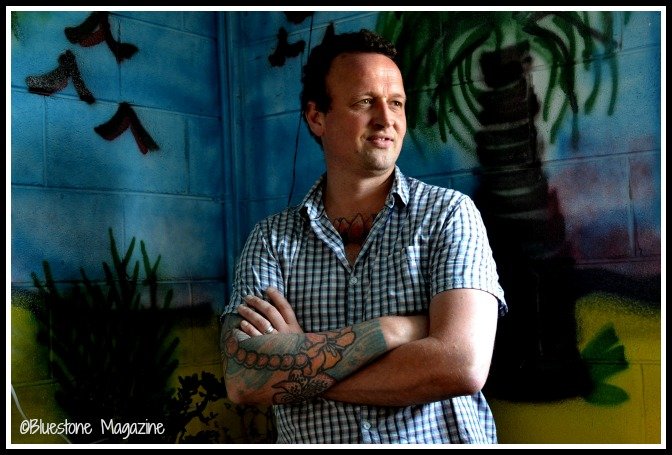
Warrnambool’s Patloch Lane has had a makeover, but nothing like what was originally proposed and remains largely unused. Image: Bluestone Magazine.

Analysis – Carol Altmann

[dropcap style=”font-size: 60px; color: #A02F2F;”] B[/dropcap]efore I write one word about the upgrade of Patloch Lane – the first of what is intended to be several lane upgrades around the Warrnambool CBD – let me say this: all of the artists involved have done great work.

It is not their fault that the rushed job that became the laneway upgrade is nothing like what was originally proposed and does not address some of the fundamental issues that were raised for this thoroughfare, including that very few people used it, and they still don’t.

I doubt, for example, that many people have sat on the two stunning, spotted gum seats hand-crafted by Lillier Fine Furniture. These bench seats are totally wasted by being stuck at the very end of the lane: they should be in one of the main streets – Liebig, Lava, Timor or Koroit streets – where the seating is metal, peeling and plain ugly.

gift subscription pic

Warrnambool City Council, for all of its grand plans, has a tendency to go for near-enough-is-good-enough and what is often promised is rarely delivered in full or at a level of quality where it can work well for years.

This applies to the big things – such as the upgrade of the Warrnambool railway station precinct which in 2010 was flagged to become a “public space that the city can be proud of” but remains a pedestrian/traffic nightmare – right down to one of Cr Peter Hulin’s favourite topics, the $100,000 disabled access ramp at the main beach which is regularly buried in sand.

It is one thing to bring in the experts to help develop inspiring plans, but it is another to actually deliver these plans through a combination of lobbying state and federal governments for funding, combined with clever decision making and prioritising at a council level.

Which is why I am writing this piece, because there are lessons to be learned from the microcosm of Patloch Lane as Warrnambool waits patiently for the long-awaited upgrade of Liebig St that has been years in the making and is now expected to start in 2017,  a year later than hoped.

If we can’t get one laneway just right, what are the hopes of getting an entire street upgrade right without the temptation of cutting corners, or by-passing the input of the experts? Both of these things happened with Patloch Lane.

Let me explain.

sand removal
Council workers were last week again removing sand from the disabled access ramp at Lady Bay which has been a constant problem since it was added in 2011. Image: Bluestone Magazine.

[dropcap style=”font-size: 60px; color: #A02F2F;”] T[/dropcap]hrough a combination of Freedom of Information applications, questions to council and talking directly with people involved in the original Patloch Lane project, Bluestone has been able to piece together a picture of a lost opportunity to do something truly special for the city.

In a nutshell, Patloch Lane was to be a functional and striking art project that grew from the council’s Hidden Histories project, a series of art events that tapped into the lesser-known stories of our city. (The State Government provided $150,000 for the Hidden Histories project, including the laneway works).

Patloch Lane was intended to show what was possible, while at the same time becoming the first link in a chain of integrated laneway upgrades across the CBD, rather than a mish-mash.

liebig st_6
Potholes pock-mark the southern “restaurant” end of Liebig St, just a short walk from Patloch Lane. The long-awaited upgrade of Liebig St is now expected to start in 2017. Image: Bluestone Magazine.

[dropcap style=”font-size: 60px; color: #A02F2F;”] T[/dropcap]o this end, in late 2013 the council invited the highly regarded Professor Paul Carter and his team from the School of Architecture and Design at RMIT University* to oversee the Patloch Lane design as part of a wider brief to develop a “Hidden Histories” public art strategy for the CBD. (*RMIT was paid $53,625 for its work on the Hidden Histories project).

In consultation with the council and community stakeholders, Prof Carter and his team developed a concept – ‘Breaking Wave’ – that included a canopy structure down Patloch Lane, new paving that could be engraved as an artwork, light sculptures and an audio installation that would recreate the sound of a wave breaking as you walked through the lane, giving people a huge incentive to use it.

It was bold and exciting and was budgeted at around $90,000 – which is what the council had earmarked for the laneway – excluding engineering works and new paving to replace the cracked concrete which, as Prof Carter had pointed out, was a basic necessity for any upgrade in Patloch Lane.

breaking wave
An artist’s impression of the ‘Breaking Wave’ canopy structure over Patloch Lane that would have included an audio installation and light sculptures. Image: Material Thinking.

[dropcap style=”font-size: 60px; color: #A02F2F;”] T[/dropcap]he council was inspired enough to ask Prof Carter to provide a detailed breakdown of costs. That was in late 2014 and Prof Carter, in turn, asked if the council could provide an estimated cost for the engineering works and paving.

It was never provided, so Prof Carter suggested developing a scaled down version of ‘Breaking Wave’ at the laneway entrance, which would be a much cheaper option, but still a ‘lure’ for passersby.

Again, this went no further, so Prof Carter submitted his Hidden Histories public art strategy in early 2015 which included recommendations on how ‘Breaking Wave’ could be developed, and left it there.

What Prof Carter didn’t know was that the council in late 2014, around the time he was asking for engineering costs, had already hired another consultant (One Design Collective) to help bring a different version of Patloch Lane to life.

The “upgrade” itself was all done within about three weeks from early June and, despite being involved since 2013, Prof Carter was told nothing about it.

patloch lane2
Hello? Patloch Lane photographed on a typical Friday afternoon. Image: Bluestone Magazine.

[dropcap style=”font-size: 60px; color: #A02F2F;”] A[/dropcap]nd while the Patloch Lane artists – including Fiona Clarke, Kate Gane, Jessica Meggs – have done a great job with the “ocean” brief they were given, the final $52,000 project was ultimately done in a rush and on the cheap.

(By comparison, as Bluestone has written this week, $178,000 is being spent re-tiling the Aquazone changerooms…)

The whale etching, for example, is engraved into cracked old concrete that will eventually have to be replaced, and there is still no incentive for anyone to actually use the laneway. It is already looking unloved.

All of these same artists could have been involved in bringing something truly special to life: what a wasted opportunity.

In the meantime, Prof Carter remains hopeful his ‘Breaking Wave’ will still show up somewhere in the CBD renewal.

I hope he is right.

[box]The full breakdown of the Hidden Histories $150,000 project fund: $29,536 – Patloch Lane physical works; $22,827 – commissioning artists work in Patloch Lane; $8690 – One Collective Urban Design Studio, Patloch Lane upgrade consultancy in Jan/Feb 2015 ; $53,625/$4950 – RMIT University/Material Thinking for “Hidden Histories: A Public Art and Spaces Strategy” and development of concept plan for Patloch Lane, both overseen by Prof Paul Carter, Aug 2013-Feb 2015; $32,000 – The F Project, Hidden Histories Laneway Festival Jan-May 2014 including a Patloch Lane mural.[/box]

newsletter Eat And Drink StonesMore reading – Have you seen what’s in The Vault?


The WCC’s big shed shemozzle, part 2 

Behind the scenes of an ugly pre-selection battle or ‘How Michael Neoh lost Liberal support’


Artery is pumping and here’s what’s next…

helen emma_small
Some of the faces of the F Project: president Dr Emma Charlton and vice president Helen Bunyon, who are part of the seemingly tireless team operating The Artery in Warrnambool.

By Carol Altmann

[dropcap style=”font-size: 60px; color: #A02F2F;”] T[/dropcap]he success of The Artery art space in Warrnambool since opening just over two years ago has been nothing short of extraordinary, and it is getting bigger.

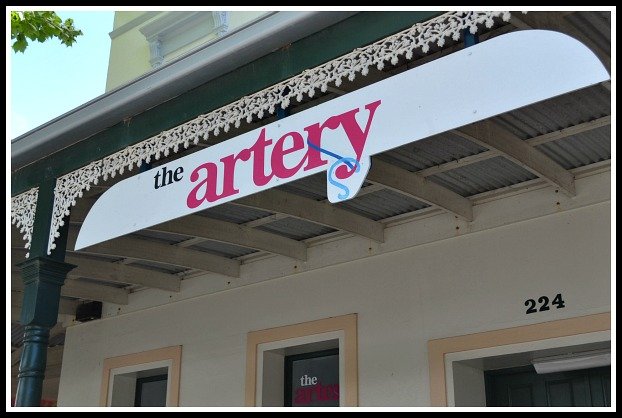
The F Project – the volunteer art collective behind The Artery – already manages 30 artist studios, a community gallery space and a retail shop and, before the end of the year, it will take over the five-bedroom, top floor of the Timor St building to accommodate a visiting artists and artists-in-residence program.

gift subscription pic

As F Project president Dr Emma Charlton explains, the expansion is the next step in a five-year plan to build The Artery into a dedicated arts space that serves local artists and visiting artists, while at the same time building a strong arts presence in the community.

“A large part of The Artery is about getting art out into the community and to develop an appreciation of the arts in our community, and I think we are certainly achieving that,” she says.

artery_11
The F Project has hit it straps since leasing the former funeral home in Timor St and creating, The Artery.

[dropcap style=”font-size: 60px; color: #A02F2F;”] P[/dropcap]rior to leasing the former Guyett’s funeral home at 224 Timor St, the F Project – which started in 2008 –  had a less prominent space upstairs in what was the old Fletcher Jones shop on the corner of Liebig and Koroit streets.

But as vice president Helen Bunyon says, creating a new, street-front premises has been a game-changer.

“It really has created a central contact point for the arts in this community and has taken off like topsy. We always have people dropping in, coming to ask questions, or wanting to become involved,” she says.

Emma adds that The Artery has become a way for new artists who arrive in town to find an immediate audience and creative network.

She gives the example of artist Caroline Healey, originally from the UK, who recently moved to Warrnambool and volunteers as the group’s public relations officer. Largely through her connections with the F Project/Artery, Caroline has already established a following for her work and will soon hold an exhibition.

pye mural artery
The striking kookaburra mural by Nathan Pye and Jim Sargent outside The Artery: one of many murals around the city that have been coordinated by the F Project.

[dropcap style=”font-size: 60px; color: #A02F2F;”] A[/dropcap]s it happens, the gallery space – which is hired out to artists and hosts various art events such as the South-West International Women’s Day Art Prize – has a fully booked calendar for 2016.

As such, it has virtually replaced the original intention of the Alan Lane Community Gallery at the Warrnambool Art Gallery.

The 30 studios wax and wane in occupancy and some artists have moved on to set up their own professional studios at places like Factory Arts, in the former Fletcher Jones factory.

There is no doubt, however, that the F Project has become integral to just about every community arts event in Warrnambool.

This includes the Warrnambool City Council’s ‘Hidden Histories’ project that saw 10 different events held in the city’s laneways, to Arts on the Grass, to the murals appearing in laneways, the Fletcher Jones Christmas picnics, the refurbishment of Patloch Lane, numerous arts markets, and even the replacement of the city’s tired Christmas decorations.

But is it too much for a volunteer group?

artery_8

[dropcap style=”font-size: 60px; color: #A02F2F;”] U[/dropcap]nlike the Julia St Creative Space in Portland, The Artery/F Project receives no council funding other than that provided to fulfil specific projects such as the laneways.

Julia St is also volunteer based, but has a part-time Community Arts Officer employed by the Glenelg Shire Council and operates in a council-owned building.

The WCC no longer has a community arts officer, but is reaping the many benefits of having the F Project/Artery fill the gap for free.

Neither Emma or Helen wish to get into the politics of council funding, but Emma acknowledges the dependency on volunteers and says the group plans to apply for an Australia Council grant next year to employ a part-time coordinator.

When I asked how many hours they each devote to the Artery/F Project each week, both Helen and Emma answer “between 10 and 20”, although I know they are being modest.

Both are keen to stress that the workload is shared among many.

“We have people involved who bring a whole range of different skills and, for others, it is a way of developing those skills,” Helen says.

“It is a lot of responsibility,” Emma adds. “But the negatives are far out-weighed by the coolness.”

[box]The Artery is at 224 Timor St, Warrnambool and is open from Wed-Sun 10am to 4pm. The retail area sells works by local artists. The current exhibition is Small Gems, the F Project Members Christmas Show, until 3 January. You can find The Artery on Facebook here. P: (03) 55 62 1109 [/box]

newsletter Eat And Drink Stones You might also enjoy…


Discovering the voice of Vanessa Parkinson

No shying away from social commentary: Megan Cheyne

Broken link prompts a fresh start: Jenny Altmann

The quiet contemplation of still life: Jan Allan

Dynamic duo step out on their own: Glenn Morgan & Barry Tate


A year of mid-century designs: Clinton Krause

clinton krause_1Bluestone columnist and architect CLINTON KRAUSE previously worked in Daylesford before relocating his business to Warrnambool. Clinton explores the retro styles that gives our region so much character.
I have just celebrated the first anniversary of my foray into the world of online journalism with Bluestone Magazine and to mark the occasion, I thought I would go back to where it began and recap on a remarkable year of mid-century finds.

With a fascination for the abundant stock of mid-century homes across the south-west coast, I hatched a cunning plan in late 2014 that would not only allow me to further indulge in my love of  ‘house cruisin’ but would also provide a compelling modus operandi to make contact with the owners of these retro gems and even gain a glimpse beyond the front door!

Of course it only seemed fair that I start with on our own home, given I was about to impose myself upon other unsuspecting homeowners…

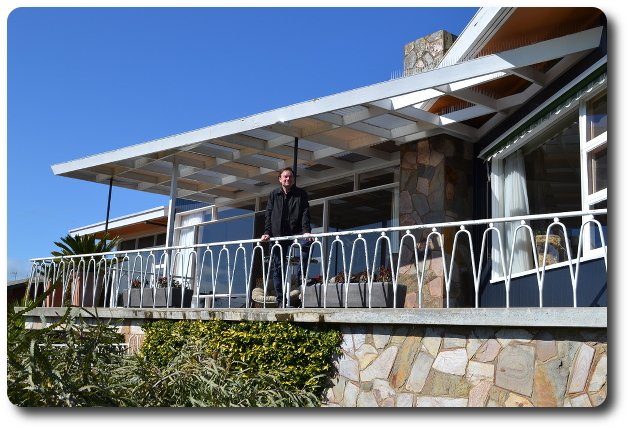
The “expose” on the Krause House proved to be a much bigger hit than I imagined, with many readers commenting that they knew this house from either a connection with the original owner’s (the Downie’s) or because of its striking street presence.

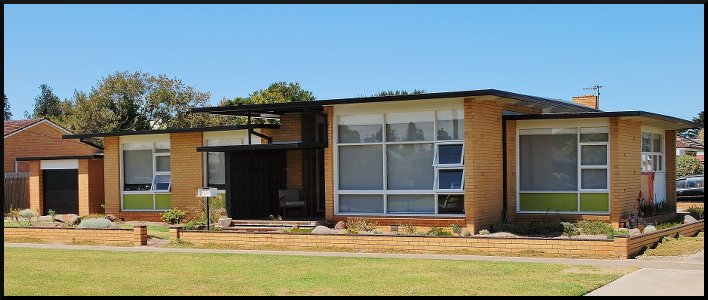
An elegant composition of varying roof heights and window geometries.

With such positive feedback from Bluestone and healthy audience numbers, I decided to jump in the deep end with a forensic investigation into the history of local architectural identity Tag Walter.

Tag’s influence in the mid 50’s thru to late 60’s on the region’s architectural landscape is indisputable and with assistance from sources such as the local history museum, and contact with his daughter Robin I was able to uncover both the professional and personal achievements of this well-respected local.

As good fortune would have it, I would visit a number of Tag Walter designed homes during the year, but meeting the Murphy family and visiting their Walter-designed house in Port Fairy was a highlight for me.

Both Liam and Jo are both keen ‘ retro revivalists ’ and worthy custodians of this ‘little retro ripper ’ but it was Liams  forensic  restoration of the period wallpaper following a mishap with baby Charlie that will always remain in my mind and reassure me that this house is in good hands.

pronto-blend

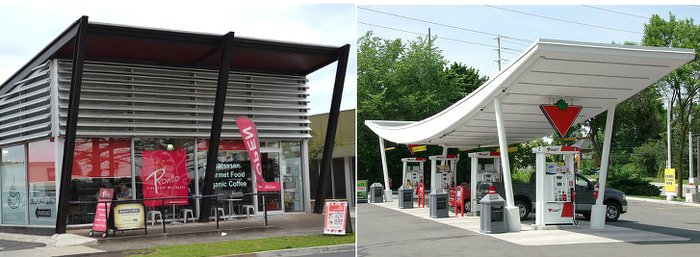
In early 2015 we took a detour from local design into ‘Googie Groove’ and highlighted the influence this flamboyant style has had on some of the local architectural icons of  Warrnambool.

With references to the Jetsons, John Lautner and the Googie Style indicators, Bluestone readers were now well equipped to converse on the subject at any posh gallery launch, haute coutre show, or gala opening – should the occasion arise!

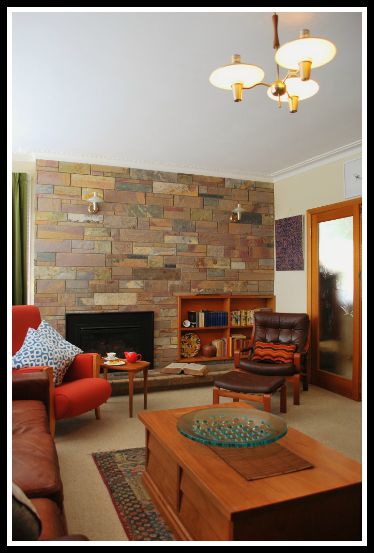
A visit to the wonderful Herbert’s home in February demonstrated how a well-designed Tag Walter home could be fine tuned to become a stylish contemporary residence with all the facilities, flair and flexibility of a modern equivalent.

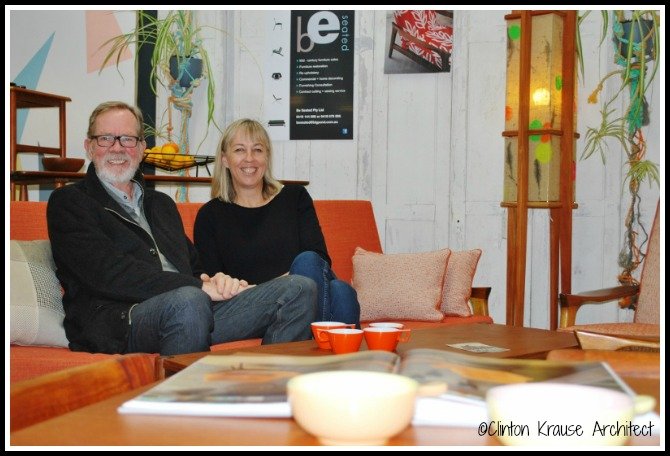
Jack and Megan Jarret reclining in the be seated showroom


[dropcap style=”font-size: 60px; color: #DC943C;”]W[/dropcap]anting to mix things up a little, I devised a two-part road tour that was really just a ruse to drive around town is some of Harry Drostes’  fabulous classic cars.

Harry provided some enjoyable anecdotes about his working relationship as a cabinet maker for Tag Walter and our itinerary also covered some buildings that I plan to return to at some stage in the future.

My visit to Helen’s quirky renovated home in Japan Street was a real delight. I will never forget coming across Marilyn Monroe in her bathroom or the revelation that the wardrobe walls were lined with kaleidoscope patterns of printed shoes (look closely and you will see them).

But it was a trip to Portland to the home and business of ‘Be Seated’ couple Jack Van Roo and Megan Jarrett where I felt like I had hit the motherlode! Not only a great 60’s home filled with fabulous retro furniture, but a business focussing on the renovation, restoration and repurposing of all sorts of mid-century décor.

I can hardly bring myself to mention those fantastic original Featherstone chairs and how much they were bought for – I still weep when I think of it……

5 Altmann lounge

Discovering Golsworthy’s Hardware Store in Mortlake brought home the sad reality of many of these buildings that are now past their glory days.

With the uncertainties of changing ownership, declining demographies and shifting retail habits, I hope that buildings like this one will find a new lease of life in the hands of an innovative respectful entrepreneur.

Having traversed quite a bit of the country-side, for the September column I decided to stroll a few doors down from my own house to the ‘Bluestone headquarters’ staffed by Carol Altmann and Louise North.

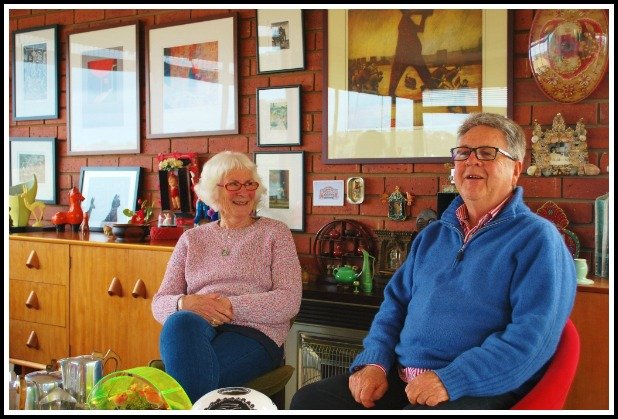
As a touchstone for all things arty and tasteful, it is no wonder that the Bluestone home, like the magazine, is a cornucopia of the stylish, creative, eyecatching  and slightly off centre!  Over tea and biscuits we reminisced about the ‘good ole days’ and really showed our age.

claire and tony

My last article for the year was a cautionary tale for readers…

Seeking an understanding of  what can lie ahead for the avid retro enthusiast, I was directed me to the amazing home of Tony and Claire Drylie. While I personally found their myriad collections of all things wonderful, whimsical and ‘ wayout-there ’ inspiring , be warned – once you develop an eye for the creative, unusual, or even strange, it is only a short step towards complete surrender.

And so with the year drawing to a close, I would like to sincerely thank all those who generously offered up their home, time and privacy and allowed both myself and the Bluestone readers an insight into the wonderful places and people that are the heart of our community here in the south-west.

I have loved writing for you this year and look forward to bringing you more architectural exclusives in 2016.

Merry Xmas

Clinton


The Vault: emails on cost of swimming pool tiles

[author] [author_image timthumb=’on’]http://the-terrier.com.au/wp-content/uploads/2015/11/vault3.jpg[/author_image]Welcome to The Vault – this is where Bluestone will place all sorts of subscriber-access-only material, including information on local politics that should be in the public domain, but isn’t. It is a place where you can also have a look behind the scenes of Bluestone, including our Freedom of Information applications, some email exchanges (where appropriate and when dealing with official spokespeople, not our private sources) and anything else we think you might find interesting. If you have something you would like to submit, please email us at editor@bluestonemagazine.com.au[author_info][/author_info] [/author]

This email exchange between Bluestone and the Warrnambool City Council relates to our piece on the $178,000 cost of upgrading the changerooms at the Warrnambool pool (Aquazone), which included retiling, replacing mirrors and toilet partitions:

——————

Is it correct that:

1. The cost of the tiling and associated works in the male and female changerooms has escalated from $120,000 to more than $180,000?
If so, what is now the expected cost of these works?
(See story from Nov 2014 which refers to $120,000 project: http://www.standard.net.au/story/2709187/temporary-change-rooms-for-aquazone-pool-upgrade/)

No. The contract awarded to (name removed by Bluestone) last year was $178,000 for stages 1 and 2.

(Figure provided to Standard a year ago is likely to have referred to an earlier estimate)

2. Has the contractor had to go back and repair or change work in the male changerooms already completed as part of the contract?

Yes. Some rework on the male changerooms was carried out and work deferred on stage 2 until this was completed.

3. Who is the contractor completing this work?

(name removed by Bluestone)

4. When is the project expected to be completed?

Stage 2 will be completed by the end of November.

—————–

Thankyou.
I just want to clarify, if possible, when the $120,000 budget figure quoted in the Nov 14 story changed to $178,000?
The reason I ask is because, obviously, when this story was published, the work was already underway.
– Cheers,
Carol
—————-

Hello Carol,

The contract was always $178,000.

I can’t recall the explanation for the $120,000 quoted at the time but it is likely that it was either an old figure or it might have related to a component of the project eg cost of materials or cost of labour, or it could have been me not reading correctly my scrawled notes.

My mistake, shouldn’t have responded to the question at the time without double checking but the reporter at the time had said the story was focused on addressing concerns around the inconvenience of the temporary changerooms, not about the cost of the project.

The figure in the Standard story is wrong but it was not the fault of the reporter.

—————-
Thanks for that clarification – and I know how these things can happen. Just a final question on this, is it still on budget at $178,000? ie. is that the final figure given the project is coming to an end shortly?
Cheers –
Carol
————–

Hello Carol,

Final settlement has yet to be made with the contractor and won’t be until the project is completed and our engineers are satisfied with the work.

————-
Got it. Thankyou.
– Cheers, Carol


The artistic face of Christopher Grace

[printfriendly]

Having walked away from a potential career as a photographic artist in his teens, Christopher Grace is returning to his love of shooting with film.

Words and images by Carol Altmann

[dropcap style=”font-size: 60px; color: #A02F2F;”] N[/dropcap]ot long into our conversation across a table outside Proudfoots Boathouse, Christopher Grace lights a second cigarette and leans in: “I realise I fucked up”.

The celebrated south-west chef, who has worked at just about every top restaurant in the region, is not talking about stuffing it up with food, but his first love – art.

He is also speaking of a time when he was not Christopher Grace – which is virtually a brand name – but Chris Grace, a gifted art and music student fresh out of Box Hill Tech, who was accepted into the highly competitive photography degree at RMIT university.

gift subscription pic

He dropped out after two years. Not because the work was beyond him, but because, like for so many uni students, the temptations beyond the tute room proved too great.

“There is a level of self motivation required to succeed at university and I, unfortunately, didn’t have it at that time,” he says with a crooked smile.

What should have been a beginning, became an abrupt ending.

Reaching out - or back - to a love of photography has reignited a creative heart in well-known chef, Christopher Grace, who works with a trusty Nikon F4 film camera.
Reaching out – or back – to a love of photography has reignited a creative heart in well-known chef, Christopher Grace, who works with a trusty Nikon F4 film camera.

[dropcap style=”font-size: 60px; color: #A02F2F;”] C[/dropcap]hristopher left art behind and, like local counterpart Ryan Sessions, fell into cooking (by taking a job at a takeaway joint near the call centre where he was working) and realised he had a knack for the chemistry of food.

His career as a chef has been stellar, including 14 years in the south-west working at celebrated restaurants including the Royal Mail, Merrijig Inn, Portofinos, Basalt and in his current role as manager of Proudfoots but now, at the age of 36, there is a stirring.

“I quit the booze for a while about 18 months ago and had a realisation that I was never going to be content unless I had another crack at photography,” he says.

The only problem was, the world had moved on and digital images and Photoshop had all but replaced film and darkrooms.

“I didn’t own or know how to use a digital camera, and I didn’t want to,” Christopher says.

“For me, it is still about film. Film is really important to me because you make decisions, you control the process, you have an intent and it is so much more rewarding than holding up a computer and letting it take the photo for you.”

chris grace_11
A face in the crowd: one of the 30 best images Christopher shot on film during a recent trip to Bali using the Nikon F4 which, he says, made people feel more relaxed than pointing at them with a smartphone.

[dropcap style=”font-size: 60px; color: #A02F2F;”] A[/dropcap] friend sold Christopher his Nikon F4 film camera, a heavy, full-metal-jacket unit built to withstand a war zone.

Christopher carted the beast across Bali and shot four rolls of precious film with 36 shots per roll. The results are framed and waiting for a wall in his home, where we pick up the conversation.

” I got about 30 images that I really like,” he says, pulling a selection from the pile.

They remind me of photos from the 70s: pre-Photoshop, natural, muted tones, and strangely captivating for this very reason.

“The images have scratches, burn marks, finger prints and some have been developed in old developing fluid, which has created its own effect. They are imperfect and that is the whole point,” Christopher says, his voice animated.

black cockatoo - chris grace
A photograph or a drawing? Christopher’s hand-coloured photograph of yellow-tailed black cockatoo blurs the boundaries – and that’s just how he likes it.

[dropcap style=”font-size: 60px; color: #A02F2F;”] P[/dropcap]art of the appeal of both cooking and photography to Christopher is that they both rely on rules: what works, what doesn’t.

But while he says he “likes rules”, he also likes to bend if not break them.

As Christopher shows me his portfolio of work, which includes photography, collage and spray painted art works, it is hard to tell what is a photo, what is a drawing, and what is a painting. And that, again, is the whole point.

“I will take a photo and hand colour it with pencils or Textas, so it is no longer looks like a photo, but a drawing – but it is still a photograph,” he explains, smiling at the deliberate confusion he creates.

chris grace_9
Christopher with a section a large work, a photograph of gravel on the roadside that is being transformed into something quite different through hand colouring.

[dropcap style=”font-size: 60px; color: #A02F2F;”] I[/dropcap]t is all about the freedom to experiment, explore and maybe even occasionally fuck up, and in this I get a sense Christopher is rediscovering a freedom that no longer exists for him in cooking where, in a smartphone world, food has become an obsession and everyone is a critic.

So while Christopher has set a goal to create 52 art works in 52 weeks – and is on track – he is ambivalent about an exhibition.

“I would love to have a small exhibition, but I am not sure if anybody would come and that doesn’t bother me, because I don’t need other people judging my work when I already judge myself so harshly,” he says.

If any proof was needed of that fact, look no further than the letters on Christopher’s spare bedroom, where much of his art is stored: MONASA.

“The Museum of New and Shit Art,” he laughs.

chris grace_13
A detail from a series of images experimenting with objects laid on mirrors and photographed from above.

newsletter Eat And Drink StonesComplement this story with…


Diving deep into an ocean of risk: Peter Condon

The Stag starts a new chapter in Sessions

Developing a passion for vintage cameras

A life behind the lens: Jack Wilkins

Revealing the eye of the tiger: Peter Clayfield