[dropcap style=”font-size: 60px; color: #A99E90;”] W [/dropcap]atch out wine lovers, we have something very special for you!
This week we are giving our Bluestone Club members the chance to win a delicious bottle of Newton’s Ridge Chardonnay (valued at $28) made by supremo David Falk at his Cooriemungle vineyard.
To be in the draw, you need to be a paid subscriber (aka, a member of the Bluestone Club) and email us the answer to this simple question: what vintage is the bottle of Penfold’s Grange featured in our Tipsy Tips #5?
Email us at editor@bluestonemagazine.com.au. Competition closes February 21.
The winner of this competition was Jan Allan.
T-shirt captures the infamous ‘Cri’
Lawyer ROY REEKIE, who recently returned to live in his home town of Warrnambool, tells us about an item that is dear to his heart in this week’s Treasures:
Roy Reekie with his treasured Cri t-shirt (and matching sunglasses!) outside where the Criterion Hotel stood for more than 140 years before being demolished last year.
[quote]
[dropcap style=”font-size: 60px; color: #0A0A0A;”] I [/dropcap] treasure this t-shirt because it incites memories of the (in)famous, dear-departed Criterion Hotel in Kepler Street, Warrnambool.
The Cri was one of three pubs that my high school friends and I would visit, despite being under-age…
Pat Farrell holding court in the front bar with the Wooden Eye joke is one vivid memory – most likely burned in by repetition.
Cri gigs by Psycho Sloth, the Bondi Cigars and Rollerball all figured highly in the development of my musical appreciation, with loud, raucous, guitar-driven rock a common thread.
My 21st birthday downstairs in Bungs also comes to mind: teacher and singer/guitarist Don Cowling played all night – a happy troubadour until he smashed his back windshield packing his amps away.
After a fire, the shell of the Criterion Hotel was all that remained until its demolition.
[dropcap style=”font-size: 60px; color: #0A0A0A;”] T [/dropcap]he guys on this t-shirt – the Cri Pigs – hold a special place in my memories. They were ex-clients; brothers who dabbled in minor, sometimes violent, but always thoughtless crime. They could play pool like demons and held those two Cri tables with an iron grip.
I went in there one night, with my sister Kathy, for a few celebratory beers for some reason. The two brothers held both tables, having played and intimidated everyone else out of challenging them.
Given that I knew them, I bowled up, chatted a while, shouted them some beers and got shouted back, before putting it to them – the best of 3 games; doubles; my sister and I against them. They scoffed but didn’t factor in Kathy’s consummate pools skills and my misspent youth and determination.
Three-nil later, Kathy and I held the tables, and kept them all night with the Cri Pgs doing their snarling utmost to win them back.
A t-shirt of memories – and well-earned, I’d say.”
[box] Do you have a treasure? It might be sentimental, it might be valuable, it might be part of a collection, or it might be something you just can’t live without. If you have a treasure that we can feature here, let us know! Email us at editor@bluestonemagazine.com.au [/box]
The mystery behind “Granny” of Granny’s Grave has finally been unravelled.
By Carol Altmann
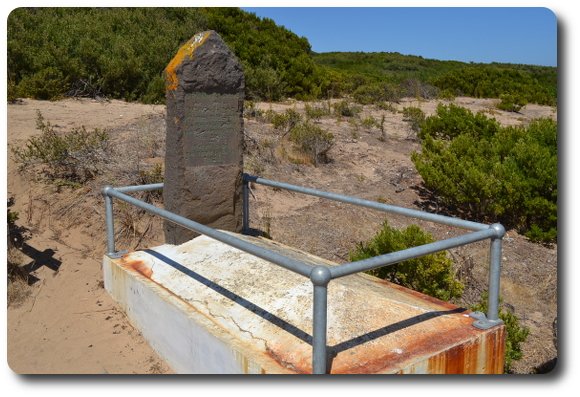
One of Warrnambool’s most enduring mysteries has been the identity of the “Granny” buried at Granny’s Grave high in the sand hills of Lady Bay and now, more than 165 years after her death, she is to finally have due recognition.
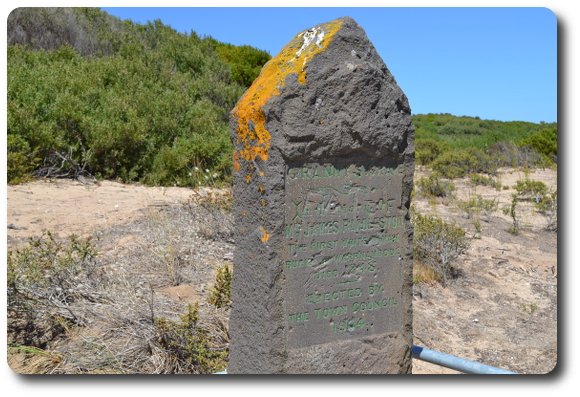
The Warrnambool City Council will add a plaque to the grave site by the end of June that will correct a long-standing error that named “Granny” as Mrs James Raddleston – the name inscribed on the headstone – and confirm that she was in fact Agnes Ruttleton.
Very little was known about Agnes Ruttleton beyond the perfunctory details etched into her headstone that told us she died in 1848 and was the “first white woman buried in Warrnambool” which at that time was still part of NSW.
Bluestone, however, has pulled together the threads uncovered by various researchers to tell her full story.
We began with a bunch of history books and a visit to the Warrnambool & District Historical Society that holds a thin manila folder on Granny’s Grave which contains the bare bones of her life and identity.
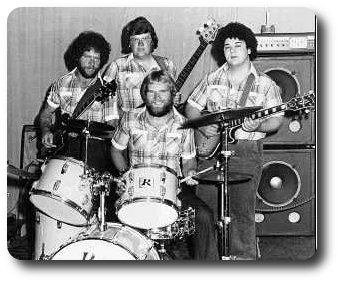
The Granny’s Grave band in the 1980s: Teejay Netherway, (left) Peter ‘Prof Walters, Eric ‘Coogee’ Read (drums) and John ‘Marra’ Maroniti (image: South-West TAFE archive).
The books and clippings reveal that Agnes and her husband – who was incorrectly named as a James Raddleston – lived in a tent somewhere near Flagstaff Hill in 1847-48 and eked out an existence through odd jobs and selling crayfish. At that time, Warrnambool was just a speck, with the first land sales having been held in 1847 and its population at around 100.
Among the first people to buy land was Richard Osburne, the newspaper publisher and historian, who at the age of 22 bought a block on the corner of Kelp and Merri streets not far from where Agnes and James were living. Richard knew Agnes as “Granny”, probably because of her age (more on that later) and, it appears, became quite emotionally attached to the “old” woman.
When Agnes died in 1848, Osburne is named among a group of men who organised for a coffin and a funeral service to be held at a burial spot in the isolated dunes, as Warrnambool did not yet have a cemetery. A fence was built around her grave but years of scarifying wind, rain and shifting sands saw the fence – and entire gravesite – eventually disappear from view.
Indeed Osburne was mortified when he returned to Warrnambool in 1886 and despite “walking and walking” he was unable to find Granny Raddleston’s final resting place.
“I tired myself from the search,” he wrote in a letter to the local paper.
Granny’s bluestone headstone was finally erected in 1904 – more than 50 years after her death.
Osburne used his letter to implore the council to erect a proper headstone in honour of one of Warrnambool’s pioneering women, but nothing was done for almost another 20 years when, in 1904, a group of citizens raised funds for the bluestone headstone that stands today.
(In the intervening years, an anonymous resident used a piece from the 1888 wreck of the Edinburgh to mark Granny’s Grave – perhaps as a subtle hint for the council to hurry up.)
When the headstone was finally unveiled, it had Agnes reduced to “Mrs James Raddleston”, a person who did not technically exist, although it was not uncommon for name spellings to be mangled through either mis-spellings, poor handwriting or mispronunciation. Raddleston had been recorded as Rittleton, Ruttleton and Raddlestone.
And this is where Jenny Fawcett, from Warrnambool, comes in.
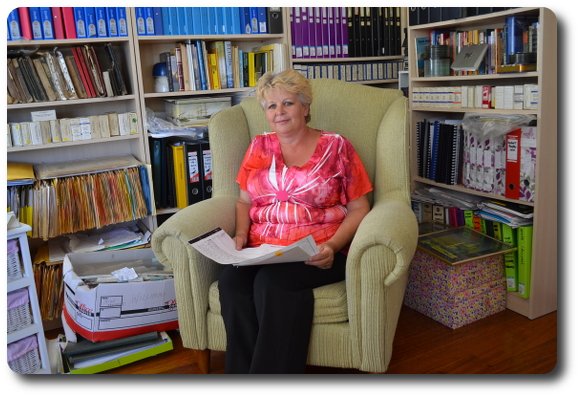
Researcher Jenny Fawcett in her library: she has devoted more than 20 years to uncovering the stories and mysteries of the south-west coast, including that of Granny’s Grave.
To call Jenny an amateur historian is a gross understatement: she is researcher unlike any other we have met before. Jenny has devoted hours of her time, driven by personal passion rather than profit, researching the history and characters of the south-west Victorian coast.
Her files are extraordinary, and her recall of individual details and events is mind-boggling.
It is Jenny who has reached back through time to find that Agnes Raddleston is Agnes Ruttleton and, in so doing, uncovered how James and Agnes came to be in Warrnambool.
“I like unravelling the mystery behind an individual, and Granny’s Grave is one of those stories that just had to be unravelled,” she said.
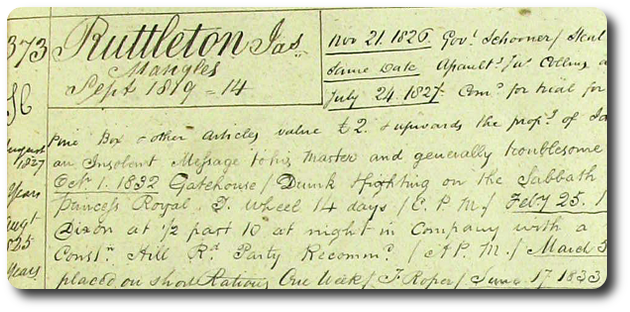
Through meticulous searching of convict records, Jenny traced James Ruttleton as an English boatman who was sentenced to 14 years for stealing and transported to Australia in 1820 – first to NSW, and later, after escaping, to Hobart Town. He was 31 years old.
Tasmanian convict records track the story of James Ruttleton, who was sentenced to 14 years for stealing.
After a variety of indiscretions, James was finally granted his Certificate of Freedom in 1834 and settled into a life in Tasmania.
Somewhere along the way, he met Agnes. Jenny has not been able to uncover her maiden name, or whether she was a convict too, but there is no record of James ever marrying.
“Maybe they were already married when he was sentenced and she joined him in Australia later, which could happen, or perhaps they were never married at all,” Jenny said.
What we do know, thanks to Jenny’s research, is that the pair sailed from Tasmania to Port Fairy on board the Essington in November 1846 and are listed as James and Agnes Ruttleton.
Both were then aged in their late 50s, but Jenny believes James may have been lured by the opportunity of better work. The Geelong and Portland Bay Immigration Society – which included Port Fairy – was keen to bring in labour.
Shipping records show the Ruttleton’s among the passengers on board the Essington bound for Port Fairy in 1846.
It appears the new opportunity didn’t quite work out, however, with James and Agnes living in virtual poverty for their final years.
Agnes died only 12 months after they arrived, at the age of 60, on December 13, 1848.
Agnes was also not the first white woman to die in the area.
Landholder John Allan (from Allansford fame), lost his first wife Jemima in 1842 and buried her on an island in the Hopkins River. There were most likely other deaths among the original sealers and settlers.
Agnes was, however, perhaps the first white woman to be buried in the newly proclaimed area of Warrnambool.
James Ruttleton died three years after Agnes, on June 15, 1851, and is buried in the Port Fairy cemetery…his death certificate incorrectly names him as John.
While Warrnambool’s infamous “Pioneers Board” (now housed in the library) doesn’t include any female pioneers among its faces, the Granny’s Grave plaque will recognise at least one of the many brave women who ventured to what was then nothing more than a tiny settlement behind the sand dunes.
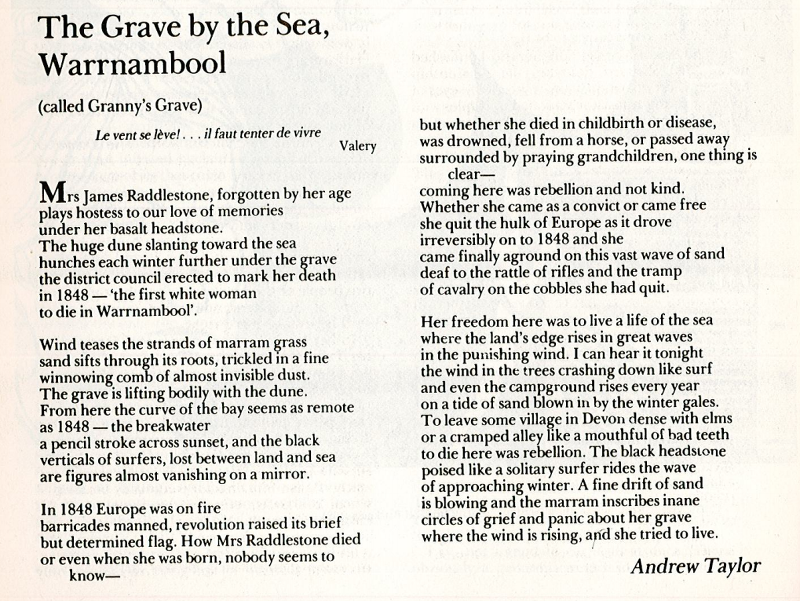
In researching this story, we uncovered a rare and beautiful poem about Granny’s Grave by Professor Andrew Taylor, who was born in Warrnambool. The Grave by the Sea, Warrnambool was first published in Quadrant Magazine in March 1981. Prof Taylor has kindly granted us permission to reprint his poem in full here. We would also like to thank Dr Simon Cooper for his efforts in finding a copy of the poem that, being written pre-computers, Prof Taylor did not even have. He does now!
Has food ever felt this good?
These felt lobsters are among Tara Davies’ range of “foods” that are being snapped up.
[dropcap style=”font-size: 60px; color: #DDCE8D;”] W [/dropcap]hen Tara Davies began stitching and sewing items to sell at her first market, she didn’t expect some of her best customers to be five year olds.
Yet it is Tara’s range of “felt food” that has since been flying off her market stall like hot cakes or perhaps, more specifically, felt cup cakes, or felt gingerbread men …
Each piece of felt food is hand made by Tara, right down to hand stuffing each individual yolk of the fried eggs, and her stall can sometimes look more like a grocery stand than a purveyor of crafts.
The kids and their parents, it seems, can’t get enough of the fake fruit, steak, vegetables, seafood and pasta that might be inedible, but feels a lot better than plastic and is far more cuddly. More mature folk have also been known to snap up a lobster or a slice of watermelon just because they can’t resist touching them.
Tara, from Portland, comes from a family who have always enjoyed making things and her grandmother, in particular, loved painting, drawing and crocheting.
But like many women who have moved into the craft market scene, Tara started sewing a range of items just for fun and decided to sell a few online as Sewww Pretty Handcrafted Gifts and Homewares before trying out her own stall in the middle of last year.
“The response and feedback at the markets has been just amazing and it has gone in ways that I never, ever expected,” she said.
Tara Davies is reviving some of the crafts of yesteryear, like scrappy mats made from recycled fabrics.
[dropcap style=”font-size: 60px; color: #DDCE8D;”] A [/dropcap]side from the felt food, Tara’s hand-sewn heat packs and her version of the “scrappy mats” that were once so popular in the 40s and 50s have proven to be winners.
The scrappy mats are made from recycled fabrics such as denim, felts or silks that are cut into strips and hand-knotted onto a backing mat. A small mat can involve up to 6000 individual pieces of material and take 10 days to complete, while the larger mats use up to 10,000 pieces: that means tying 10,000 knots.
“They are very time consuming, but luckily I find it relaxing and I can work on it in front of the TV,” Tara laughed.
The scrappy mats are also a direct link back to the crafts her grandmother did as a younger woman, when women would tear up old towels to make a “new” bathmat: who ever said up-cycling was a new concept?
Zero cholesterol and pure fun: the hand-stuffed and sewn fried eggs.
[dropcap style=”font-size: 60px; color: #DDCE8D;”] W [/dropcap]hile Tara has been delighted with how well her crafts have been received, she now suffers from a common complaint among her peers and that is finding the time – and space – to keep up with demand.
“My craft room is getting overloaded and I have already moved the sewing machine into the lounge room,” she said with a laugh.
Fortunately Tara’s boss – Sobey Services, where she has worked as office manager for the past 10 years – is understanding when it comes to occasionally needing flexible hours to prepare for a market.
“It never feels like there is enough time – if only we didn’t have to sleep!”
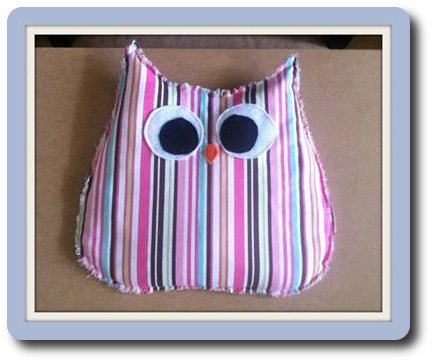
A heat pack or a hoot pack?
[box] Tara appears at various markets around the south-west region and you can find her on Facebook here. [/box]
[dropcap style=”font-size: 60px; color: #A5CECD;”] B [/dropcap]luestone Magazine is part of a growing grassroots campaign to save the best of the iconic Fletcher Jones site in Warrnambool from being lost through neglect.
The site is rapidly deteriorating and yet there is still no firm plan in place to preserve what has been deemed a place of state significance. It is also an important part of Warrnambool’s social history and holds a special place in our hearts.
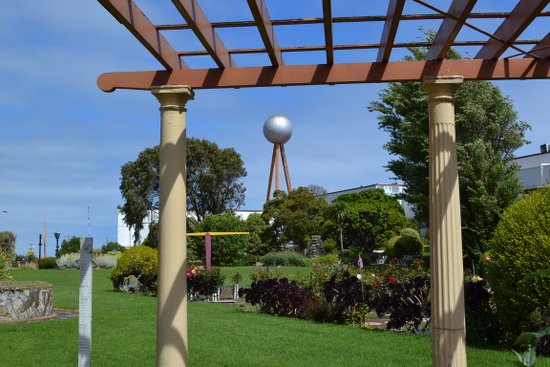
Shortly after we wrote two opinion pieces on this issue, two people – Julie Eagles and Tonia Wilcox – started a Facebook page for those who wish to see the gardens, the silver ball and other important parts of the site saved. An enormous number of people are sharing their memories and images on this page, some of which we have collated for our youtube clip.
[box] You can join the Save the Silver Ball and Fletcher Jones Gardens group by clicking here.[/box]
You can also read our latest opinion pieces about the Fletcher Jones site below:
The Warrnambool Planning and Heritage Group wrote a report 18 months ago that warned Fletcher Jones faced the same fate as the demolished 94 Merri St, which dated back to the earliest days of Warrnambool in the mid 1800s, unless action was taken now. The Warrnambool City Council’s response to the group’s 15 recommendations was tabled at its 9 December 2013 meeting (see a summary here).
[box] If you are passionate about the future of the Fletcher Jones site, as we are, please take a moment to read the latest and to get involved. Bluestone Magazine will have regular updates as the campaign unfolds.[/box]


 Find other Treasures here…