Be all things or stick to the basics?
council plan
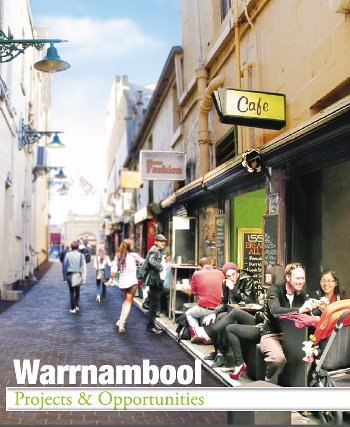
The dream: an image of bustling cafes built into the sides of Warrnambool’s laneways graces the cover of the council’s recently released priority ‘wish list’.


[dropcap style=”font-size: 60px; color: #A5CECD;”] C [/dropcap]ouncils were once primarily responsible for rates, roads and rubbish: my, how times have changed.

The 16-point list of advocacy priorities released by the Warrnambool City Council suggests that the council must now be all things to all people, fixing everything from school retention rates, to unemployment, to developing the region’s food export industry…right down to upgrading the stormwater drains. But is this what ratepayers really want or expect?

Sixteen points is a lot of priorities for a council covering only 32,000 people and they can’t possibly all be met, especially when we struggle to get the public toilets right.

I say this because as I was walking back from a media briefing on the plan last week, I wandered past the vandalised portable toilet box on Gilles St, across the road from the heritage precinct of the former police station and court house.

Having only been back in Warrnambool a relatively short time, I thought these toilets must have been installed for the comfort of the workmen repairing the former post office nearby.

A google search, however, revealed the eyesore is considered a public toilet and has been sitting there since 2011 while the council finalises its public toilet strategy.

My heart sank. If it takes more than three years to sort out the public lavatories, what hope is there of achieving the bulk of the 16 priorities that had just been outlined to the media by Mayor Michael Neoh and CEO Bruce Anson?

Moreover, do we need to have 16 priorities? What about focussing on five, securing the funding for these, and doing them really, really well? (We will list our top five later).

toilet_19
The reality: the ‘temporary’ toilet block on Gilles St indicates that making progress on some projects can take years.


[dropcap style=”font-size: 60px; color: #A5CECD;”] W [/dropcap]hile there is nothing wrong with thinking big and aiming high, we have three levels of government for the simple reason that each one looks after different levels of responsibility.

Ratepayers, I suspect, want a local council to focus on maintaining and improving their local amenities, to ensure that their city is a good looking and vibrant place where people want to live, work or visit for an unforgettable holiday.

Given this, it was heartening to hear Mr Anson list the revitalisation of the CBD as the number one priority, but there was scant detail on how this would be done, and by when. (*Since this piece was written, WCC has announced it is seeking an architect to redesign the portion of Liebig St between Koroit St and Raglan Parade).

The gradual rejuvenation of some of the city’s laneways – a wonderful council project –  is an example of what can happen, yet the F Project artists behind all of this hard work are scrimping and scraping to develop their art space down at The Artery, in Timor St.

The Artery has the potential to utterly transform what was a bland part of the CBD and to draw tourists in droves, but unfortunately this simple project has received very little council money.

At the same time, the council says in its latest document that it hopes to secure $100,000 for a “comprehensive study” into food production in south-west Victoria and potential export markets. Why? Isn’t this the domain of the State Government and, more particularly the local member, Denis Napthine? Or perhaps it is even better suited to the Federal Government, and our local member, Dan Tehan?

bluestone2_29
The Artery artists’ hub in Timor St has the potential to be a magnet for tourists and locals alike.


[dropcap style=”font-size: 60px; color: #A5CECD;”] L[/dropcap]obbying the other two tiers of government is part of what local councils do, but do we really want to secure and spend $100,000 on another study in the process?

Even a portion of this money would go a long way toward, for example, The Artery being able to open its retail space, gallery and studios – heck, they might even be able to get their signwriting done.

To be fair, the council’s priority list does contain some good, grassroots project such as upgrading the dated public swimming pool and working on a plan to improve the equally dated and tiny library, but it also contains a chunk of ‘priorities’ that have been around for so long now, most of us have forgotten when they were first announced, such as sorting out the future of the Fletcher Jones site, Flagstaff Hill and the railway station precinct.


bluestone2_25
Warrnambool will receive a longer airport runway, but the trains will still be slow, unreliable and crowded.

[dropcap style=”font-size: 60px; color: #A5CECD;”] S[/dropcap]peaking of the railway, improving the inadequate train service to Melbourne has been another, long-standing priority that has again been wish-listed by the council, yet it is the extension of the Warrnambool airport runway that is taking precedence for $4.5 million in state and federal funding.

The number of people who use this runway will be minuscule compared to the number of train commuters who already struggle to find a seat on a service that operates only three times a day and lumbers along at a Cobb-and-Co-like speed of 74 kph.

We should be outraged, especially as our compatriots in Bendigo, Ballarat and even Traralgon each have more than a dozen services a day, including a number of express trains.

A fast, reliable commuter service between Warrnambool and Melbourne is also critical to tourism, yet there is no indication that the service will receive another cent from either the state or federal governments.

The council has developed an enormous amount of strategic plans and strategies – the latest one brings the total to 32 in the past 10 years – but my fear is that it is spreading itself too thin, that it expends too much time and money reaching for the stars rather than dealing with the basics, and that, like the toilet box in Gilles St, it will ultimately struggle to be flush with success.

[box] Below are Bluestone’s five funding priorities (what are yours?):[/box]

  • Secure and save the best of the Fletcher Jones site and gardens and lobby for state funds to make it happen. This site is critical to creating a sense of ‘arrival’ to Warrnambool and has the potential to be something very special.
  • Fix the train service with more frequent, faster and reliable trains that include express services.
  • Revitalise the CBD by, for example, offering incentives to restore and repair the heritage buildings, remove the parking meters and create a true restaurant precinct.
  • Finish the sensational foreshore bike path by, as previously suggested by the council, linking it back through Lake Pertobe to the railway station. People would travel to Warrnambool (on a fast train) just to ride this path – I have already met some.
  • Upgrade the whale watching precinct into the world-class attraction that it should be.

Logo Smile newsletter More opinion pieces…


Who will step up for Fletcher Jones?

Time for a fresh start with Australia Day

Broken link for Artlink

Losing sleep over a lot of rubbish

Close Flagstaff Hill; save Fletcher Jones

When scrutiny is sub-standard, democracy suffers


Port Fairy bookclub review: Eyrie

[box] Bluestone recently profiled the Last Thursday Book Club in Port Fairy and invited members of the group to tell us about their book of the month. This month, BRIGID FOARD, is in the chair: [/box]


port fairy book club
Brigid Foard (right), who is a member of The Last Thursday Book Club, in Port Fairy, gives us the rundown on Tim Winton’s latest novel.

[quote]

[dropcap style=”font-size: 60px; color: #A5CECD;”] T [/dropcap]im Winton’s Eyrie commanded much discussion between the members of The Last Thursday book club, in Port Fairy this month.

The mark of a good read can often be the ripple effects of discussion when there are no easy answers, no comfortable resolutions of character or motive. The ambiguous elements of Eyrie are its strength, with Winton going to great lengths to avoid sentimentality and cliché.

Our discussion ranged from what really was the stain on the carpet at the start of the text, to was Tom Keely trying to save himself by helping Kai?

Eyrie is a thought provoking work dealing with themes such as redemption, class and the future of Australian society (more specifically, WA).

Most agreed that this is the most thrilling of Winton’s books in that it had that page turning effect on most of us.

I felt that Keely’s mother Doris was one of Winton’s more convincing female characterisations to date. The humour in the novel was something we all remarked upon. There are some hauntingly beautiful images in the novel which I will remember for years to come (surely testament once again to the work’s quality).

Winton has once again structured his writing around a few motifs: in ‘Eyrie’ they are birds, flight, falling; in ‘Breath’ – breathing, resuscitation, water.

This structural formula serves as both a functional and aesthetic framework, (including the title) and in my opinion solidifies the work as a classic.

Eyrie is one of those works that stays with your consciousness and makes you really think.”

winton

[box type=”bio”] Have you read Eyrie? What did you think?[/box]


Logo Smile newsletter You might also enjoy… 


What I am reading: Portland arts identity Jan Colliver

What I am reading: O2 Media director Karen Foster

Second hand bookstore opens in Koroit

What I am reading: artist Gareth Colliton

Biblio-Art prize launched at Blarney Books

What I am reading: ABC Radio south-west breakfast presenter Jeremy Lee


From a cupcake copper to a farmer’s wife

farmers wife_5
Within the space of about a fortnight, Jo O’Keefe went from being a police officer in Portland to running her own cafe in Port Fairy, The Farmer’s Wife Harvest Cafe.


[dropcap style=”font-size: 60px; color: #ABCCAB;”] A [/dropcap]t the risk of using a bad pun, a new alleyway café in the heart of Port Fairy is quite arresting – not least because it is run by a former police officer.

The Farmer’s Wife Harvest Cafe, tucked at the end of a gorgeous bluestone and rubble walled lane off Sackville St, is the latest venture for local Jo O’Keefe who has had what can only be described as a varied career.

Until last November, Jo was Senior Constable O’Keefe based at the Portland police station as part of a 10-year career with the thin blue line.

Prior to joining the force, however, she had spent most of her life in hospitality, including working in kitchens while studying – and completing – a Fine Art degree at Deakin University in Warrnambool in the early 1990s.

“Everyone used to call me the Cupcake Copper because I was better known for my scones and cupcakes that I would bring into work, than for any actual policing,” Jo laughs.

“I have always had a background in hospitality though and, since I was 18, worked in Lorne, Apollo Bay, Warrnambool and up at the snow fields.”


farmers wife_15
An earlier life in hospitality has seen Jo turn full circle and live her dream of opening her own place.


[dropcap style=”font-size: 60px; color: #ABCCAB;”] A [/dropcap]fter the birth of her son, Tex, in 2000, Jo decided to scratch an itch that she had harboured since she was 12 years old, after one of the police horses visited her school in Melbourne.

“That horse, ‘Gendarme’, had me completely hooked and I was determined to join the force one day…I finally did, just before I turned 40,” Jo explains.

“I am not sure why, but I thought it might also be better for me as a single Mum, which I was at the time, but I didn’t factor in the night shifts,” she laughs.

As a result, Tex was “raised by the village” of Port Fairy with various friends chipping in to help when Jo moved there in 2006.

It has made Tex a well-adjusted kid, who now helps out making smoothies and juices in the café during school holidays, says Jo.


farmers wife_16
Some of the tasty treats on offer: the brownies sold by the tray-full during the peak summer season.


[dropcap style=”font-size: 60px; color: #ABCCAB;”] F [/dropcap]our years ago, life took another turn when Jo married local farmer Scott Moore – hence the inspiration for the name of her café.

“I had been thinking about getting out of the force and I always wanted to run my own café, then this place came up and I jumped at it,” Jo says.

“I finished up work in November and, two weeks later, opened up the café in December.”

The café, which offers simple healthy lunches, coffees, cakes, fresh juices and a range of gluten-free products, hit the ground running and Jo found herself making 5.30am starts to keep on top of the summer rush.

“I knew it was going to be full on for those first couple of months, but it was great fun,” she says.

Part of the café’s appeal is that it is tucked well away from the main street and provides a safe place for kids who are kept entertained by the plastic farm animals that are provided by Jo and can be hidden into the nooks and crannies of the sandstone wall.

“I am not sure if we have found them all again yet,” she smiles.

farmers wife_22
Some of the local patrons that help to keep the kids happy…

[box] The Farmer’s Wife Harvest Cafe is at 47a Sackville St, Port Fairy, and is open 9am-3pm seven days. You can find it on Facebook here. [/box]

newsletter Art Music Stones You might also enjoy…


New path leads to Lozzar’s

Room with a view at Pavilion

Rocksalt rocks on in Port Fairy

Lido lives up to expectations

Pick a Pickled Pelican

Homestyle cakes a recipe for success


Conservation and creativity in the same basket

cherree densley_4
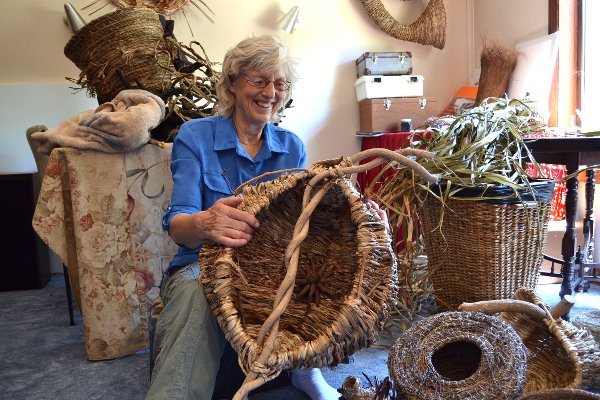
Cherree Densley in her Killarney studio – a re-commandeered bedroom – where she creates baskets using the timeless techniques of many cultures.


[dropcap style=”font-size: 60px; color: #A02F2F;”] B [/dropcap]ushwalking with Cherree Densley would be an eye-opening experience, as not only does she know the names of hundreds of native plants, she can also see the potential for each to be the inspiration for a stunning work of art.

Since retiring from her 30-year career as a secondary school teacher about 10 years ago, Cherree has devoted a large portion of her life to plants and, through them, tapped into her twin loves of conservation and creativity.

On the outside, the garden of her Killarney home is a two-acre sanctuary of low-water succulents, bulbs, native plants and perennials while inside, the remnants and off-cuts of native plants and grasses are transformed into beautiful baskets and fibre sculptures.

Cherree recently reclaimed her son’s old bedroom to create a simple, sun-filled studio in which she spreads out the seed pods, grasses, leaves, prunings and various fibres that she has collected in her travels, or from her own land, and that would normally be composted or left to rot on the ground.

From this raw harvest, she creates the designs that she has sketched in her journals as part of daily ritual that keeps her disciplined and captures inspirational ideas before they float away.

[quote]

I find it is a lovely thing to be able to make something useful or beautiful from things that might normally be thrown away,” Cherree explains. [/quote]

“You can take this discarded material and turn it into something entirely new: you can make an object that is not just creative, but which also has a purpose.”

cherree densley_19
The exquisite range of baskets reflect the raw materials from which they are made.

[dropcap style=”font-size: 60px; color: #A02F2F;”] C [/dropcap]herree’s range of baskets and fibre sculptures is astonishing and shows influences from her fascination with how baskets have been used in various cultures for thousands of years.

Some of her work reflects the baskets and eel traps made by Indigenous Australians, others have a distinct African style, while others are uniquely her own.

“I collect books on basket-making and was reading just the other day how an African community used tightly woven baskets to store their beer,” she says.

“With almost any culture, you only have to scratch the surface and there is a history of basket-making there.”

cherree densley_6_01
“I find it is a lovely thing to be able to make something useful or beautiful from things that might normally be thrown away.”


[dropcap style=”font-size: 60px; color: #A02F2F;”] C [/dropcap]herree also makes much larger sculptural works using fibres and found objects and is currently preparing for a second exhibition with her sister, painter Di Holland, who lives near Edenhope. The pair held their first SisterShow in 2012 at the Warrnambool Art Gallery.

The SisterShow2 exhibition will be held at CEMA, Portland, from March 24-April 29  and will again see Di’s meticulous wildlife paintings paired with Cherree’s sculptural works. The 2012 show included, for example, a large painting of a platypus by Di that was exhibited alongside a metre-long platypus nesting burrow woven by Cherree.

This time, the challenge includes enhancing Di’s painting of a Southern Right whale, but Cherree is already well underway with a piece that reflects the whale’s ‘song lines’. The sisters plan to exhibit 25 large paintings and 3o sculptural works in total.

cherree densley_20
This delicate basket made of New Zealand flax was part of an exhibition held at Whalebone Gallery, Port Fairy.


[dropcap style=”font-size: 60px; color: #A02F2F;”] P [/dropcap]erhaps not surprisingly, the sisters come from a line of grandparents and great grandparents who loved gardens and crafts – textiles, leatherwork, basketry, mosaics, floristry, spinning and dyeing wool – and both grew up in bushland near Heywood.

Cherree used her superannuation to return to those roots by buying a rare slice of 200 acres of native bushland near Portland that is protected with a covenant to ensure its preservation into the future. Since buying the property, Cherree has recorded 299 individual plant species growing on the property.

“I am really struggling to reach the 300, but I think I may have found a native mint that will take me over the line,” she says, laughing.

cheree baskets_6
To market, to market: some of Cherree’s work at the recent Port Fairy farmers markets.

[box] Cherree Densley’s work is often for sale through the Port Fairy markets and F Project pop-up markets at The Artery, 224 Timor St, Warrnambool. Cherree also offers basket making classes at her home for individuals or up to groups of eight. You can contact her on 55 68 7226 or via cherree@hotkey.net.au for more details.[/box]

newsletter Eat And Drink Stones  You might also enjoy…


Home is where the art is: Karen McKenzie

Heather Wood: art springs from the heart of Seaview.

Revealing the layers of a sapphire: Kate Melican Rollo

Smooth lines inspired by the ocean: Damian McDonald

Hot glass melts hearts: Robert Gatt and Freya Marriott


Oh Biba, look at you now!

Biba_Salon36
The transformation of 222 Timor St, Warrnambool continues, with a new hairdressing salon filling the bottom floor. Image courtesy of Sinead Murphy.

shopfront
As it was before the transformation by Luke and Nat Taylor began early last year.

[dropcap style=”font-size: 60px; color: #A02F2F;”] L [/dropcap]ate last year, Bluestone Magazine captured the transformation of 222 Timor St, Warrnambool, from a derelict heritage-listed building to a wonderful, character-filled space that was ripe for a new tenant.

And while the building is still not completely finished – owners Luke and Nat Taylor have plans for an apartment and residence on the top floor – it has started a new chapter in its 164-year history with the arrival of the upmarket hairdressing salon, Biba.

It is the first Biba to be opened outside of metropolitan Melbourne and marks a return to Warrnambool for owner, Mia Nicolson, who had previously worked at Paris Hair and Beauty in East Warrnambool.


Biba_Salon06
Mia Nicolson, left, has made a conscious decision to keep the character of the building…while adding some quirky and funky touches. Image courtesy Sinead Murphy (http://www.sinead-murphy.com/)


[dropcap style=”font-size: 60px; color: #A02F2F;”] M [/dropcap]ia has made a conscious effort to capture the character of the old building, while adding some very modern and funky touches.

There is a vintage barber’s chair (picked up from the Mailors Flat secondhand store), a heavy work bench from Melbourne, and old wooden boxes from Ponting Bros that Mia found in her grandmother’s stables, but also an eye-catching, off-beat mural by local artist Felix Pilling that dominates one wall of the colour bar. Recycled leadlight glass enhances an antique window in the same room.

“Biba salons have an industrial look, so I have added some of those industrial features while also linking in to the heritage aspects of the building,” Mia explains.

The series of photos below capture the full transformation. The Biba images were taken by talented graphic designer and photographer Sinead Murphy who has kindly given us permission to reproduce them here. (You can find Sinead’s website here.)

lukefamily
Nat and Luke Taylor, with son Lewis, in the front room of the building early last year.

Biba_Salon18
The same space today is almost unrecognisable and forms the main entrance to the salon. The vintage barber’s chair is to the left and the old workbench doubles as a reception desk.

shop_64
As it was: the back room behind the main salon space.

Biba_Salon21
The same space converted into a ‘colour room’, complete with the leadlight-enhanced antique window.

Biba_Salon26
One long wall of the colour room now features a mural by local artist, Felix Pilling.

newsletter Eat And Drink Stones You might also enjoy…


T-shirt captures the infamous ‘Cri’ 

Who is the Granny behind Granny’s Grave?

Who will step up for Fletcher Jones?

Art is the heart of old Hawkesdale home

Behold this bluestone beauty: Fennessy’s at Rosebrook

Colonial oven still makes a crust, Dunkeld

Secrets of an old shoe