Just one of the wonderful images: Workers in the main sewing room at the then-newly opened Fletcher Jones factory at Pleasant Hill, Warrnambool, in 1948.
By Carol Altmann
[dropcap style=”font-size: 60px; color: #A02F2F;”] A[/dropcap] treasure trove of rare images capturing the lifespan of the Fletcher Jones story is poised to be the focus of a series of artworks by noted Warrnambool artist, Glenn Morgan.
More than 100 images are contained on three CDs given to Glenn by the late David Jones – son of Sir Fletcher – about eight years ago when the pair were sitting on the Warrnambool Art Gallery Advisory Board.
“I’d made a couple of pieces around the Fletcher Jones theme and so David turns up with these three discs of images that he said I could have, so I put them to one side thinking I would take a proper look one day,” Glenn explains.
“I have always been interested in doing a sculpture reflecting the Fletcher Jones’ floats in the Florado festival (an annual Warrnambool street festival that started in the late 1950s) and so I started browsing the images on the discs and thought, bloody hell, there is some good stuff in here!”
“A dash of Cold War spy”: a Fletcher Jones’ fashion parade in the 1930s, possibly staged at the Warrnambool Town Hall?
[dropcap style=”font-size: 60px; color: #A02F2F;”]G[/dropcap]lenn is not exaggerating.
The photographs provide a literal snapshot of the growth and the hey-day of the Fletcher Jones story, from Sir Fletcher’s humble beginnings as a hawker, to the beginning of the last great years of the Pleasant Hill factory the late 1980s.
There are images of window displays, fashion parades, staff parties, the legendary Christmas picnics, the construction and opening of the Pleasant Hill site, family shots, staff shots, FJ sports teams, samples of early advertising and some of the many social and community causes that the Jones’ family supported.
“There is some really interesting stuff and it takes in not only Warrnambool, but Fletcher Jones in Adelaide, in Hobart, in Collins St,” Glenn says.
“The more you delve into it, the story just gets richer and richer.”
The Fletcher Jones basketball team from 1946. Do you recognise any of these faces? If so, let us know in the comments box below.
[dropcap style=”font-size: 60px; color: #A02F2F;”]G[/dropcap]lenn has already started to seek private and public funding to build a new body of work from a series of images he has selected from the 100-plus.
“I would, ideally, like to spend a couple of years just working purely on this project – an FJ project – leading up to an exhibition at the factory itself, and then touring to Melbourne and Sydney,” he says.
“Funding, of course, is always the issue but I am applying for grants as we speak and hope to get some funding on board.”
Artist Glenn Morgan, known for his quirky sculptures, hopes to produce a body of work around the rare Fletcher Jones images.
“It is such a great story, a very Warrnambool story, and I would love to be able to tell a part of it,” Glenn says.
Glenn and fellow artists Barry Tate and Jenny Altmann all run individual art classes at the former Fletcher Jones factory, with Jenny and Barry recently launching the Outlaw Gallery in the same space.
Suzi Walter, the fashion designer behind the Sweezy label, has successfully revived a career that once saw her named among the best young designers in Australia.
Words and photos by Carol Altmann
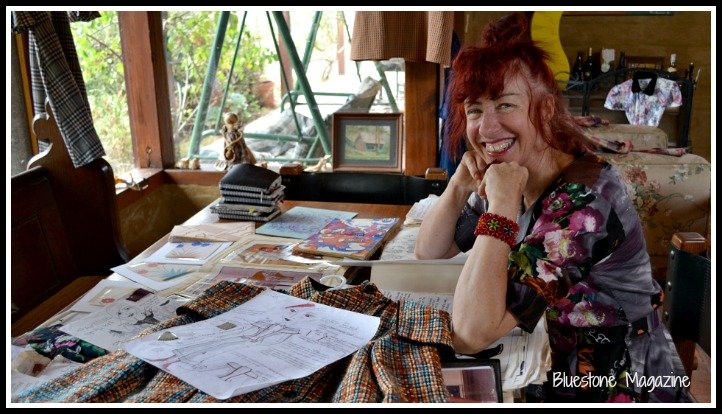
[dropcap style=”font-size: 60px; color: #DC943C;”] ‘W [/dropcap]e are so lucky, aren’t we? Doing jobs we love,” says Warrnambool fashion designer Suzi Walter as she spreads out the scrapbooks and patterns, drawings and diaries, samples and swatches, from a lifetime of work that has unfolded in two chapters.
Chapter 1, for Suzi, who owns the Sweezy label, began as a teenager living in Adelaide in the 1960s, when she was Sue Bell and sewing her own clothes using popular patterns from big names like Butterick, Simplicity, Vogue and McCalls.
“I would take one of these patterns and tweak it a bit because I didn’t like the collar, or how the pleat fell or something like that,” she laughs, which is something Suzi does often, and infectiously.
These tweaks revealed an early talent for design and turning a standard pattern into a striking original.
A 16-year-old Sue Bell, right, who was still a student at Seacombe High School when she won a competition to design three outfits for 60s pop star, Bev Harrell, left.
Her first real ‘break’, however, came when the young Suzi entered a competition to design three outfits for 1960s pop singer Bev Harrell (you can see Bev in action on Youtube here) and won. The prize opened up the opportunity to work with Adelaide-based designer Bruce Westwood, so at 16, Suzi quit school and did just that.
Westwood saw her potential early: “She always had a flair for designing..always,” he was later quoted as saying.
“She has her own flair, she will go a long way,” he said.
And he was right.
Suzi’s winning design for the label, Emma, on the right, took out the Australian Wool Award ahead of a design by fashion giant, Norma Tullo, centre.
[dropcap style=”font-size: 60px; color: #DC943C;”] S [/dropcap]uzy enjoyed a career trajectory that would see her work in the heart of the thriving fashion industry around Flinders Lane in Melbourne during the vibrant early 70s when women like Prue Acton, Norma Tullo and Adele Palmer were taking Australian designs to another level.
“I worked on the Emma range that was sold through Myer, and Sportsgirl and pretty much had free rein to design what I wanted, but a particular favourite was hotpants,” Suzi laughs.
In 1971, although still a relative newcomer to the fashion scene, Suzi won the top Australian Wool Fashion Award – the “Golden Ram” – with an Emma Aztec-printed hooded bean pole dress, beating a Norma Tullo designed dinner dress.
Where does a young, world-at-their feet designer go from there? London, of course!
“I had some money from another prize I won (the Adelaide Festival of Arts Fashion Award) which I knew would pay for my fare, so off I went,” Suzi explained.
I assumed she meant by plane. But no. She and seven other adventurous souls bought a Kombi van and drove it to Perth, where they loaded it onto a ship and sailed across to India from where they drove to London.
“We travelled through Nepal, India, Madras, Pakistan, Afghanistan, Istanbul, Iran…all the way through Europe and across, finally, to London,” Suzi says, showing me the notebooks she kept along the way that are jammed with sketches and jottings: the mind of an artist at work.
“These little books became my bibles for ideas,” she says.
Suzi decided to get back into fashion after designing a dress that drew multiple compliments during a visit to Bali: “It got me thinking that, hey, I can still do this.”
[dropcap style=”font-size: 60px; color: #DC943C;”] S [/dropcap]uzy spent three years in London as a freelance designer, including working for Jane Carlin, in Bond Street, on high-fashion items destined for places like George’s in Collins St, Melbourne. This was a world where zips and hems were hand-stitched, and some garments were taken by Suzi to the Queen’s beader.
After meeting the man who would become her husband, Andy Walter, Suzi returned to Australia – via a road trip through Africa – and the pair settled in Melbourne to start a furniture business and a family. It would be another 25 years – in 2005 – before Suzi, as Sweezy, would return to fashion.
“It really began again with a design I called my ‘shoplifting’ dress,” Suzi says, before going on to explain that she made a one-off dress with a large bustle, that drew dozens of compliments during a trip to Bali.
“It got me thinking that, hey, I can still do this – I can still make really interesting clothing that people are drawn to.”
Suzi and Andy saw an opportunity to not only revive Suzi’s fashion skills, but to also help the Indonesian people.
Up close: just a small sample of the designs and swatches Suzi prepares to send to her team in Indonesia where they are created into garments.
[dropcap style=”font-size: 60px; color: #DC943C;”] H [/dropcap]ow it works is this: Suzi and Andy travel to Bali twice a year to select high quality, eye-catching and beautiful fabrics, often the whole stock if they love it enough, as Andy did with a fine red-and-black Japanese silk.
They then work with two Balinese men who, it is easy to see, have become a very special part of Suzi’s life: Gunter who cuts the patterns from her unique designs she sends to him via email, and Made, who does the sewing.
“When we first met Gunter, he had an old sewing machine out on his verandah and when it rained he would pull the whole lot in,” Suzi says.
Guntur has since built a new house, on the back of his work for several designers, including Suzi.
The Sweezy label (which is Andy’s nickname for Suzi) produces between 400-500 garments a year sold through Melbourne, Ballarat and Warrnambool and has built what Suzi describes as a “beautiful story” between the Walter’s and their Indonesian friends.
“When I first said I wanted to get back into fashion, I was warned not to, that it was no longer what is used to be. Well, of course, that only made me more determined to do it,” Suzi laughs.
Suzi with a dress made from the stunning Japanese silk fabric her husband, Andy, spotted on one buying trip to Indonesia: “He took the lot!”
[box]The Sweezy Emporium is located in Warrnambool at the end of Ozone Walk, off Koroit St. You can also find Sweezy on Facebook here. Suzi can be contacted on 0439 415 713. [/box]
Life can be a laugh: Fletcher Jones market stall volunteer Dianne Gaetani, with Jax, and stallholder Lisa Austin whose stall specialises in “garage-nalia”.
By Carol Altmann
[dropcap style=”font-size: 60px; color: #A02F2F;”] F[/dropcap]or a dedicated op-shopper and sucker for the secondhand like me, walking into the Fletcher Jones Markets is overwhelming to the senses.
And I am not the only one.
Since Bluestone Magazine moved into a small office above the markets, I have been privy to the comings and goings of the dozens of people who venture in for a look around. And they all do what I did on my first visit: stop, stare and sort of slowly exhale when they realise this is second-hand heaven, market Mecca, op-shop overload.
“When I first saw the place, I fell in love with the place,” says stallholder Eric van der Wal, a retired federal public servant who has collected antiques all of his life and is now selling off a few pieces as a hobby.
Eric is one of 26 different stall holders who, between them, have filled two levels of what was once the Fletcher Jones factory floors with an eclectic and colourful variety of collectables, antiques, clothing, vintage, vinyl records, ephemera, furniture, dining wear, trinkets, soaps, wind chimes, musical instruments, artworks and a mind-boggling array of bits and bobs.
“People can wander through here and find something whether they are a serious collector, or whether they are just looking for some nice little piece to take home that is cheap,” Eric says.
But it wasn’t always as alluring.
Stallholder Eric van der Wal who joined the markets after retiring to Warrnambool: “When I first saw the place, I fell in love with the place”.
[dropcap style=”font-size: 60px; color: #A02F2F;”] M[/dropcap]any of the stallholders remember the “difficult days” when the markets were part of the Mill Markets group, run by the then-owner of the Fletcher Jones complex, Ian Ballis, whose company went into administration in mid-2012.
While the future of the Fletcher Jones site hung in the balance, the markets stalled and then barely clung on as the derelict factory began to continue to fall apart around them.
But then businessman Dean Montgomery, who hails from Geelong but now lives in China, bought the 2.3ha site in early 2014 and began an entirely new chapter for the factory.
Fears the markets would be “moved on” were not only put to one side, but the entire space has seen significant amounts of money spent on repairs and making the markets look clean, water-tight and professional.
As one stallholder says, snapping her fingers, “we were so used to being told things would get done and they would never happen, to now being told something will get done and it happens like that!”
A feast for the eyes: every nook and cranny at the markets is filled with an eclectic array of collectables, gifts and goods.
[dropcap style=”font-size: 60px; color: #A02F2F;”] O[/dropcap]n-site manager Troy Kelly, who began 12 months ago, said the markets were part of the long-term vision for the complex, which will centre on the Warrnambool Motor Museum that is now under construction at the far eastern end.
“We would hope to continue to make the markets bigger and better as part of a mix that will bring a whole variety of different people here, and who can make a day of it,” Troy explained.
That mix will include the car museum, scheduled to open in 2016, the markets, the art studios at Factory Arts, and the new Outlaw Gallery, all overlooking the refurbished Pleasant Hill gardens that now have the help of paid gardeners provided through Western District Employment Agency (WDEA).
“In just the time I have been here we are starting to see a real increase in foot traffic and that is only going to get better,” Troy said.
Eric has noticed the same shift.
“Everything is looking and feeling a lot better,” he says.
“There is so much enthusiasm around what can be done and it is great to be a part of that.”
Original vinyl: from gramophone records to retro records, the turntable is still very much in vogue at the markets.
[box]The FJ Markets are at the western end of the Fletcher Jones factory, Flaxman St, Warrnambool. Open seven days from 10am -5pm. You can also find them on Facebook here.[/box]
[box]SOLD OUT – Waiting list now available. Email us at editor@bluestonemagazine.com.au to be added to the list.[/box]
[dropcap style=”font-size: 60px; color: #A02F2F;”] A[/dropcap]s the number of subscribers to Bluestone Magazine continues to grow, we plan to bring more exclusive, subscriber-only events to south-west Victoria.
An evening with acclaimed Australian author Helen Garner, in conversation with Bluestone co-editor Carol Altmann on Thursday April 21 at Blarney Books & Art, Port Fairy, is our first such event. (Subscribers have first access to the limited 60 tickets – any remaining tickets will then be offered to the general public.)
This exclusive event is a one-off opportunity to hear and meet Helen in the south-west, as she will be doing very little public promotion for the release of her new book, Everywhere I Look, (to be released in late March).
We can guarantee that this will be a fabulous, intimate evening, limited to only 60 people. Merrijig Kitchen is providing canapés, and there will be wine on arrival.
We know the Bluestone community is interested in hearing from inspiring artists, authors, leaders and those who have chosen to live their life differently, so we intend to stage events that feature just these sorts of people.
If you would like to be part of what Bluestone is all about, then please become a subscriber for $85 for 12 months.
Not only will you have access to our exclusive events, but you will be supporting an independent media voice that is part of a growing, dynamic community in south-west Victoria.
In the meantime, we are thrilled to be hosting an evening with Helen Garner that is sure to both a sell-out, and memorable!
Uncovered: Rena Jones’ lovely letter to the people
Rena Ellen Jones, wife of the late Sir Fletcher Jones, was a major support to Sir Fletcher as he slowly built his clothing and drapery business from the ground up, including learning how to drive the delivery truck. Image courtesy of The FJ Foundation.
By Carol Altmann
[dropcap style=”font-size: 60px; color: #A02F2F;”] A[/dropcap] little hidden gem has emerged from amid the thousands of items donated to the Melbourne University Archives by the family of the late Sir Fletcher Jones.
MUV archivist Melinda Barrie went searching among the substantial collection for evidence of the contents of a time capsule that is believed to have been installed in the Fletcher Jones factory at Pleasant Hill, Warrnambool, some time after it was officially opened in 1948.
The official invitation to the opening of the FJ Trouser Unit at Pleasant Hill, Flaxman St, Warrnambool on June 21, 1948. Image reference: 2012.0031 Fletcher Jones Collection, Melbourne University Archives.
What Melinda found was a letter from the late Rena Jones, wife of Sir Fletcher, that she no doubt drafted and re-drafted and then tapped out on a typewriter, to be placed behind the foundation stone of the Pleasant Hill factory.
The letter, which was possibly accompanied by a series of photographs, was intended to capture a little of the ethics, spirit and philosophy of Sir Fletcher and his family as they slowly built their business from the humblest of beginnings.
What Rena didn’t know at that time, of course, was just how successful the Fletcher Jones company would become, how many people it would go on to employ in Warrnambool, Mt Gambier and Melbourne – and how strong the connection remains to Warrnambool through the revival of the Fletcher Jones site and the ongoing collection of personal stories about the site.
The letter penned by the late Rena Jones, wife of Sir Fletcher Jones, and placed behind the foundation stone of the Fletcher Jones factory and gardens when they opened on June 21, 1948. Image courtesy of the Melbourne University Archives.
Here is the letter in full:
To those who follow:
‘This has been written by Rena Ellen Jones, the wife of David Fletcher Jones, to be placed behind the foundation stone of this building, June 21st, 1948.
This is written, feeling that some members of future generations succeeding us may be interested in these brief details and photographs of the life and work of my husband.
David Fletcher Jones, the son of Samuel Henry Jones and Mahala Jones (nee Johns), was born at Golden Square, Bendigo, on August 14, 1895, was a member of a family of seven children, and deprived of education beyond the age of 13 1/2 years.
His first calling was that of a tomato grower, until he enlisted in the 1914-18 war, where he served as an Infantryman. Being invalided home in 1917, he changed his profession to that of a soft goods merchant, with a two-horse waggon (sic). This enterprise led to that of a travelling draper. Photographs of the hawker’s wagon and other vehicles used until 18 months after we were married and settled in Warrnambool in 1923 are included in this history.
Mr Jones’ then specialised in boys’ wear, ladies’ wear and mens’ wear. Three years later, he concentrated on mens’ wear and, at the time of writing, he has a staff of around 200 employees, and is Chairman of Directors of the Warrnambool Woollen Mill Co, and a director of Leviathan Ltd.
Anxious to make a contribution to “peace in industry”, he has made the Warrnambool shop, Melbourne shop and Trousers factory into staff co-operatives, limiting the shares of the family to 48%; 52% having been made available, on easy terms, to the staff.
At the time of writing, there is considerable unrest in the industry. Mr Jones is happily spending himself, endeavouring to evolve a system of sharing all profits with his employees and the consumers of the goods he manufactures and sells. Our three children, Ralph Fletcher, Lois Ellen and David Fletcher Jr, and myself have all happily agreed on this thing and are all anxious to see this world a better and happier place because this family has been privileged to do this work.
We are persuaded that God’s plan is perfect, and that if we only ask Him to guide, teach, manage and strengthen us, and help us to witness humbly, that all will be well.”
[dropcap style=”font-size: 60px; color: #A02F2F;”] T[/dropcap]he MUV Fletcher Jones collection includes more than 3000 photographs and artefacts – including many from the Warrnambool factory in the 70s, 80s and 90s – all of which will be cleaned and then 300 selected for digitalisation.
“We are on track to get that project well and truly underway this year, to select and digitise the 300 items that best capture the story of Fletcher Jones,” Melinda said.
The late Rena Ellen Jones, who died in 1970 at the age of 76. Image courtesy of the FJ Foundation.
You can read more Fletcher Jones related stories here…


 You might also enjoy…




 You might also enjoy…


