[dropcap style=”color: #a5cecd;”]B[/dropcap]ricklayer Barry Knowles is the sort of person who is often described as “salt of the earth” and he very much lives up to this reputation.
The Warrnambool tradie – who was born in Merrivale – comes from a proud working class background where people were not afraid to give each other a hand, and where he learnt early that hard work was the only way to get ahead: no matter what your trade or profession.
Barry was recommended to us as somebody who would be prepared to help out with our project to restore the Robert Ulmann whale mural on the corner of Flaxman and Nicholson streets, even though we were relying on community funds to pay for the project and, therefore, had a limited budget.
As soon as we spoke to Barry, we knew we had the right person. He came down to the site, declared that it was something he could definitely help with, and that he would be proud to be involved so that when his grandkids walked past “they would know that I helped fix it”.
Barry’s skills will be used to repair the cracks and chips in the wall and remove or replace the metal fixtures that have rusted in the sea air.
Even though Barry is an absolute dyed-in-the-wool Collingwood supporter – a fact we can overlook for the moment (!) – he is very much our Quiet Hero for showing such enthusiasm and generosity toward the whale community project.
When we convinced Barry to be in this photo, he thought it was to help promote the project – and it is – but it is also a way for us to say thankyou, Barry.
[box] Barry will receive a coffee and cake voucher from Lozzar’s Lounge Cafe, Warrnambool. Thankyou, Lozzar’s, for supporting our quiet heroes.[/box]
[button link=”http://the-terrier.com.au/subscribe-2/” type=”icon” icon=”heart” newwindow=”yes”] Did you enjoy this story? Please subscribe here to help Bluestone thrive.[/button]
Retired: the second (and final) Fletcher Jones cross sits in council storage, having been replaced by a more modern cross that is erected on the Uniting Church. The whereabouts of the original FJ cross, first used in 1967, remains unknown*.
[dropcap style=”color: #a02f2f;”] W [/dropcap]ith the former Fletcher Jones factory in Warrnambool officially changing hands last Thursday (19/6), there has been a renewed focus on tracking down the iconic, original fixtures in the hope that they can be returned to the site, including the very first FJ cross.
New owner, the Geelong-born, China-based businessman Dean Montgomery, has indicated his willingness to restore the garden furniture and features, including what we call ‘The Man in the Pressed Pants’, but who was formally known as ‘the FJ man’, who once stood so proudly in his pleats at the front of the property.
The man, unfortunately, is now a broken shell of his former self. What does remain, however, has been enough to inspire Mr Montgomery to consider commissioning an artist to rebuild his legs and restore him to his full glory.
Another iconic piece of the original factory that is proving harder to trace is the original Fletcher Jones illuminated cross that was winched up the silver ball water tower each Christmas (and removed after every Easter) to cast its comforting glow across the city.
Up she goes: this image is believed to show the original, much heavier cross being hoisted into position using a boat winch. Image courtesy Amy Fitzgibbon.
[dropcap style=”color: #a02f2f;”] S [/dropcap]ir Fletcher Jones was a socialist Christian, or what might now be called a left-leaning Christian, who believed the cross would provide a gentle reminder of the role of Christ around an increasingly consumer-driven Christmas.
The cross was first erected when the silver ball was built in 1967 and, it is understood, was literally plugged into a powerpoint on top of the silver ball and ran off a timer.
At some time in the late 80s (nobody we spoke to was exactly sure when), this cross was replaced with a much lighter, aluminium structure that had light bulbs mounted along its sides.
This newer cross continued to be placed on the silver ball each year, right up until 2010 when the deteriorating condition of the ball made it unsafe.
In a now infamous move, the Warrnambool City Council (WCC) – who had taken over responsibility for the cross – found a new home for it on top of a west Warrnambool water tower, owned by Wannon Water.
The cross had barely been lit, however, before it was removed by Wannon Water after a single complaint by a resident, Graham Keith, who claimed that it was “religious advertising” on “public property”. (Mr Keith must have been apoplectic during all of those years that Sir Fletcher Jones and his family kept “advertising” their religious beliefs).
The second cross, with its somewhat antiquated light system, was relocated – briefly – to a water tower in west Warrnambool before a single complaint saw it removed in 2011. Image: Robin Sharrock, Herald-Sun newspaper.
[dropcap style=”color: #a02f2f;”] A [/dropcap]fter a fierce backlash to the decision by Wannon Water to remove the 2.5m tall cross, the WCC found a new home for it on top of the Uniting Church, in Koroit St, not far from where Fletcher Jones once ran his clothing store, “The Man’s Shop”.
The cross, however, again proved to be a safety hazard due to its basic lighting system. This cross – the second FJ cross – was retired and placed in council storage and a new, smaller cross, with environmentally friendly LED lighting, was built for the church to use.
What became of the original 1967 cross, however, remains a mystery, despite our attempts to track it down*.
The Uniting Church has certainly had never seen it, and the WCC only have the second cross in storage.
WCC media spokesman Nick Higgins sent us the following words about the mystery:
“Our infrastructure chief thinks the wooden cross may have its origins in the 1960s. It’s possible it was replaced with aluminium, not because it was rotten, but because aluminium was lighter and easier to install. But we don’t know for certain – this was at a time when the council was not closely involved with FJs.”
The second Fletcher Jones cross shone like a beacon across the Warrnambool skyline for more than 25 years, after replacing the original cross that was first erected in 1967. Image: Courtesy Mitch Stansfield.
[box] Former Warrnambool City Council planner and photography enthusiast Lisa Gervasoni is one of the few people to photograph the cross on all three structures. Lisa no longer lives in Warrnambool (although she maintains close ties), but she kindly gave us permission to reproduce the three images below:[/box]
[button link=”http://the-terrier.com.au/subscribe-2/” type=”icon” icon=”heart” newwindow=”yes”] Did you enjoy this story? Please subscribe here to help Bluestone thrive.[/button]
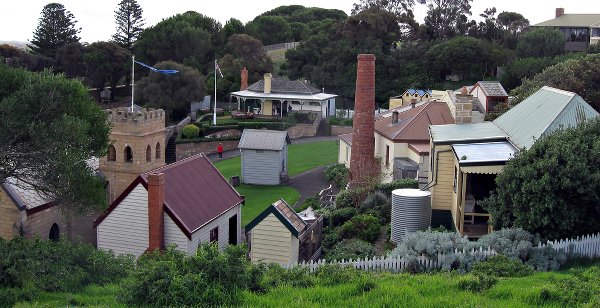
Warrnambool’s Flagstaff Hill is at a crossroads and requires a long-term commitment of $15million to prosper. Image: letsgotravelaustralia.com
OPINION
With all the excitement around the sale of the Warrnambool Fletcher Jones site, important details on the future of another prominent site in the city – Flagstaff Hill Maritime Village – have slipped by virtually unnoticed.
But despite the distractions, we do need to talk about Flagstaff Hill – or “Flaggy” as it is called by those closest to the action – because unlike the FJ site, which was privately owned, this one is costing us money.
At the moment, the Warrnambool City Council is absorbing an annual deficit of around $500,000 for the 40-year-old Flagstaff Hill Maritime Museum due to falling visitor numbers that have tumbled from 80,000-plus a year to below 60,000. As I have written before, the village needs at least 80,000 visitors a year to break even.
While profit is not everything when it comes to community assets, something significant needs to be done to turn things around, or – it has now been confirmed – the site will cost the council (ie. ratepayers) almost $9 million in “losses” over the next 20 years.
It is crunch time and the crunch is that almost $15 million must be spent in the next three years on Flagstaff Hill to make any real difference to its future.
This is the conclusion reached by consultants, Coffey Sport and Leisure, who were paid $90,000 to prepare a masterplan that mapped out how to turn the site around and whose final report was recently made public.
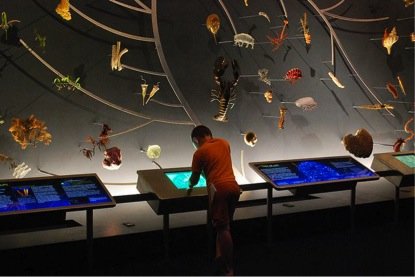
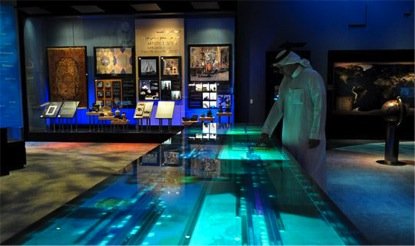
The masterplan includes images of what a new interactive discovery centre might look like at Flagstaff Hill.
The masterplan set out a number of scenarios – from do nothing, which would eventually see the site close – through to an all bells-and-whistles affair that would cost almost $26 million.
The report ultimately recommended a middle ground that would cost $14.8 million over three years and, potentially, turn the site into a profitable venture by doubling the number of visitors over the next 20 years.
The “middle ground” plan includes broadening the whole theme of the centre to the Great Southern Ocean (which, to some extent, has already begun); building a new, sexy interactive discovery centre that captures the stories of the Great Southern Ocean (from indigenous history, to whales, to shipwrecks); upgrading the existing sound and light shows; giving free access to the colonial village; adding another cafe and introducing food/wine events; and linking the whole site up with Lake Pertobe and Cannon Hill.
To make it happen, the council would need to chip in 25% of the total cost – ie. around $4 million – and the remainder come from state and federal funds, which, given the harsh cuts within the last Federal Budget, would be difficult.
The most important point, however, is that the report makes it clear that this plan is the very least that is required if Flagstaff Hill is to remain relevant and viable.
In other words, unless we are able to find almost $15 million in combined ratepayer and taxpayer funds, we are pretty much wasting our time and delaying the inevitable.
Another image from the masterplan report that shows how Flagstaff Hill might improve its displays which were described as “uninspiring and static”.
The council knows this, but it also knows that trying to find a spare million or two in its budget right now is almost impossible.
As a result, it recently agreed to contribute $500,000 in 2014-15, and another $500,000 the following financial year toward a $3 million upgrade of the very-dated Shipwrecked sound and laser night show, plus some other minor improvements. It hopes the state and federal governments will at least chip in another $2 million between them.
It is a Band-Aid on an oozing knee, but the council somewhat optimistically hopes that this will lift visitors to its night show by 30%.
I say optimistically, because sound and light shows were a big deal in 2002 – when Shipwrecked began – but people now have access to such technology in their own lounge rooms and will expect something pretty special.
Still, it is a start, but the conversation that still needs to be had is whether the community wishes to see up to $15 million spent on the site over the next three years.
Cashed up private investors like Dean Montgomery, who recently bought the Fletcher Jones site, may prove critical to the long-term survival of Flagstaff Hill.
The council sought public feedback on the masterplan last year, and while the 145 people who responded said they wanted to see Flagstaff Hill continue, it is only now being laid out in black and white as to what funds will be required to make that happen in any robust way.
Indeed, the total cost of the long-term plan is rarely mentioned at all, but instead its is framed as a “staged development”. (There was certainly no mention of $14.8 million in the council’s most recent media release on the issue.)
There is also regular reference to the council seeking private investment for the site, in the hope that – once again – a cashed up white knight will come and save the day for Warrnambool.
Unfortunately a Dean Montgomery only comes along once in a blue moon and he has grabbed hold of the Fletcher Jones site where, unlike Flagstaff Hill, the conversation became very public, very frank and, ultimately, very productive.
So, do we spend $15 million on Flagstaff Hill in the next three years to turn its fortunes around, or not?
Over to you.
From serious science to one cool cat
Sisters Victoria (front) and Elizabeth Carey are the smiling faces behind the wonderfully named Day Kitty cafe in the former Flaherty’s Chocolate Shop, Warrnambool.
[dropcap style=”color: #a5cecd;”] A [/dropcap]mid all the gloom of shops closing in Warrnambool, the city’s burgeoning cafe scene is stepping up to the plate to show how funky places can not only survive, but thrive.
The wonderfully named Day Kitty cafe is among the newcomers, having taken over the former – and famous – Flaherty’s Chocolate Shop building in Kepler St, right next door to the Capitol Cinema.
Since opening six months ago, the cafe with a striking black-and-white decor has carved out a niche market with its emphasis on organic that includes home-made, artisan milkshakes and icecreams, fresh-pressed juices, light meals, salads and hot drinks.
It is like a soda fountain, meets a coffee shop, meets a gourmet salad-and-juice bar – and it works.
The sisters (Victoria in the middle, Elizabeth, right) were always close and have ended up working side by side after initial careers as scientists. They are pictured here with their eldest sister, Anastasia.
[dropcap style=”color: #a5cecd;”] W [/dropcap]arrnambool sisters Victoria and Elizabeth Carey are behind the venture, although Elizabeth insists she is simply “helping out” Victoria, who created the dream and has pulled all of the pieces together.
Both are former scientists who, after 10 years in their respective fields (the sisters were born two years apart), decided they wanted to do something completely different with their lives.
Victoria worked in dairying manufacturing at Murray Goulburn, in Koroit, where she gained all of the experience necessary to break out into making artisan icecreams that would use only organic ingredients.
The waffle cones, which are hand-made by Elizabeth, use the egg whites leftover from the icecream.
The cafe’s icecream and milkshake bar harks back to the hey-day of Flaherty’s, who were known not only for their extraordinary array of chocolates – particularly at Easter – but for the entire Flaherty family each taking a turn at serving icecreams and milkshakes to cinema goers.
“I knew exactly the sort of cafe I wanted to have, and I knew it had to be here, in this building,” Victoria says.
“We have had different members of the Flaherty family drop in to see how it looks, and that has been really lovely,” she adds.
Victoria hand-makes all of the icecreams, using only organic ingredients, while Elizabeth makes the waffle cones using the leftover egg whites.
[dropcap style=”color: #a5cecd;”] B [/dropcap]efore joining her big sister at Day Kitty, Elizabeth specialised in the remediation of contaminated land so it is not surprising that she, too, has a strong commitment to sustainability.
“We try and recycle and reuse as much as we can. Our food scraps are composted and all of the cardboard is taken away and recycled,” she explains.
Even the cutlery and drinking straws are made from recycled bamboo – rather than plastic – although it did take a bit of trial and error to find the right straws.
“We started with some paper ones, but they fell apart before the drink was finished,” Victoria says, laughing.
Day Kitty is now “about 95 per cent organic”, according to Victoria, with a particular style of coffee bean proving to be the final, 5 per cent hurdle.
As for the name, it was chosen simply because it sounded good and is easy to remember.
“It was going to be Day Kitty-Night Owl, because we had planned to eventually open in the evening and offer cheese platters with a nice glass of wine,” Victoria says.
That may still happen, but for now the pair is happy to keep growing the business during daylight hours. The next chapter is about to unfold, with the hiring of a chef so that they can expand their lunch and breakfast menu.
“One day I would really like to also run an organic fruit and vege store, but that is a little further down the track,” Victoria says.
These vintage scoops were found in secondhand stores around Warrnambool and may have even been used by Flaherty’s….who knows?
[box type=”bio”] Day Kitty, 53 Kepler St, Warrnambool is open Mon to Fri 8.30 to 5.30 and Sat 9-5. Ph: 5561 6921[/box]
[button link=”http://the-terrier.com.au/subscribe-2/” type=”icon” icon=”heart” newwindow=”yes”] Did you enjoy this story? Please subscribe here to help Bluestone thrive.[/button]
South-West author Wendy Coyle has so far produced two books for children based on her own, often challenging, experiences of raising three sons.
[dropcap style=”color: #a02f2f;”] W [/dropcap]hen author Wendy Coyle was growing up, there was no such thing as Attention Deficit Disorder or the like, instead some school kids were just classed as “naughty” and in need of a firm hand.
A generation later, ADD and its close cousin, Attention Deficit Hyperactive Disorder, are diagnosable conditions that often require medical intervention, but that hasn’t stopped children who suffer from the condition being dismissed as “uncontrollable” or “naughty”.
“What a lot of people still don’t understand is that kids with ADHD don’t want to be like they are, but it is how their brain fires off,” Wendy says.
Wendy, who lives on two acres in Mepunga with her husband, Ian, and their three sons, speaks from first-hand experience, with her eldest child, Jack, diagnosed with ADHD during Grade 1 in 2005.
The family was living in Melbourne at the time and Wendy “began to write down notes on scraps of paper” about how Jack’s ADHD affected himself and those around him.
By 2008, the scraps of paper began to take shape in Wendy’s mind as a children’s book that could help others – children, teachers and parents – to see ADHD from the perspective of the young sufferer.
The Naughty Kid, featuring a seven-year-old main character called Jack, was self-published in 2012.
“This labelling of a child as ‘the naughty kid’ is really powerful because once they have that title, it is very hard to lose it, no matter how hard they might be trying to change,” Wendy says.
“My kid was that ‘naughty kid’ and I know how terribly hard that was for Jack.”
Wendy with son Jack, now 15, whose battle with ADHD spurred her to write her first book, ‘The Naughty Kid’, so that others might better understand the condition.
[dropcap style=”color: #a02f2f;”] T [/dropcap]he book hit a nerve with other parents of ADHD children, with one mother writing to Wendy to tell her that she cried when reading “Jack’s” story, as it mirrored that of her own child.
Jack is now 15 and no longer on the medication that was required to stabilise his impulsive behaviour. But just as Jack was emerging from the worst of his symptoms, Wendy youngest child, Ryan, was diagnosed with ADD – “no H this time” – again in Grade 1.
“That seems to be when it starts to become a problem, because while the other kids are all settling into school and routines, these kids are going the other way,” Wendy explains.
Raising three “gorgeous but often challenging boys” has been at times exhausting, but Wendy says it also fuelled her creativity.
Since The Naughty Kid – which Wendy is reproducing as an e-book – she has published a chunky, almost indestructible book, My Very Own Alphabet Book, which has large cut-outs for personal photographs to be inserted for each letter.
“This is how I taught my boys the alphabet: through familiarity and consistency,” Wendy says.
Earlier this year, Wendy launched a My Very Own Alphabet app and, when we meet, she is finalising the manufacture of a plush toy, Angus the ant, who features in the book.
Wendy admits she is rarely not thinking about more book ideas or ways of extending the reach of those she has already written.
[dropcap style=”color: #a02f2f;”] W [/dropcap]endy laughs as she admits that her own mind, much to the frustration of partner Ian, “doesn’t stop sparking with ideas” now that she has been bitten by the book bug.
“I really like writing and I am always thinking of something…I also really like writing for boys, because it gets them interested in reading,” she says.
Her next project is a series called Billy And Max about two adventurous farm boys who are always narrowly avoiding trouble…or meeting it head on.
Despite being born in Melbourne and having lived there for most of her life, Wendy has embraced the country since moving to South-West Victoria – “just for two years” – in 2010.
When she is not writing, or mucking about on the land, Wendy works as an administrative assistant at Warrnambool College and Noorat Primary School.
“Writing is a risk, especially a financial one, but you have to take a risk to do something interesting with your life,” she says.
“There is always an element of uncertainty about whether it will work, but you still have to take that chance.”
[box] The Naughty Kid and My Very Own Alphabet Book are available locally through Warrnambool Books. To find our more about Wendy’s work, visit her website and find her on Facebook.[/box]
[button link=”http://the-terrier.com.au/subscribe-2/” type=”icon” icon=”heart” newwindow=”yes”] Did you enjoy this story? Please subscribe here to help Bluestone thrive.[/button]


 Meet our other Quiet Heroes…


 If you like local history, you might also enjoy…