[box] As part of our Treasures section, we will make a monthly visit to Tony and Luke at Ozone Bazaar in Koroit St, Warrnambool (who are great supporters of Bluestone Magazine) to see what intriguing items they have picked up locally.[/box]
[dropcap style=”font-size: 60px; color: #E6E600;”] W [/dropcap]ell before the Thermo-mix, Bamix and Kitchen-Aid, there was the Sunbeam mixmaster.
Just about every kitchen across south-west Victoria had one of these tucked in the kitchen cupboard from the 1940s to 70s, but to find one today in buttercup yellow, with matching bowls and even the instruction booklet is rare indeed.
Even more miraculous is the fact this 1950s model is still in working order: it is hard to imagine any modern kitchen device lasting for 50 years!
Did your mother have one of these?
Ours did…and in my case (Carol), it was white, with the big dial on the end that you could turn to match the recipe – cakes, cream, mashed potato etc. The mixer would roar into life, puffing a cloud of slightly oily smoke into the room, which served as a reminder that Mum needed to put a drop of Singer sewing machine oil into its mechanism.
The best bit, of course, was at the end when Mum would undock the beaters, hopefully covered in cream, and hand them to us kids to lick. Some simple pleasures don’t change.
[button link=”http://the-terrier.com.au/subscribe-2/” type=”icon” icon=”heart” newwindow=”yes”] Do you enjoy Bluestone? Please subscribe here to help Bluestone thrive.[/button]
Capturing Warrnambool: Photographer James Mepham with partner Emily Reeves and their six-month-old daughter, Elliott.
Words and pictures: Carol Altmann
[dropcap style=”font-size: 60px; color: #A02F2F;”] O [/dropcap]n the surface, Warrnambool and its surrounds may appear to be a very Anglo-Saxon kind of place, but professional photographer James Mepham and his partner Emily Reeves are seeking to capture another side.
The couple – who recently moved back to what is Emily’s hometown – have travelled the world and immersed themselves in various cultures, particularly across south-east Asia and India, but their latest project involves documenting the many cultures that make up south-west Victoria’s largest city.
“When I moved away 20 years ago, Warrnambool was thought to have very little culture and seen as very mono-cultural, but that has really changed,” Emily says.
About six months ago, the pair launched the Cultural Diversity Photography Project – “we could probably do with a better title,” James laughs – where James would photograph local people who were born overseas, while Emily recorded an oral “snapshot” of their stories.
These people and stories would be contrasted with local residents who were born and bred in Warrnambool and who have never been abroad: there are quite a few people who fit that category too.
“We are not here to judge, we are not here to put people in boxes, but to simply get this information out there – these stories out there – and hopefully generate a bigger conversation,” Emily says.
“Yes,” adds James, “in that way it is a documentary: it is documenting a moment in time, capturing how things are in Warrnambool right at this moment.”
Local faces from faraway places: Alex (USA) and Artur (Brazil) are among those photographed for the cultural diversity project. Their actual portrait will be revealed next year. Image: James Mepham. www.warrnamboolphotography.com.au
[dropcap style=”font-size: 60px; color: #A02F2F;”] W [/dropcap]ith the help of Phil Hoggan from the Warrnambool City Council’s now-disbanded skilled migrant program, the pair has made contact with people from a number of countries, including China, India, Sudan, the Philippines, Scotland, Sri Lanka, Brazil, Poland and the USA, but are keen to hear from more volunteers.
The stories are already proving to be fascinating.
One Polish couple, for example, was asked by Emily about their dreams for the future.
“They said ‘there is no dream for the future, because this is our dream: this is it,”’ Emily said.
While the experiences captured so far have been overwhelmingly positive, the pair know that not all migration stories have a happy ending – racism and isolation can make living in a regional area very difficult. These stories, if people are prepared to tell them, will be included too.
James and Emily are still in the gathering and interpretation stage of the project, but hope to have an exhibition ready by next March. Both the Warrnambool City Council and Warrnambool Art Gallery have shown a strong interest in showing the work, which will be the first time those involved will see their portraits.
Polish couple Danuta and Vladek are among those who have volunteered so far for the cultural diversity photography project in Warrnambool. Their final portrait will be revealed next year. Image: James Mepham. www.warrnamboolphotography.com.au
[dropcap style=”font-size: 60px; color: #A02F2F;”] B [/dropcap]efore coming to Warrnambool, James worked as a professional photographer in Melbourne, having taught himself photography while in the army and going on to become a photo-journalist for the military. His assignments included East Timor, Bougainville, Solomon Islands, Sumatra and being the first photographer on the ground after the tsunami hit Banda Aceh.
Such experiences not only left him worldly, but open-hearted to suffering and how fortunate we are to live in Australia.
“I have always been interested in people’s stories and meeting people from all walks of life: it’s a world I have always enjoyed and I want my daughter (Elliott) to enjoy,” James says.
While in Melbourne, he was part of the Free Photography Project, offering free portraits to low-income earners, homeless people, or unemployed people who needed a photograph for a job.
Emily, meanwhile, has just returned to work after the birth of Elliott and it says a lot about how much Warrnambool has changed that she is the Asia-Pacific manager for World Animal Protection, yet works from home.
Both are loving life back by the ocean and say the cultural diversity project has provided an instant friendship circle.
“I must admit that was another one of my motivations: it is a great way to get to meet really interesting people,” James says, smiling.
Here’s looking at you: James Mepham and partner Emily Reeves are behind the project to capture the cultural heart and diversity of Warrnambool.
[box] If you would like to be photographed for the Cultural Diversity Photography Project – either as a migrant to Warrnambool or someone who has never travelled overseas – you can contact James on 0414 833 012 or james@warrnamboolphotography.com.au. There is no charge. Visit the Warrnambool Photography website here for more details.[/box]
[button link=”http://the-terrier.com.au/subscribe-2/” type=”icon” icon=”heart” newwindow=”yes”]Bluestone is aiming for 500 subscribers. If you enjoyed this story, please click here to become one![/button]
The family that cooks together… The Phillips family – from left, father Gary, Aleesha, Tryleen, mum Chris and Shantelle far right, are all involved in Dunkeld Delights.
By Carol Altmann
[dropcap style=”font-size: 60px; color: #512D97;”]T[/dropcap]he colour purple has always been linked to royalty, so it is the perfect decor choice for a new family-run cafe that is fast becoming the king of sweet treats in Dunkeld.
Everything from the purple floor to the purple coffee cups, napkins, chairs and tongs gives an indication that Dunkeld Delights is a place with a sense of fun and that’s exactly what to expect when you drop in to what is a stylishly converted shed next to the Phillips family home in Williams St.
The Phillips family are an extraordinary group.
Not only do they get along well enough to share a house – with three of the four children having moved away and since returned – but they now all share in the family business of baking and making delicious goodies.
Until recently, Dunkeld Delights had been a regular on the local market scene, with mother, Chris, and daughter, Shantelle, making a name for themselves over the past eight years through the homestyle quality of the treats they produced in their home kitchen.
“We had the idea for a long time to do something like this (a cafe), but it was only last year that all of the pieces started to come together,” Shantelle explains.
The magnificent garden at the front of the Phillips’ family home, alongside which they have based their cafe that overlooks the grounds.
[dropcap style=”font-size: 60px; color: #512D97;”] O [/dropcap]ne of those pieces was the popularity of the Dunkeld Delights cookies and cakes at Cafe 109, also in Dunkeld, where Shantelle was working at the time and which stocked her cakes and slices.
“I started to think that maybe it was finally time to go out on our own and do our own cafe,” she said.
Another was the return home of sisters Aleesha and Tryleen (who is, as far as she knows, the only person named Tryleen in Australia), neither of whom were bakers, but who were prepared to learn.
Chris and Shantelle are the type of self-taught cooks who can make anything, so they quickly taught the pair the finer points of baking and each sister now has her own area of expertise (more about that in a moment).
The final piece of the puzzle was father, Gary, who had recently retired and was able to help out with the behind-the-scenes book-keeping and other business essentials.
There was only one sticking point.
“The shed that we hoped to use was absolutely full of junk – lawnmowers and all the usual stuff you find in a garage,” Chris recalls with a laugh.
The solution? Build another shed for all of the garage junk.
The home-made chicken and mushroom pie that actually smells like fresh mushrooms and tastes delicious.
[dropcap style=”font-size: 60px; color: #512D97;”] E [/dropcap]arlier this year the front shed was converted into a commercial kitchen, shopfront and small cafe, with an outdoor dining area that overlooks the Phillips’ magnificent garden. The cafe opened for business in August and has not looked back.
Indeed there is already talk of expanding the premises to allow for more seating and the self-contained room that son/brother Jayson uses on visits home may have to be sacrificed for that one!
The menu has also expanded to include a range of savoury items, including what might possibly be the best chicken-and-mushroom pie I have ever tasted.
“We all have our areas of expertise now,” says Chris, while identifying herself as the maker of the pie.
“Shantelle is the slice person, I am the big cakes and pies girl, Tryleen is biscuits and Aleesha makes a carrot cake to die for,” she laughs.
And who decided on the purple floor?
“It was meant to be grey and white, but when I saw it, I thought, boy that looks boring, and I kept looking at the purple thinking, ‘hmmmm,” Chris says.
“It is all a bit of fun and that’s how I wanted it. I want my kids to go to work every day and say, I am going to have the greatest day.”
Judging by the amount of laughter and happy banter during our visit, the purple is definitely working.
Shantelle, Gary, Tryleen and Aleesha with “natural cook”, Chris in front, out in the garden area of their new cafe that opened in Dunkeld in August.
[box]Dunkeld Delights is one of four cafes now operating in Dunkeld and can be found at 35 Williams St, off Victoria Valley Rd. Open 7 days from 9am-4pm. You can join them on Facebook here. The Discover Dunkeld Weekend is on from Oct 17-19: what a perfect time to visit the town. Full details here.[/box]
[button link=”http://the-terrier.com.au/subscribe-2/” type=”icon” icon=”heart” newwindow=”yes”]Bluestone is aiming for 500 subscribers. If you enjoyed this story, please click here to become one![/button]
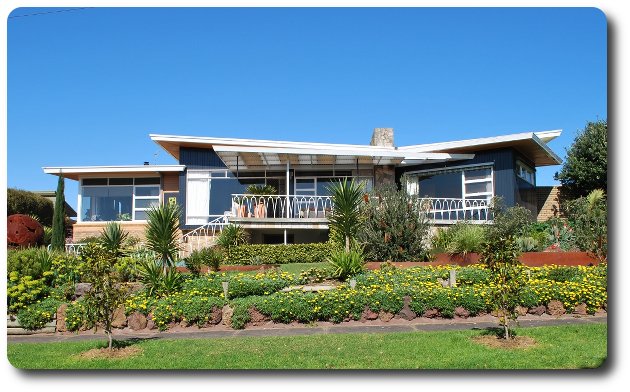
The imposing house on the corner of Altmann Ave and Gladstone St in Warrnambool is one of the best-known (and coveted!) in the city. It was built by owner-builder John Dowie in the 1950s.
This is the second feature by our new monthly columnist, architect CLINTON KRAUSE, who previously worked in Daylesford before relocating his business to Warrnambool. Clinton explores the mid-century architecture that gives our city so much character, but about which most of us know very little…
It would seem that a lot of people are familiar with our home in East Warrnambool.
‘Great House!’, ‘Í‘ve had my eye on that one’ and ‘hope youré not going to make too many changes?’ were just some of the comments from neighbours, new friends and acquaintances when we took up residency 4 years ago.
It appears that this great example of mid century design has achieved a degree of minor celebrity among the local community.
Given this, I thought this month I would keep my column “close to home” by taking a closer look at my own home.
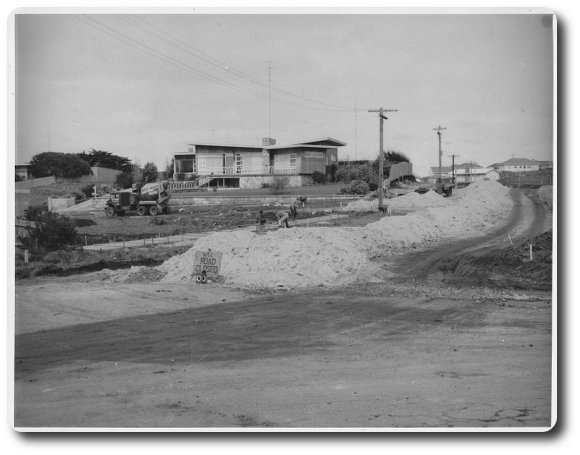
An early shot of the Downie house shortly after its construction. The design made a statement for its time.
The home was built in 1958 by local builder John Downie who along with his wife and young family settled in Warrnambool to contribute to the post-war building boom in the region.
They adapted a plan from one of the many home design magazines of the time that offered up architectural ‘patternbook’ designs to the readership as a means of raising the bar for the average suburban homeowner. Many were inspired by American designs (read more about this in my first column here).
The original plans prepared by John reveal that the floor plan layout and detailing continued to evolve and that subsequent renovations and additions were sympathetically handled to enhance this already distinctive design.
Early photos show the home perched proudly atop the crest of the site looking peculiarly ahead of its time compared to the neighbouring bungalows and street vehicles.
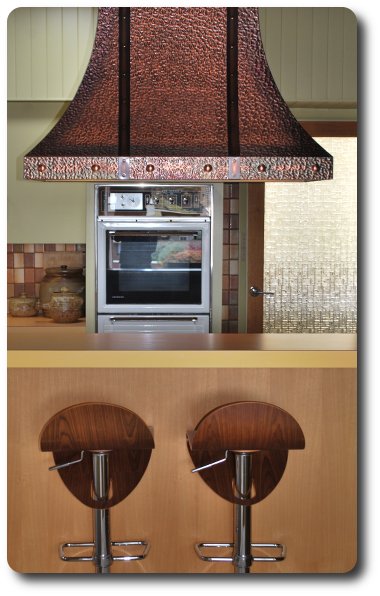
The original 1950s-styled kitchen is still intact, complemented by some modern furnishings.
The defining design element for the house is its butterfly roofline.
A simple, shallow ‘V’ shaped roof over the main house is complemented with angled terraces, pergola and intersecting room projections to create a dynamic mix of angles, planes and shapes.
With its gentle roof pitch and the large one-metre overhangs, the roof soars out and hovers over the house below.
Architecture of this time experimented with the structural limitations of ordinary building materials and walls and rooflines were lean and streamlined often defying gravity to excite the senses.
But it was not only just about appearances.
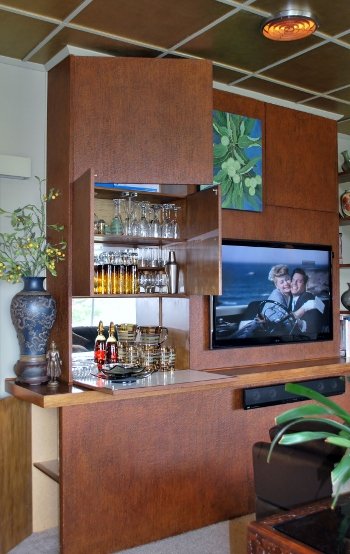
Drinks? The James-Bond inspired cocktail bar is discreetly tucked away inside a purpose built cabinet. Also note the original down-lights in the ceiling.
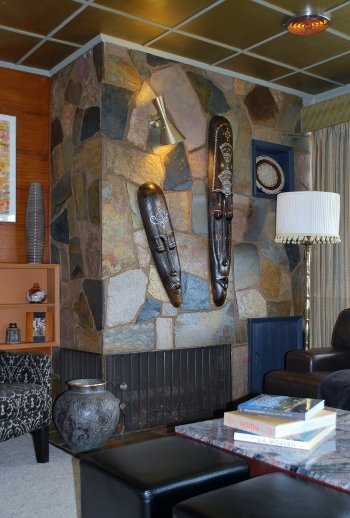
The crazy stone fireplace provides a dramatic centrepiece to the loungeroom.
The Downie house also responds to the vagaries of our local environment. Large expanses of glazing soak up the warmth of winter sun and are shaded in summer by the overhanging roof.
Internal room layouts respond to the orientation with living areas enjoying good natural light and the house sheltering from the prevailing winds.
Distinctive interior décor elements include the ‘James Bond’ built-in cabinet, that conceals a cocktail bar along with other storage nooks and crannies. Martini anyone ?
The living room ceiling features a battened grid layout originally picked out in a mosaic pattern of dusty greens and mustard shades along with early prototype downlights – quite advanced for the time.
A crazy stone fireplace dominates this room and features display niches and an original spun aluminium anodised wall lamp.
Other building elements such as the imposing stone clad chimney, delicate iron balustradings and the cantilevering of rooms over lower base walls are all design elements that define this era in architecture.
As custodians of this great example of mid-century design, it is our pleasure and honour to restore, cherish and enjoy this special home.
Clinton
Next Month:Just who was Tag Walter?
Granny’s Grave buried in bureaucracy
Despite promises of greater recognition for the ‘Granny’ behind Granny’s grave – and the need for restoration – the site remains unchanged and falling into further disrepair.
OPINION
[dropcap style=”font-size: 60px; color: #DC943C;”] T [/dropcap]here are not a lot of memorials to women in Warrnambool: in fact compared to the ovals, parks, plaques, sculptures, plinths and pioneer boards that have been devoted to civic-minded and influential men, there is barely anything at all.
The historic Warrnambool Pioneer Board appears to have set the standard and has become as famous for its omissions as its inclusions.
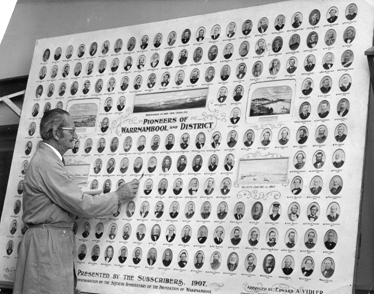
Put together in 1907, the 3m x 2m board features 204 individual photographs of Warrnambool’s pioneers and not one of them is a woman. In an almost humorous twist, the board itself was assembled and illustrated by a woman, Lillian Foyle, but nobody remembers her name compared to those who feature in the circular frames.
You would think that more than 100 years on things might have changed considerably, but it appears not.
I am happy to stand corrected, but the only high-profile monuments to women that come to my mind easily are the contemporary Val Bertrand Stadium in west Warrnambool and the 110-year-old Granny’s Grave in the sand dunes off the bike/walking track in east Warrnambool.
And the Granny’s Grave site is looking increasingly worse for wear.
The Warrnambool Pioneers’ Board, now displayed at Warrnambool’s History House, was made in 1907 and does not feature a single woman. Image: Warrnambool and District Historical Society.
[dropcap style=”font-size: 60px; color: #DC943C;”] D[/dropcap]espite being passed by thousands of people every year, including tourists who are encouraged to visit the grave, the monument is covered in rust stains, the paintwork is peeling and chipped, the metal surround is completely out of character with the grave, and the site is surrounded by weeds.
There is also no interpretive plaque or information about “Granny”, other than the few – and as it turns out, incorrect – lines etched into the basalt headstone, even though the Warrnambool City Council announced earlier this year that a plaque would be in place by the end of June.
It is now the middle of October, and I have become tired of asking the council when the plaque might be coming and no doubt they have tired of me too.
Bluestone wrote earlier this year about the fascinating story behind the “Granny” who lies in Granny’s Grave – Agnes Ruttleton – and how she has come to represent all of the faceless and nameless women who were among the very first to come to a scrap of a town called Warrnambool in the hope of a better life.
Agnes was never a rich woman, and she died in poverty at the age of 60 in 1848, but there was something about her indefatigable, pioneering spirit that more successful and wealthy citizens like Richard Osburne thought was worth commemorating. He lobbied for years to have the approximate site of her burial marked by an official grave.
The council knows this is a special site, but the wheels turn extremely slowly when it comes to preserving key elements of our past.
A council report from 2008 first raised the need for significant restoration on the high-profile site, but only the handrail has been replaced.
[dropcap style=”font-size: 60px; color: #DC943C;”] A [/dropcap] 2008 management report into the city’s public art and cultural assets concluded way back then that Granny’s Grave needed “significant restoration”, including replacing the rusted handrail, ongoing weeding and, with the help of expert advice, cleaning the stone surface, removing the rust stains and re-patching and re-coating the concrete as required.
The handrail has been replaced, but that’s where work has stopped.
I wonder if the council – and us, as residents – would be so accepting of the situation if the memorial marked a returned soldier, a famous footballer, or a founding father of the town?
The council recently voted to apply heritage planning controls over the Granny’s Grave site and I was slightly stunned that it hadn’t already been covered.
Councillor Jacinta Ermacorasummed it up when she said the heritage protection process not only for Granny’s Grave, but for dozens of other sites around Warrnambool had “taken far too long”. Given the process began in 1983 – when the council first realised its heritage controls were hopelessly out of date – Cr Ermacora is being generous.
Why is it like this?
Why does it take so long for any action to be taken on preserving our heritage and, when it is, it is often half-finished and then abandoned?
It appears that we are so focussed on the “now” that we have lost sight of preserving the characters and essence of our past.
Agnes is certainly a rare character from our past who deserves her proper place in our story.
Meanwhile, in Portland, the council is adding contemporary monuments to key women from the city’s past, including this seat in honour of suffragette Vida Goldstein by local artist Carmel Wallace.
[button link=”http://the-terrier.com.au/subscribe-2/” type=”icon” icon=”heart” newwindow=”yes”]If you would like early access to Opinion pieces, please subscribe to Bluestone.[/button]


 You might also enjoy…


 You might also enjoy…


 You might also enjoy…