Investigation launched into Flagstaff Hill

Flagstaff ingots_18
Flagstaff Hill in Warrnambool is under investigation after revelations of missing and lost items, and damage to Loch Ard artefacts. Image: Bluestone Magazine.

EXCLUSIVE: Carol Altmann

[dropcap style=”font-size: 60px; color: #A5CECD;”] T [/dropcap]he Flagstaff Hill Maritime Village in Warrnambool is under formal investigation by Heritage Victoria over missing items from its collection and damage to relics from the wreck of the Loch Ard.

As recently reported in Bluestone Magazine, two of the 10 copper sheets from the Loch Ard (1878) that were loaned to Flagstaff Hill by the Federal Government have been cut.

It is believed that a large slice was taken from one of the sheets in recent years for use as a sculpture or trophy, while the other has had a 10 x 10cm piece removed.

The Loch Ard, arguably Australia’s most famous shipwreck, is listed as a wreck of state and Commonwealth significance.

It is an offence under Section 13 of the Commonwealth Historic Shipwrecks Act to “destroy or cause damage to a historic shipwreck or historic relic” and can lead to a fine of up to $10,000 or imprisonment for an individual, or a $5000 fine for a body corporate.

In addition, Flagstaff Hill manager Peter Abbott recently confirmed in a letter to the local newspaper that the museum had lost track of at least 129 items from its collection, including the brass ship’s bell from the wreck of the Newfield (1892) that was once displayed in the Great Circle Gallery.

Heritage Victoria told Bluestone Magazine late Friday that, as a result of the revelations, it had opened an investigation into the collection practices at Flagstaff Hill.

“Tim Smith, Executive Director, Heritage Victoria confirmed Heritage Victoria is investigating the care and storage of items at Flagstaff Hill Maritime Museum,” a spokeswoman said via email.

Mr Smith was unavailable for further comment.

Heritage Victoria is responsible for the initial investigation into any potential breaches of the federal law governing historic shipwrecks. It is also responsible for investigating if there have been any breaches of the Victorian Heritage Act, which carries its own penalties.

Copper Sheets-2
An image of the copper sheets from the Loch Ard which clearly shows the bottom sheet severed from right to left.

[dropcap style=”font-size: 60px; color: #A5CECD;”] F [/dropcap]lagstaff Hill, which is accredited by the museum governing body, Museums Australia, has had the spotlight turned on its collection management processes after questions late last year by Warrnambool City Councillor Brian Kelson.

Mr Kelson’s probing about gaps in the museum’s online collection database led to revelations that 220 lead ingots from the Loch Ard could not be accounted for.

Flagstaff Hill was given custody of 872 lead ingots in 1984 as part of the same federal loan agreement that governed the copper sheets.

Mr Abbott and council chief executive officer Bruce Anson have both since given assurances that the bulk of the missing ingots are in the hull of the derelict Rowitta ferry, although there has been no official count due to the poor condition of the vessel.

The ferry, which sits on the pond at Flagstaff Hill, is scheduled for demolition later this year.

Mr Abbott has recently been caught up in a separate scandal, after he was named by the local newspaper as the author of several anonymous comments made to its online forums, in which he made personal attacks against Cr Kelson and Cr Peter Hulin.

Cr Hulin has since indicated he will move a motion of no confidence against CEO Mr Anson at the first council meeting of the year on February 2, citing his handling of Mr Abbott’s behaviour as an example of why the Local Government Minister should be asked to intervene.

 [button link=”http://the-terrier.com.au/subscribe-2/” type=”icon” icon=”heart” newwindow=”yes”]Bluestone needs at least 500 subscribers in 2015. If you wish to support independent media, please click here to become one.[/button]

Stones Smile newsletterYou might also enjoy…

Flagstaff Hill: a museum in transition, or a mess?

Are missing Loch Ard ingots the tip of the iceberg?

The changing landscape under Midfield Meats

Sucking the wind out of Portland’s sails

Granny’s Grave buried in bureaucracy

All words, no funding, for Fletcher Jones story


Women shine in W’bool Australia Day awards

1-vicki jellie_4
Warrnambool’s 2015 Australia Day Citizen of the Year, Vicki Jellie. Vicki was recognised for creating the hugely successful fundraising campaign, Peter’s Project, to build a cancer treatment centre in the south-west.

The founder of the hugely successful Peter’s Project fundraising campaign, Vicki Jellie, has topped the list of Warrnambool City Council Australia Day awards for 2015 as one of six women awardees.

Vicki has been named Warrnambool’s Australia Day Citizen of the Year in recognition of her work in driving the fundraising campaign for a cancer treatment centre in south-west Victoria.

“It is really lovely to receive this recognition for my work, but this award belongs to all of the Peter’s Project board and to the community – it is really about the community,” Vicki said.

The other winners include Ann Krause, Megan Nicolson and Julie Eagles, each of whom received a Warrnambool Australia Day Local Achiever Award, together with disability advocate Lorraine De Kok, the inaugural president of the Inner Wheel Club of Warrnambool, Kaye Slater, and firefighter and mentor Wayne Rooke.

Young Citizen of the Year is Sam Maloney who was recognised for his mentoring work with young people through 3WAY community radio and Brophy Youth Services.

It is very different picture to 2014, when the council received only two nominations for women and neither were among the winners. (Teenager Olivia Niddrie was Young Citizen of the Year.)

This prompted a concerted effort within some sections of the the community to ensure that more women were among those in contention for an award in 2015.

Bluestone Magazine was among those to nominate Vicki, Ann, Megan and Julie and encouraged our readers to either do the same, or nominate a woman candidate of their choice.

We are thrilled to see such inspiring women formally recognised for their contribution to our community.

1-Ann Krause_10
Australia Day Local Achiever Award winner Ann Krause, who was recognised for her work with women who have experienced breast cancer.

Ann Krause was recognised for her incredible work with supporting breast cancer survivors, having been diagnosed with breast cancer herself in 2007.

Ann was one of Bluestone’s Quiet Heroes and, as we have written previously, volunteers for a range of breast cancer support groups.

She is the regional community liaison officer for Breast Cancer Network Australia (BCNA), a group that ensures women and their families are given the very best support upon diagnosis, and is also the co-ordinator of the Warrnambool Social Breast Cancer Support Group.

Ann was also the instigator of the Warrnambool South C Dragons women’s paddling group and remains its president. This social group is soon to head to its first Tasmanian regatta.

julie eagles aust day
Winner of a Local Achiever Award, Julie Eagles, was recognised for her involvement in numerous community projects, including lobbying for the preservation of local heritage such as the Fletcher Jones gardens and silver ball. Image: Bluestone Magazine.

Julie Eagles – who was another of Bluestone’s Quiet Heroes – was recognised for her contribution to the conservation and promotion of local history.

The WCC said Julie has been a “tireless campaigner for many years” toward recognising and preserving the city’s built and social heritage and assisted in critical decision making and planning processes around this heritage.

“As a key player in the Warrnambool Heritage and Planning Group, Julie has helped to protect and preserve our irreplaceable built and social heritage for the enjoyment of the community and for generations to come,” the council said in its media statement.

megan nicolson_12
Warrnambool artist Megan Nicolson has been recognised for her contribution to the arts. Image: Bluestone Magazine.

And, as it so happens, local achiever Megan Nicolson was our very first Quiet Hero, way back in September 2013.

As a long-term member of the F Project artists’ collective, Megan was instrumental in establishing The Artery art space in Timor St, which has not only revitalised the local arts scene, but also a key part of Warrnambool’s CBD.

Megan, an artist, has since played a pivotal – and often exhausting – role in the highly successful Fletcher Jones community picnics and arts markets, held at Pleasant Hill last September and December.

Congratulations to all the award recipients, including the Community Event of the Year, the Rotary Hole-in-One Competition.

The award winners will be officially recognised at a ceremony in the Warrnambool Botanic Gardens on Monday, January 26, from 10.30am.


Love birds flock to Portland gannet colony

1-mel wells_14
Marine biologist and self-confessed seabird nut Melanie Wells will lead a tour of the Point Danger gannet colony at Portland on January 25. Image: Bluestone Magazine.

By Carol Altmann

[dropcap style=”font-size: 60px; color: #DC943C;”] M [/dropcap]elanie (Mel) Wells is beside herself with excitement: not only are the glorious Australasian Gannet seabirds back at Point Danger, near Portland, but they have guests.

“We have counted three Cape Gannets (from South Africa) and two have had chicks,” she says with a level of enthusiasm that makes you instantly want to grab your binoculars and go for a peek.

“It is rare to have them coming here, and they have never bred before.”

Mel, from Warrnambool, will be sharing all that she knows about the gannet – and that is plenty – during a free, guided “gawk and talk” at Point Danger on January 25 (see details at the end of story), where people may be lucky enough to see the South African tourists. (Update: unfortunately the Cape Gannets have since abandoned the nest and their chick died, edit.)

aus&cape
Love birds: an Australasian Gannet (left) and Cape Gannet get cosy at Point Danger. The Cape Gannet has a white iris, pale blue eyelids and a longer black stripe on its throat. Image: Mel Wells.

[dropcap style=”font-size: 60px; color: #DC943C;”] M [/dropcap]el, a marine biology honours student at Deakin University, has had a fascination with the Australasian Gannet since first spotting one from the Warrnambool breakwater.

“I had always liked birds ever since I was a little kid – I remember going for a walk around Melbourne with my Dad and coming home to write down all the birds I had seen,” Mel laughs.

“But my first love has always been the ocean, so when I started to study marine biology, it was seabirds that came to be my thing.”

Gannets are a superb seabird. A broad wing span (it can extend up to 2 metres) and a dynamic flight pattern that is part kite, part racing car and part dive-bomber, make for a spectacular sight.

But spotting them is usually not easy, as they spend the majority of their lives on the ocean, only coming to land to breed.

“They are perfectly designed for a life at sea and once they have fledged, they will stay out at sea for the first five years of their life,” Mel explains.

gannets mel wells
Mel on location at Pope’s Eye, near Queenscliff, where the nesting birds have become familiar with human company. Image: Mel Wells.

[dropcap style=”font-size: 60px; color: #DC943C;”] S [/dropcap]outh-west Victoria is particularly privileged, as Point Danger is the only mainland gannet colony in Australia where people can see the birds without needing a boat.

They arrive in their hundreds from September each year to take advantage of the bonney upwelling – a natural phenomena where nutrient rich waters are pushed to the surface from deep below, providing a sort of drive-through cafeteria for a range of marine animals, including seabirds.

“Gannets mate for life and will keep coming back to the same place each year to breed,” Mel says, adding that she knows of one female gannet at Pope’s Eye, off Queenscliff, that is 24 years old.

[button link=”https://www.dropbox.com/sh/udkjpwn3fhhzhi6/AABm0cognIL4GK7JDwDO-7koa/pointdanger.MOV?dl=0″ newwindow=”yes”] If you have Dropbox, you can watch a 1 min video of the Point Danger gannets here.[/button]

The species is also a great believer in gender equality, with both the male and female taking turns to look after the chick, of which they have only one each year.

“They are so gentle and loving toward each other, it is really beautiful to watch, but when they are breeding, they can be super aggressive to anything else,” Mel says.

In fact Mel and her fellow researchers strap plastic chopping boards to their shins when walking among the Pope’s Eye colony to avoid having their legs pecked to pieces.

gannets on head
Not quite a fascinator for the Melbourne Cup…Mel has an unexpected head-to-head during a research trip to Pope’s Eye. Image: Mel Wells.

[dropcap style=”font-size: 60px; color: #DC943C;”] M [/dropcap]el has been studying the feeding habits of the Australasian Gannet since last July as part of her honours thesis, under the guidance of lead researcher Associate Professor John Arnold.

The work involves attaching a tiny camera and GPS to the tail of the gannet which records where the birds are feeding and how their diet varies according to their location.

“Some of the images we are getting back are just amazing – David Attenborough stuff,” Mel says.

It appears to be both fascinating and fun work and Mel hopes to specialise in such research after she finishes her thesis in April.

In the meantime, she is thrilled to be able to use the Summer by the Sea guided walks to share her passion for gannets, before they start to take flight again in February.

gannet chick
Gannets have just one chick which, once fledged, will remain at sea for the first five years of its life before returning to breed. Image: Mel Wells.

[box]The Gannets Gawk and Talk is on Sunday, January 25 at 10am. Meet at the Point Danger Gannet Colony Car Park, off Madeira Packet Road, Portland (near the Alcoa smelter). Free, but numbers are limited, so you must reserve your place here. Find full details here.[/box]

[button link=”http://the-terrier.com.au/subscribe-2/” type=”icon” icon=”heart” newwindow=”yes”]Bluestone is aiming for at least 500 subscribers in 2015. If you enjoyed this story, please click here to become one![/button]

newsletter Why Not Stones If you enjoyed this story, you might enjoy…
 

Horses rocking into old age at Hawkesdale

Just the kit for Portland culture

Cooking up a seachange at Cape Bridgewater

Farms, faces and wide open spaces: Peta Jolley

Sharing the secrets of a simpler life: Janis Bennett


Glorious remnants of “Googie” groove

ball blend
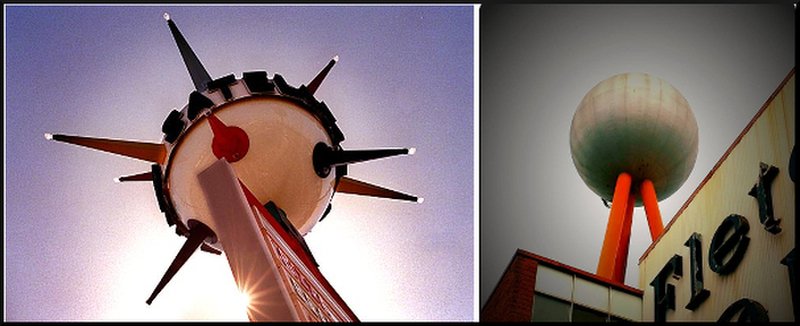
A satellite Shopland sign, Katella Ave, Anaheim, California and our beloved silver ball crowning the Fletcher Jones complex: both have a touch of Googie style. Image: www.snapthepix.com and Liz Gannon.

Bluestone columnist and architect CLINTON KRAUSE previously worked in Daylesford before relocating his business to Warrnambool. Clinton explores the architectural styles that gives our region so much character.

Anyone who remembers  the futuristic buildings depicted in the ‘Jetsons ’ cartoons of the late 60’s would be familiar with  ‘Googie’ style.

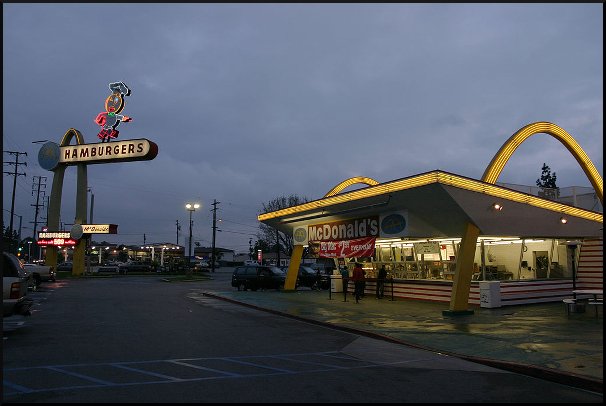
Emerging in the early 50’s and burning incandescently for just over a decade, this spacey, heroic and showy architecture epitomised post-war American optimism for the future and its inevitable destiny as the pinnacle of human civilisation.

The term ‘Googie’  is alleged to have originated back in the late 1940’s when renowned architect John Lautner designed the groundbreaking ‘Googie’s’ coffee shop in Los Angeles – affectionately referencing the nickname of the client’s wife.

The name became the moniker for a whole trend in design that embraced the ideals of the time around space travel, the automotive industry and America’s future: and we can find examples of it here in the south-west.

The building style was particularly suited to the new roadside architecture of fast food shops , roadhouses, shopping malls and bowling alleys. Gobsmacking rooflines, eyepopping colours and garish symbols all vied for the motorist’s attention along the sleek freeways that sprung up across the country.

mcdonalds
Early McDonald’s restaurants from the 1950s reflect the ‘Googie’ style, including this one which also features the chain’s original mascot, “Speedee” the chef. Image: www.snapthepix.com

citycenter2 (1)
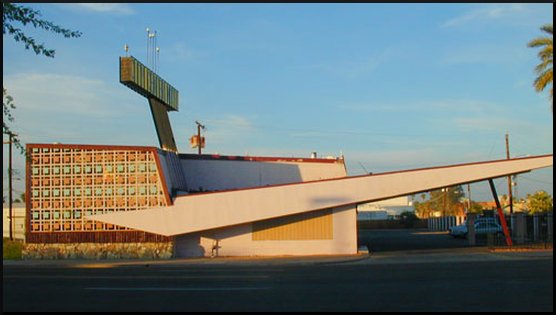
The City Center Motel (1958), Phoenix, Arizona, is a fine example of the eye-catching designs aimed at luring passing motorists. Image: www.snapthepix.com

Favourite motifs were adopted and applied over and over again – the atomic symbol, the starburst, amoeba and boomerang, domes, saucers and sweeping geometric rooflines and cantilevers.

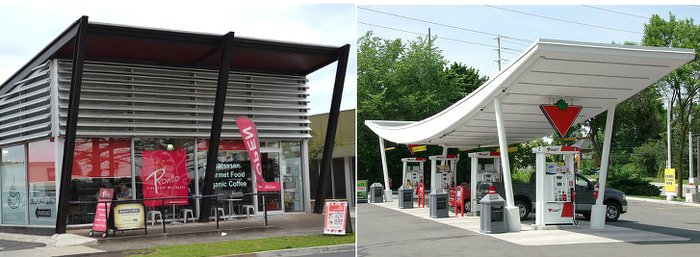
This exciting architectural trend was explored in Australia and is evident in many structures around Warrnambool, including the Pronto’s building on Raglan Parade, which was designed as a car showroom by Tag Walter.

pronto-blend
Prontos in Raglan Parade , designed as a car show room by Tag Walter, epitomises the style’s brash cry for the attention of passing traffic. Images: Bluestone Magazine (left), www.snapthepix.com

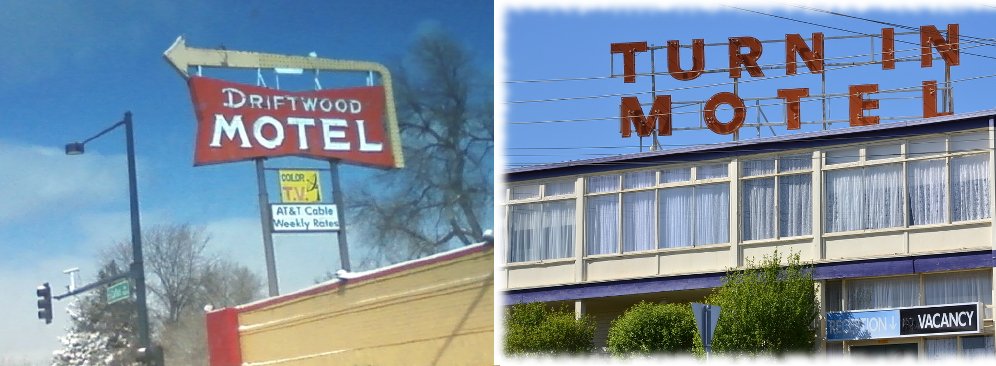
Another example is the iconic Turn In Motel sign that dominated the eastern entrance to Warrnambool when the highway passed by the motel’s front door (it has since been diverted).

And even our beloved Fletcher Jones silver ball pays homage to the era.

turn in blend clinton krause
‘Driftwood’ Motel sign on East Colfax Ave, Denver, Colorado and the signage atop the ‘Turn in Motel’ in Warrnambool. Images: www.snapthepix.com and Bluestone Magazine.

These structures all derive from the Googie aesthetic and often delight in giving  a  ‘cheeky thumbs’ up to the “Establíshment”.

Indeed the style was derided by many architects of the time for being  frivolous, common and lacking in any serious philosophical basis.

The end of the 60’s saw the loss of America’s innocence with the assassination of two Presidents, the debacle of the Vietnam war, and the baby boomers rebellion against the principles of the older generation.

Googie suddenly began to look slightly jaded, comical and irrelevant. Many of the best examples of the style were demolished, butchered or ‘made over’ as developers rejected the high maintenance costs of preserving these monuments to a Utopian idyll.

another bits the dust
Unfortunately many architectural gems of the 1950s are making way for more modern – and mediocre – designs. Image: www.snapthepix.com

As with all architectural misfits, these buildings represent a unique moment in our cultural history and need to be cherished and celebrated for their uniqueness amidst the current sea of prevailing design mediocrity.

Clinton-Krause


Tea-totallers welcome at Panmure pub

1-panmure hotel
Putting the kettle on at the Panmure pub: Annie Lenehan has added a tearooms to the historic hotel as part of a change of direction that attracts a whole new clientele.

Words and pictures by Carol Altmann

[dropcap style=”font-size: 60px; color: #A02F2F;”] T [/dropcap]eetotalling has taken on a whole new meaning at the Panmure Hotel, with owner Annie Lenehan offering beer in the bar and a Bushells out the back.

In what might seem an unusual mix that actually works, Annie and partner Graeme Throckmorton have added a retro-style tearoom to the back of the pub where women – and it is mostly women – can enjoy an afternoon tea or even high tea.

“One older lady said to me that nobody serves scones with jam and cream anymore – well they do at the Panmure pub,” Annie says with a laugh.

Annie bought the historic hotel (built 1871) five years ago, but took over the lease in August 2012. She has since worked hard to make it very much a family friendly place and a country pub with a point of difference.

“It was a very traditional pub in the sense that it wasn’t the sort of place you could walk into and feel entirely comfortable,” Annie says.

panmure_15
The back of the Panmure Hotel will be unrecognisable to most, where pots refer to teapots rather than beer.

[dropcap style=”font-size: 60px; color: #A02F2F;”] I [/dropcap]n earlier times, a hotel could get by offering cold beer, a bed and a basic meal, but expectations have changed.

“These days, pubs can’t survive by just selling beer over the bar anymore, you need to be able to cater for a very different clientele,” Annie says.

A tearooms decorated in rose pink and an eclectic mix of retro and vintage items collected over the years is about as different as it gets.

“Nothing in here matches,” Annie laughs, “but it works.”

The tearooms also contain a sample of the more than 200 teapots that Annie has collected for many years, despite being a non-tea drinker for most of her life.

“I only started to drink tea about five years ago,” she says.

“But I have always loved teapots!”

panmure_2
Annie with partner Graeme Throckmorton: together they are transforming the old Panmure Hotel which Annie bought in 2012.

[dropcap style=”font-size: 60px; color: #A02F2F;”] A [/dropcap]nnie was born in Panmure and moved around the south-west quite a lot as a child and, later, in her 30-year career in hospitality.

She was living and working in Port Campbell when she decided to make the move back to her home town.

“I am a country girl. I really don’t like the city and can’t wait to get out of it when I go,” she says, and I assume she is talking about Melbourne, until she reveals it is Warrnambool.

Shortly after opening her tearooms, one of Panmure’s local identities, artist Glenda Hirth, dropped in to welcome her to the town and to see if she could host an event for the local Country Women’s Association.

“Glenda ran it by the CWA committee and they agreed. They had an absolute ball and have been coming here ever since,” Annie smiles, knowing endorsement by the local CWA is high praise indeed.

This more genteel side of the Panmure pub would surely meet the approval of the late Violet Meere, who helped her husband, Herbert Walsh, run the hotel in the early 1900s after being initially reluctant to work in such a male-dominated domain.

Annie hopes the tearooms will see the pub thrive into the future.

“Too many country pubs are closing down: well this one is not going to.”

violet meere-peter walsh
Violet Meere, who helped her husband Herbert Walsh to run the Panmure pub in the early 1900s. Image: Museums Victoria.

[box]The afternoon teas, which are served at weekends, can be stylish or simple: Devonshire tea, mini high tea and a full high tea, with or without champagne. Groups by arrangement. Panmure Hotel, Princes Highway, Panmure. Ph: (03) 55 67 6270 [/box]

[button link=”http://the-terrier.com.au/subscribe-2/” type=”icon” icon=”heart” newwindow=”yes”]Bluestone is aiming for at least 500 subscribers in 2015. If you enjoyed this story, please click here to become one![/button]

newsletter Eat And Drink StonesYou might also enjoy…


The simple joy of baking, French style: Bridie Claire

Cafe Bagdad pops up in Penshurst

From a cupcake copper to a farmer’s wife

Lana Campbell’s garden of eden

Buffalo cheese a Shaw thing