An extract from the Merrivale letter-drop by the Red Circle real estate asking homeowners to consider selling while their houses hold their value. Image: Bluestone Magazine.
[dropcap style=”font-size: 60px; color: #A02F2F;”] T [/dropcap]he proposed milk processing factory and cold storage plant at Midfield Meats still need planning approval, but at least one real estate company is urging Merrivale homeowners to consider selling in case property values fall.
Red Circle real estate associate Phil Gray has letter-dropped several streets in the Merrivale area to tell homeowners about a potential opportunity to sell their property before any impact on prices from the Midfield development.
“I’ve been following the progress of the plans to further develop the Midfield site, which may have an impact on the sale prices of Merrivale homes in the future,” Mr Gray writes.
“This could be a great opportunity for a change of scenery as we have been approached by an investor looking to buy properties to rent to future workers,” the letter says.
Mr Gray told Bluestone that the investor was not, as some residents believed, connected to the Midfield group, but was a number of individual people.
“Several people have put it to me that they think it would be a good investment to buy in the area, not to live in, but just to rent because they feel rental prices will increase,” he said.
[dropcap style=”font-size: 60px; color: #A02F2F;”] P [/dropcap]roperty prices, however, may go down as a result of the development, he said.
“We are expecting it to have some kind of effect,” Mr Gray said.
Mr Gray’s letter also reinforces this point: “…this could be the perfect opportunity to move forward and take full advantage of the current market situation”.
A significant portion of the Midfield Meats workforce is made up of overseas workers on temporary visas who need to rent, rather than buy, in the Merrivale and west Warrnambool area.
“Investors see Merrivale as good for rental returns because of the relatively low property prices and, either way, there is strong demand for rentals in the area,” Mr Gray said.
[button link=”http://the-terrier.com.au/subscribe-2/” type=”icon” icon=”heart” newwindow=”yes”]Bluestone needs at least 500 subscribers in 2015. We survive by subscriptions, please click here to become a valued subscriber[/button]
Janis and Dean Bennett, with Princess Penelope, in the yard of their Merrivale home. The couple are among those fighting to stop two major industrial developments by the Midfield Group on land now zoned Public Use.
Words: Carol Altmann
[dropcap style=”font-size: 60px; color: #8F9F59;”] W [/dropcap]hen Janis and Dean Bennett bought their little rough diamond of a house in Merrivale almost 10 years ago, they knew it wasn’t far from the Midfield meatworks, but they could live with that.
Like most young couples, they needed a home that would fit their budget and the little suburb on the west side of Warrnambool had a lot going for it: a primary school, a football and cricket club, close to a river and beach, and within walking distance to town.
The Bennetts have since had a child and, through hard work, slowly transformed their “rough diamond” into a cosy home, with a thriving vegie patch, herb garden and chicken coop. Merrivale has also changed from being a very working-class suburb to a socio-economic mix of people wanting to live in an area with character and a strong sense of community.
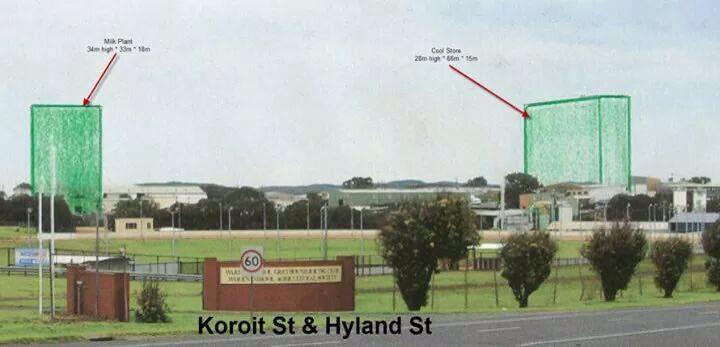
But now the people of Merrivale are being asked to accept two enormous changes to their suburb: a 29m tall cold storage facility (basically, a giant fridge) and a 35m tall milk powder factory, both of which would operate 24-hours-a-day, seven days a week, on Scott St.
In what is shaping up as a classic David v Goliath battle, people like the Bennetts are battling to have the expansion stopped and will put their case to an independent panel hearing that starts in Warrnambool on Tuesday, Feb 3. (See end of story for details and timetable).
This image by the Merrivale Community Association and the We Love Merrivale group shows how they believe the cold store (right) and milk processing plant (left) will look from the Warrnambool Showgrounds. Image: Supplied.
[dropcap style=”font-size: 60px; color: #8F9F59;”] W[/dropcap]hen the projects were first announced by the Midfield Group, they were expected to create up to 200 jobs. It has since been revealed, however, that only up to 22 full-time jobs will be created after construction. Property prices are also expected to be affected.
“We are not against a milk factory being built, but it is just in the wrong place: it needs to be out of town,” Janis said.
The planning laws, as they stand, agree with her.
Both projects require land to be rezoned from Public Use to Industrial, including land that was once owned by the people (as Crown land) and used by the Warrnambool City Council depot, until it was sold off to Midfield last year.
The Warrnambool Planning Scheme also asks that a cold store be no less than 150m from the nearest dwelling. The nearest house is less than 100m away.
The scheme also recommends that a milk processing factory be at least 300m from a home. The nearest house will be 130m.
The reason for these protections, of course, are that large-scale factories and freezers bring with them noise, lights, extra trucks, extra traffic and a whole raft of potential hazards that don’t sit well with residential areas.
“We quite happily live near a pre-existing industrial zone, but we also knew that there were laws in place to prevent certain things happening and to make sure that things weren’t forced through,” Dean said.
“The council is now being asked to change those laws and there is an expectation that it will go ahead because of the money behind it.”
Signs like this one have been popping up in windows and on fences around Merrivale as the community rallies to stop the developments. Image: Bluestone Magazine.
[dropcap style=”font-size: 60px; color: #8F9F59;”] T [/dropcap]he Bennetts are among those particularly concerned about the potential health risks of the expansion and the fact that both projects will be within 1km of a primary school.
“I know we are talking worst case scenarios, but they can happen and (Midfield) has to plan for such things happening: this is what they want to put on our doorstep,” Janis said.
The Merrivale Community Association will be among those represented at the independent panel hearing, together with at least another 17 submitters against or in favour of the project.
Spokesman Keith McAlley – who will represent the MCA – has been wading through around 8kg of documents that outline the expert witnesses to be called by Midfield and the council.
There will be lawyers and QCs and a string of experts, and then there will be Keith, and other speakers from the community who wish to have their say.
“It is daunting, but I am at that point in my life where I ask ‘what can I do to help myself?’ and ‘what can I do to help my community?,” Keith said.
Keith hopes that wider Warrnambool will get behind the MCA campaign, because he believes the impact of the development will be felt across the city through more large trucks on the road, damage to roads and a dramatic change to the visual landscape of west Warrnambool.
“As ratepayers, you will be picking up the repair bill for any damage to the road, for example,” he said.
Once the independent panel has heard all submissions, it will make recommendations to the council.
It is then up to the council to decide if it will accept or reject the recommendations: giving the Midfield Group either a green or red light.
[learn_more caption=”Click here for the panel hearing timetable”]
Hearings start at 10am and finish around 4.30pm, South-west TAFE, Level 3.
Tuesday, Feb 3: (All day)
Representatives for Warrnambool City Council.
Wednesday Feb 4:
AM: Environmental Protection Authority; Representatives for 92 Liebig St Pty Ltd.
PM: Site inspection at Scott St. (2.30pm-4.30pm)
Thursday, Feb 5: Representatives for Midfield Meat International.
Friday, Feb 6: Representatives for Midfield Meat International.
Tuesday, Feb 10: Representatives for Midfield Meat International.
Wednesday, Feb 11:
AM: Merrivale Community Association.
PM: Various submitters from the community.
Thursday, Feb 12: Various submitters from the community.
Friday, Feb 13:
AM: Midfield Meat International closing comments and right of reply.
PM: Warrnambool City Council closing comments and right of reply.
[button link=”http://the-terrier.com.au/subscribe-2/” type=”icon” icon=”heart” newwindow=”yes”]Is this the kind of journalism you like to read? Bluestone needs your support. Please subscribe here[/button]
Vertigo? What vertigo? One of the rare images of the iconic silver ball water tower being erected at the Fletcher Jones factory in 1967 from the collection of engineer Ralph Jones. (Citation: Ralph Jones Water Tower Submission and Business Papers, 2014.0112, Box 1, University of Melbourne Archives.)
Words: Carol Altmann
[dropcap style=”font-size: 60px; color: #DC943C;”] R[/dropcap]are images of the Fletcher Jones silver ball water tower have emerged from the private collection of engineer Ralph Jones who designed and supervised the construction.
Bluestone Magazine has been privileged to gain access to the images courtesy of the Melbourne University Archives which has been archiving the story behind the iconic silver ball as part of the Ralph Jones Engineering Services collection.
MUV archivist Melinda Barrie said the collection – donated by Mr Jones, who is now aged in his late 80s and living in Melbourne – included detailed documents and correspondence from 1965-1967 when the silver ball was being built.
It also includes Mr Jones’s submission to the 1975 Association of Consulting Engineers Australia -Engineering Awards, where his firm hoped to win a prize for the silver ball that, as far as we know, is without peer in Australia. (Unfortunately, the ball missed out on an award).
The brand new water tower, red-legged and silver-topped, graced the cover of the local phone directory the year after it was assembled. Image from the Ralph Jones collection and reproduced courtesy of Melbourne University Archives.
[dropcap style=”font-size: 60px; color: #DC943C;”] T[/dropcap]he documents reveal that Mr Jones’s inspiration for the ball’s design came from US advertisements for water towers made by the Pittsburgh-Des Moine Steel Company, one of which included tripod legs.
The unique design was also borne of necessity because of the “poor mains water pressure” on the east side of Warrnambool at the time, Mr Jones wrote in his submission.
It also had to take into account potential earthquakes – given that the Fletcher Jones factory was in the middle of an area that in 1903 experienced two of the worst earthquakes in modern Australian history – and was built to withstand “moderate” earthquake loading.
With the Ralph Jones Engineering Collection ready to view at MUA, Melinda and her team are now turning their attention to a significant collection of photographs, documents, personal items and archival films donated by the family of Sir Fletcher.
The collection includes more than 3000 photographs – including many from the Warrnambool factory in the 70s, 80s and 90s – all of which will be cleaned and then 300 selected for digitalisation.
Melinda described the contemporary Fletcher Jones story as a vital part of documenting Victoria’s manufacturing industry.
“We view it as very important, as it celebrates the narrative of manufacturing and retail in Victoria…and so many of those stories have been lost,” she said.
Silver lining: Melbourne University Archive academics Melinda Barrie (centre) and Sophie Garrett (centre right) catch up with working party members Mark Rashleigh, Emma Charlton and Julie Eagles (right) – and some of the artwork that has been inspired by Fletcher Jones and the iconic silver ball. Image: Bluestone Magazine.
[dropcap style=”font-size: 60px; color: #DC943C;”]M[/dropcap]eanwhile, in Warrnambool, moves are afoot to start documenting the local, personal stories around Fletcher Jones and Pleasant Hill.
A steering committee has come together with representatives from the Save the Silver Ball and Fletchers Gardens group, the Warrnambool Planning and Heritage Group, the Warrnambool Historical Society and the F Project, with MUA also helping out.
The group has already secured $5000 from the Gwen and Edna Jones Foundation (no relation to Fletcher), which will be used to record those stories considered a top priority because of people’s age or health.
“The next step for us is to sit down and determine who these people are and to capture those stories now,” said group convenor Julie Eagles.
The committee has applied for a further $15,000 from the Public Records Office of Victoria for a much broader project similar to the Silver Ball Screening Festival, where workshops are held to help people record their own FJ story, or that of someone they know.
“There is still such a strong connection between Warrnambool and the Fletcher Jones site, both as part of Warrnambool’s history and part of our individual histories,” Julie said.
The staff behind the name: the stories of everyday workers and those with a strong connection to the Fletcher Jones site will be recorded as part of a new project. Image: Save the Silver Ball and Fletcher Jones Gardens.
[dropcap style=”font-size: 60px; color: #DC943C;”]T[/dropcap]he individual projects of MUA and the local group may eventually lead to a collaborative exhibition or something similar in Warrnambool.
“Most of the people behind these great manufacturing stories want to see their stories out there and their work out there,” Melinda said.
“It is also part of our mandate here at MUA to make our collections accessible to the people, otherwise, what is the point?”
Melinda said the combination of the Ralph Jones collection, the personal collection from Sir Fletcher’s family and the work of the local steering committee would create a “well rounded archive” on one of Australia’s iconic businesses.
[button link=”http://the-terrier.com.au/subscribe-2/” type=”icon” icon=”heart” newwindow=”yes”]Bluestone is aiming for at least 500 subscribers in 2015. If you enjoyed this story, please click here to become one![/button]
The contemporary WA Maritime Museum at the centre of the original, incorrect claim of missing items. Image: Articlesweb.
UPDATE – Carol Altmann
[dropcap style=”font-size: 60px; color: #DC943C;”] T [/dropcap]he Western Australian Museum has further investigated an incorrect claim by Flagstaff Hill director Peter Abbott that more than 6680 items from its collection were unaccounted for and believes the damaging claim was a result of “confusion”.
As first reported by Bluestone yesterday, the museum strongly rejected a statement by Mr Abbott in a January 10 letter to the Warrnambool Standard in which he used the example of the Western Australian Maritime Museum to defend the fact that Flagstaff Hill cannot locate more than 130 items listed in its collection.
Mr Abbott wrote that museums around the world “go through random collection reviews” that often reveal “items have been moved or misplaced”.
“As an example…Western Australian Maritime Museum in 2009 found over 6680 (items) unaccounted for,” he wrote.
WA Museum Chief Executive Alec Coles OBE. Image: Council of Australasian Museum Directors.
[dropcap style=”font-size: 60px; color: #DC943C;”] I [/dropcap]n a statement to Bluestone today, WA Museum Chief Executive Officer Alec Coles reiterated that 6680 items “are not missing from its collection nor ever were”.
He said, however, that further investigations revealed an internal report was commissioned in 2008 to “improve and harmonise the documentation and storage of the WA Museum’s extensive maritime archeology collection, as well as those collections from Western Australian wrecks held in private collections”.
Mr Coles said the report was separate to the operations of the WA Maritime Museum, which deals with contemporary material.
“(The WA Maritime Museum) was not the subject of this internal report, the purpose of which was to demonstrate the need for improved document and storage systems which have since been achieved,” he said.
“The report states that a number of items at the time were either not audited as part of the process, or that there were inconsistencies between database and object entries, not least because a number of different databases were in use at the time leading to conflicting numbers,” he said.
Mr Coles said the total of items either not audited or with inconsistent entries was “the number cited – 6680 – but does not represent missing items”.
“In fact, the museum conducts regular audits of its collections including two full collection audits for reporting and accounting purposes in 2009 and 2014 and in both cases there were no anomalies,” he said.
Mr Coles said the museum now understood the source of the information and “can also understand where the confusion may have arisen”.
[button link=”http://the-terrier.com.au/subscribe-2/” type=”icon” icon=”heart” newwindow=”yes”]Bluestone needs at least 500 subscribers in 2015. If you wish to support independent media, please click here to become one.[/button]
Flagstaff Hill Maritime Village director Peter Abbott, far right, has drawn the ire of the Western Australian Museum for incorrect claims he made about lost items from its collection. Image: Warrnambool City Council.
EXCLUSIVE – Carol Altmann
[dropcap style=”font-size: 60px; color: #DC943C;”] T [/dropcap]he Western Australian Museum has strongly rejected a claim by Flagstaff Hill Maritime Village director Peter Abbott that it could not locate more than 6600 items in its collection.
Mr Abbott wrote that museums around the world “go through random collection reviews” that often reveal items “have been moved or misplaced”.
“As an example…Western Australian Maritime Museum in 2009 found over 6680 (items) unaccounted for,” he wrote.
The Western Australian Museum covers six sites, including the WA Maritime Museum. Its chief executive officer, Alec Coles, tonight described the claim as simply erroneous.
“The Western Australian Museum rejects any suggestion that (it) could not locate more than 6680 items in 2009 or at any other time,” he said.
“The number is almost half of the Maritime History Department’s total collection, so any claim that WAMM could not locate more than 6680 items is clearly erroneous.”
[dropcap style=”font-size: 60px; color: #DC943C;”] M [/dropcap]r Coles said the Maritime History Department had “occasionally found discrepancies involving three or four items as a result of loans or de-acquistions, or lists not being updated, but these issues have always been resolved”.
He also rejected Mr Abbott’s assertion that credible museums undertake “random collection reviews”.
“The Western Australian Museum does not conduct random collection reviews,” Mr Coles said.
“As a State Government agency, the Western Australian Museum is required to conduct regular audits of its collection for government reporting and accounting purposes and these are required to be approved by the office of the Auditor-General.
“The most recent of these was conducted last year.”
When asked where Mr Abbott may have found the information to make such a claim, Mr Coles said that was for Mr Abbott to explain.
“A thorough check of the WA records and with senior staff can’t find any source of the information that might have given rise to the claim,” he said.
[dropcap style=”font-size: 60px; color: #DC943C;”] M [/dropcap]r Cole’s comments come on the back of confirmation that Flagstaff Hill is under formal investigation by Heritage Victoria over the missing items from its collection and damage to relics from the wreck of the Loch Ard.
As recently reported inBluestone Magazine, two of the 10 copper sheets from the Loch Ard (1878)that were loaned to Flagstaff Hill by the Federal Government have been cut.
The rejection of Mr Abbott’s claims also comes in light of a separate scandal, in which Mr Abbott was named by the local newspaper as the author of a string of anonymous comments made to its online forums. He often used the forums to make personal attacks against Warrnambool City councillors Cr Brian Kelson and Cr Peter Hulin.
Cr Hulin will move a motion of no confidence against CEO Bruce Anson at the first council meeting of the year on Monday (Feb 2), citing his handling of Mr Abbott’s behaviour as an example of why the Local Government Minister should be asked to intervene.
The same meeting will also discuss a proposed $3 million upgrade to Flagstaff Hill, which has suffered from a steady downturn in visitors in recent years.
[button link=”http://the-terrier.com.au/subscribe-2/” type=”icon” icon=”heart” newwindow=”yes”]Bluestone needs at least 500 subscribers in 2015. If you wish to support independent media, please click here to become one.[/button]


 You might also enjoy …

 You might also enjoy reading…


 You might also enjoy…


