Koroit, coffee and the three-song commute

koroit claybody
Artist Clare Fennessy, who works under the name Clare Claybody, in her new studio space at the rear of the historic property she recently bought in Koroit.

Words and photos by Carol Altmann

[dropcap style=”font-size: 60px; color: #A5CECD;”]O[/dropcap]nce known as the domain of retired potato farmers, onion growers and devout Catholics, the south-west hamlet of Koroit is becoming cool – very cool.

The signs of a town in transformation are all there: a Thai restaurant, a retro bookstore (The Bookworm), a revived Country Women’s Association bursting with members aged under 45, and a steady stream of young artists and thinkers choosing Koroit as the place to buy their first home.

And if that isn’t enough to convince you, then the recent arrival of the spiritual shop, Sacred Stones, the expansion of the local IGA supermarket, the success of the monthly food swap*, and the popularity of local meditation classes, poetry slam and yoga nights should do it.

Seabreeze coffee roaster and barista Tim Mellor has been watching the transition a little more closely than others.

He reversed a trend 18 months ago by moving out of Port Fairy to Koroit, because of its affordability. Koroit offered all of the same rich history and country town charm, but without the over-blown house prices (the average is around $280,000, but rising).

“Port Fairy has become very, very expensive, so younger families are now looking elsewhere,” Tim says.

“What we have is an evolving community that is moving from footy and cricket into a place that still loves its footy and cricket, but is also developing other interests,” Tim says.

seabreeze coffee
Seabreeze coffee roaster Tim Mellor and barista Kerry Hughson in the new cafe Tim has opened in the main street of Koroit after looking at the changing demographics of the town.

[dropcap style=”font-size: 60px; color: #A5CECD;”]T[/dropcap]im dug around into the statistics that confirmed a much younger demographic was moving into Koroit, compared to Port Fairy, and this sealed the deal for his decision to open an espresso coffee shop in the middle of town.

The former fish and chip shop on Commercial Road has been scraped back, repainted, redecorated, refurnished and officially open for business as of this weekend, with barista Kerry Hughson, formerly of The Farmer’s Wife, in Port Fairy, behind the espresso machine.

“Even though we have still been setting up, the women from local exercise class have already made us their coffee stop…and the bike riding guys turned up the other day,” Tim says, smiling.

Figures from the 2011 Census, and available on the Moyne Shire Council website, reveal that Koroit is indeed a nimble little town: only 17.9% of people living in Koroit are aged 60 or over, compared to 32.9% in Port Fairy.

koroit prices
After a dip around the time of the global financial crisis, house prices in Koroit have been on a steady climb, but still remain affordable by most standards. Source: Australian Property Monitors.

[dropcap style=”font-size: 60px; color: #A5CECD;”]I[/dropcap]n the same vein, 22.3% of Koroit folk are homebuilders, compared to only 16.7% in Port Fairy, and 27.2% of the Koroit population is aged under 17, compared to 20.9% in Port Fairy.

Artist Clare Fennessy (aka Claybody) is among the new arrivals, having bought her first home in the main street of Koroit about 12 months ago.

The historic former fruit and sweet shop is full of the character that people pay hundreds of thousands of dollars for in Melbourne and sits on a block that is large enough to contain a house, a courtyard, a garage, a studio, a workshop, a fernery and a cosy room at the front that Clare intends to use as a small gallery.

“I love Koroit. It is a very cute town and everyone in the shops knows you by your first name,” she says, laughing.

koroit garage
The main street of Koroit is still packed with character and original buildings like this fabulous old garage. Image: Bluestone Magazine.

[dropcap style=”font-size: 60px; color: #A5CECD;”]S[/dropcap]ince Clare, 33, moved into her house, locals have been keen to help her uncover its history, with suggestions that its location on Spring St gave the street its name: apparently there was a natural spring in the yard and people would come to collect spring water.

“We think it might be there,” Clare says, pointing to a cement slab that looks suspiciously like it might be covering a well.

It is one of the many charming stories she has already collected and intends to investigate further.

When she is not working on her ceramics (or home renovations!), Clare works at the only childcare centre in town which is exactly 90 steps – yes, 90 steps – from her front door. It is so close, it can barely be called a commute.

“There is really no excuse to be late for work,” she laughs.

bess krause
Bess Krause found a renovator’s delight in downtown Koroit and restored it back to life. She is part of a new generation of people moving to Koroit to buy their first home.

[dropcap style=”font-size: 60px; color: #A5CECD;”]N[/dropcap]ot far from Clare’s property is that owned by Bess Krause, 29, who three years ago bought a 100-year-old miner’s cottage earmarked for demolition and, with the help of family and friends, has completely restored it to life.

The blue-and-white cottage has since become one of the most distinctive houses in the street and is within walking distance of what is considered downtown Koroit.

“You think Koroit is tiny, but it has all the necessities, but sometimes you don’t realise they are there until you live here,” Bess says.

“I can walk down to the bakery, go and have a coffee…head up to the rail trail, which I really love.”

Again, affordability was a big attraction and while Bess works in Warrnambool, she finds the 15-minute – or three-song – commute enjoyable.

“It gives you time to decompress from the day; you can play a couple of songs on the cd player and just unwind,” she says.

koroit irish festival
Koroit is nothing if not quirky – and a stickler for tradition. The annual Koroit Irish Festival, held at the weekend, still pays homage to the town’s Irish ancestry.

[box]*The Koroit Food Swap is held at 10am on the third Saturday of each month at Healing House, next to Sacred Stones, 123 Commercial Rd. The next swap is May 16. Contact Loretta on 0425 022 447 for more information.[/box]

[button link=”http://the-terrier.com.au/subscribe-2/” type=”icon” icon=”heart” newwindow=”yes”]Bluestone needs at least 500 subscribers in 2015. If you wish to support independent media, please click here to become one.[/button]

Stones Smile newsletterRead earlier stories on Koroit here…


A spiritual home in the heart of Koroit: Sacred Stones
Books pave new way for Melbourne: The Bookworm

You’ve come a long way, Koroit CWA


Hooded plovers play catch me if you can

hooded plover_26
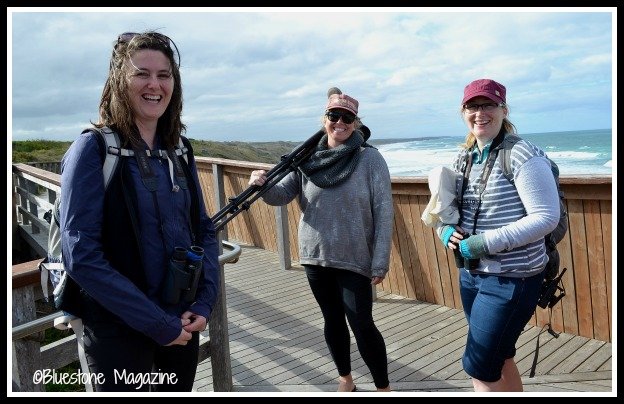
Part of the “hoodie” tag team from BirdLife Australia, Dr Grainne Maguire, (left) Robyn Burns and Renee Mea, armed with telescopes and other gear at Logan’s Beach, Warrnambool.

By Carol Altmann

Imagine trying to catch a tiny bird living on a long stretch of beach with little more than a piece of plastic grid the size of a shoebox?

It sounds like an almost impossible task, but this is exactly what a team of patient and nimble conservationists do each time they visit the south-west coast to tag and flag juvenile hooded plovers.

The tag team from BirdLife Australia has just finished its final session for the season through the area, taking in Logan’s Beach at Warrnambool, Killarney beach and several spots around Port Fairy.

The south-west Victorian coast is home to the largest population of hooded plovers anywhere in Australia because, as we know, the real estate is perfect.

“The habitat is just right,” explains Dr Grainne Maguire, a coast and marine program manager with BirdLife Australia, as she stands on the Logan’s Beach whale platform and surveys the scene below.

“The hoodies love dune protection, and the rocks just offshore and the right diet – arthropods – is here for them too,” she says.

In other words, it is the hooded plover equivalent of finding a comfy, three-bedroom home with an in-ground pool and a fully stocked, double-door fridge: bliss.

plover glenn ehmke
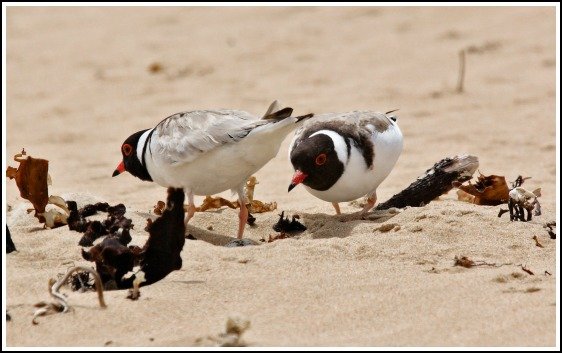
Hooded plovers find the conditions around the Victorian south-west coast perfect for their lifestyle. Image: Glenn Ehmke, BirdLife Australia.

On a good day, particularly at the start of the breeding season in September, the team would spot several juvenile plovers, which can be identified by the smoke-grey plumage on their heads which is yet to turn black.

At that point, as Renee Mead explains, the team dashes down to the beach with its special snare, which is essentially a piece of plastic grid with strings attached.

The idea is for the snare to be laid on the sand and a hooded plover walks across it, temporarily catching its toes.

I look at the beach – the very long stretch of beach – and I look at Renee, who is a Beach-nesting Bird Project officer, and wonder if she is serious, and I realise that she is.

Despite the young birds having literally hundreds of metres of beach on which to roam, they fortunately like to hang around the nesting area. This, with the help of a bit of a seaweed piled into makeshift fences and some gentle corralling, boosts the chances of being able to catch them.

Unfortunately there was only one hooded plover on Logan’s Beach that day, so the team tried Killarney Beach where, Renee later reports, a defiant little plover wandered across the plastic snare a total of 11 times without being caught! Bird conservationists are nothing if not patient.

All of this hard work is designed to help better monitor the movements of the hooded plover, which is officially listed as vulnerable.

plover grainne maguire
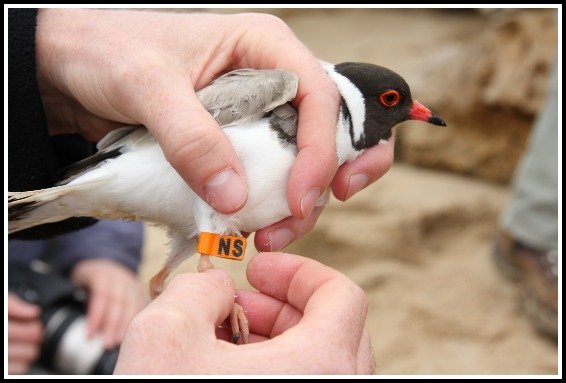
The bright-orange leg tags have a unique combination of letters which help keep track of the hooded plover’s movements. Image: Dr Grainne Maguire, BirdLife Australia.

[dropcap style=”font-size: 60px; color: #A02F2F;”] O [/dropcap]nce a bird is caught, the tag team attaches an ankle band, takes a DNA sample and then adds a tiny metal flag above the knee, with each flag having a unique code. This means if a member of the public spots a “flagged” hooded plover (with the help of binoculars), they can contact BirdLife Australia and report in.

“We had a call from a guy last winter who was having coffee at the Cape Bridgewater cafe and he spotted a flagged plover,” says Grainne.

“It turns out it had come all the way from Apollo Bay and, later, it was spotted at Torquay…and it was only about eight months old.”

(No doubt that plover, like everyone else, had heard how good the coffee was at the Bridgewater Bay Cafesee our earlier story here).

The program has tagged about 250 hooded plovers since starting in 2010 and is building a valuable database on where the birds go, and who they hang out with when they get there.

“There is a bit of partner swapping that goes on,” says Grainne with a laugh.

“Just like people, I guess, they move on until they find the right one.”

The team is also heartened by a greater awareness of hooded plover conservation programs, such as roped off nesting areas and signage, but off-leash dogs still present a challenge.

“When a person’s dog disturbs a hoodie, they might think it is only their dog, for a short time, and what’s the big deal? But for the hooded plover it is dog after dog after dog: that’s the message we try to get across,” says Grainne.

hooded plover montage glenn ehmke
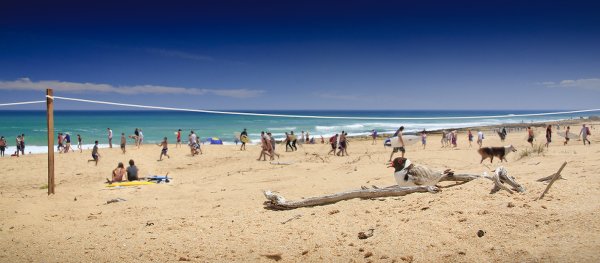
This time-lapse montage shows how many people would be exposed to the nesting hooded plover over a four-hour period, if not for protective fencing. Image: Glenn Ehmke.

[box]BirdLife Australia is always keen to hear from people willing to volunteer for various projects, including the Beach Nesting Birds project. Read more here or email hoodedplover@birdlife.org.au. You can also find them on Facebook.[/box]


The Warrnambool man who taught Namatjira watercolours

battarbee colour
Rex Battarbee and Albert Namatjira circa 1950s, when Albert was at the height of his fame. Image courtesy Gayle Quarmby.

 [box]WIN! Subscribers can go in the draw to win a copy of Battarbee and Namatjira, by Martin Edmond (Giramondo, 2014) by simply emailing us at editor@bluestonemagazine.com.au by Friday May 1. Prize supplied courtesy of Giramondo publishing. [/box]

By Carol Altmann

Just about everyone who grew up in the south-west in the 60s had at least one print by Albert Namatjira in their family home, but far less people are aware that the man who taught Albert watercolours was from Warrnambool.

Reginald Battarbee, known as Rex, is today far less famous than his pupil, but was an artist in his own right whose life journey would see him play a pivotal role in the emergence of Albert as an acclaimed artist.

While Albert Namatjira’s story has been well documented, Rex Battarbee has remained relatively in the background – until recently.

New Zealand author Martin Edmond has combined the stories of both men in his biography, Battarbee and Namatjira, (Giramondo) released late last year to what have been strong reviews and an appreciation that their shared history has, at last, been recorded in detail.

Martin has drawn extensively upon Rex’s personal diaries and other documents, many provided by Rex’s daughter, Gayle Quarmby, to tell the story of a man who grew up as one of five children in Warrnambool – the son of a pig farmer – who would later spend years of his life in the outback.

Older Warrnamboolians will remember “Battarbee’s corner” along the old highway in east Warrnambool, named for the nearby Battarbee farm, Skiddaw: there is now a Skiddaw Cr in this same area.

battarbee3
An earlier shot of Albert Namatjira with his paintings, circa 1940. Image courtesy Gayle Quarmby.

Rex began his working life there, helping his father with his ham and bacon curing business, until the outbreak of World War 1.

Rex joined the many thousands of young men from south-west Victoria who enlisted and, in so doing, stepped onto a path that would lead to a very different future.

Martin recounts the extraordinary series of events that began on 12 May 1917 when Rex was peppered with machine gun fire at Bullecourt and was so badly injured that he was left for dead.

It was only two days later that he was found under a pile of bodies, still breathing, and rescued by two stretcher bearers.

Unbelievably, the stretcher bearers also came under fire and were killed while transporting Rex to safety, requiring him to be rescued a second time.

battarbee war
Wounded: Rex Battarbee circa 1920s after he returned from the battlefields of World War 1 with his life-changing injuries. Image courtesy Gayle Quarmby.

It is an horrific, Sliding Doors moment that accompanies any near death experience and raises the question that if Rex had not survived, would Albert Namitjira have ever come to prominence many years later?

Martin describes the injuries that would change Rex’s life irrevocably: “His left hand was smashed; his right elbow and shoulder too; he took bullets in the chest as well. One of those pieces of shot, a round ball of lead, emerged years later from his armpit on the opposite side of the body upon which it entered; another token was a 1914 Australian penny with a dent in it where a bullet had glanced off.”

While maimed for life, Rex’s injuries shaped what appeared to be his destiny: he could no longer farm so, inspired by his artistic sister, he enrolled to study commercial art in Melbourne.

battarbee4
Rex Battarbee discusses a work with Albert Namatjira, circa 1950s. Image courtesy Gayle Quarmby.

How Rex and Albert’s lives came to intersect was another product of Rex’s adventurous spirit and bold, never-look-back approach to life.

By the late 1920s, he and fellow art school student John Gardner had taken to making long journeys into remote areas to spend time painting.

The ultimate remote area was central Australia which, at that time, was as foreign to most white Australians as Mars, having never seen even colour photos of the outback, let alone visited there.

Rex and John began to visit Alice Springs in the 1930s and, in 1934, held an exhibition at the Hermmansburg Mission. Unlike other exhibitions at the mission this one, for the first time, was open to both white and indigenous people to see.

battarbee2
Rex Battarbee and Albert Namatjira with Albert’s early works circa 1938. Image courtesy Gayle Quarmby.

Martin writes that the indigenous people were captivated by the watercolour paintings of their country, having never before seen it captured as if looking at a screen, compared to the top-down view of Aboriginal paintings.

One viewer, Albert Namatjira, was particularly entranced and, having looked at the paintings a long time, remarked to the pastor in charge, “I can do the same”.

At about the same time, Rex recorded in his diary: “Albert who does the poker work would like to paint and Mr Albrecht (Pastor Albrecht) is prepared to buy him paints and wants me to tell him what to get”.

And so a relationship began that, within five years, would see Albert Namatjira hold his first shows in Melbourne and Adelaide: both sold out.

An artistic legend was born.

battarbee - rennie ellis
Rex Battarbee in his later years, as photographed by Rennie Ellis, circa 1970. Image © Rennie Ellis Photographic Archive. National Portrait Gallery, Canberra.

\You can see Rex Battarbee’s painting of his family home, Skiddaw, at the Warrnambool Art Gallery website here. You can also view Albert Namatjira’s work at the National Gallery of Australia website here.

newsletter Eat And Drink StonesYou might also enjoy…

Abb, art and the immigrant journey: Abb Marzouk

From artist to children’s author: Fiona Clarke

Returning to ‘school’ completes art journey: Essie Warmuth

The magnificent mind of Marie Cook

Smooth lines inspired by the ocean: Damian McDonald


Once-proud “Rowitta” is now an abandoned ship

rowitta 1999 fred
The century-old steamer, “Rowitta”, as it appeared at the Flagstaff Hill Maritime Village in 1999 when it was considered a prize exhibit. Image: FredV45 via Flickr.

By Carol Altmann

[dropcap style=”font-size: 60px; color: #A02F2F;”] T [/dropcap]his is a tale of two, century-old, sister ships with two very different fortunes: one is about to undergo a million dollar restoration in Tasmania, while the other is being scrapped at Flagstaff Hill in Warrnambool.

The Rowitta and the Cartela are both wooden steamer ferries built in Hobart by Purdon & Featherstone, with the Rowitta the older of the pair, being built in 1909, followed by the Cartela in 1912.

They are now among only a handful of river steamers left in Australia and generate the sort of excitement among wooden boat enthusiasts that befit their rarity.

In the case of the Cartela, which has been converted from steam to diesel but has never been out of service, that excitement is only building.

A dedicated band of volunteers formed the Cartela Restoration Project Trust that lobbied for years to secure funding to restore the ferry to its original state, including its original 1912 steam engine. The project has come to fruition and, as of August last year, the Cartela restoration has been the centrepiece of the revitalisation of the port of Franklin, in the Huon Valley, as the home of wooden boat building.

For the Rowitta however, despite being one of the oldest vessels in the collection at the Flagstaff Hill Maritime Village, it is the end of the road.

rowitta - 1922 museum victoria1
Full steam ahead: The Rowitta plying the Tamar River, Launceston, in 1922. Image: Museum Victoria.

[dropcap style=”font-size: 60px; color: #A02F2F;”] H [/dropcap]aving been brought to the fledgling Flagstaff Hill back in the early 1970s as a hull, the Rowitta – which has also been known over its life as the Sorrento and Tarkarri – was the focus of a major restoration in 1989 under master boat builder, the late Ron Stewart, who’s son, Garry Stewart, continues the craft in Port Fairy today.

The Rowitta became a jewel in Flagstaff Hill’s crown, both as a popular venue for weddings, an educational tool for students and as a historic tourist attraction.

Tasmanian Irene Atkins wrote about her visit to Flagstaff Hill in 1998 and the thrill of seeing the boat she remembered from her childhood in Launceston being fully restored and taking pride of place on the lake.

“The first thing I said was ‘You have got the right colours’. They replied that they had gone down several coats of paint to establish that information,” she wrote in ‘On the Tide‘.

One of the people to show Irene around that day was boat builder Jeff McMurrich who is still the main boat builder at Flagstaff Hill and who, in 2008, gave a prescient interview to the ABC’s Jeremy Lee in which he warned that the Rowitta was in need of significant restoration work within 10 years, or it may not survive.

Sitting permanently in fresh water rotted the hull and required the Rowitta to be drydocked for proper repairs, which was difficult because it was part of the village’s Shipwrecked sound and light show *.

Instead, as Jeff explained, he did what he could with the “shoestring” budget Flagstaff Hill had to spend on such things. It was, he said, a case of “patching” rather than preventative maintenance – and this could only work for so long.

rowitta rotting
The rotting hull of the Rowitta, which has been off-limits to visitors to Flagstaff Hill Maritime Village for more than a year.

[dropcap style=”font-size: 60px; color: #A02F2F;”] D [/dropcap]espite these dire warnings, the 100th birthday of the Rowitta in 2009 was met with cheerful optimism by Flagstaff Hill, with manager Peter Abbott telling the local newspaper that the ship was still a popular drawcard.

“It’s a great venue for many types of functions and its also part of our sound and light show so the Rowitta’s definitely got plenty of years left in her yet,” he said.

In fact the boat would not see out another decade.

Faced with mounting losses at Flagstaff Hill, the Warrnambool City Council decided a couple of years ago to discontinue all maintenance of the Rowitta, which sealed her fate.

Alongside this decision has been a subtle reconfiguring of Rowitta’s place in the Flagstaff Hill story.

No longer is the ship historic, but referred to by Flagstaff Hill in its correspondence as a “replica”.

Similarly, the ship’s story is no longer considered relevant to the village, yet the South Australian built boat, the Reginald M, which arrived at Flagstaff Hill at about the same time, is.

The Rowitta’s transition from treasure to trash is perhaps best captured in this line from the council’s February 15 meeting:

Rowitta is a replica ship and deemed as surplus to the future of FHMV. Her removal will allow our limited wooden boat repair resources to focus on our real heritage vessels.”

Work on removing parts of the ship has already begun.

*The consolidation of the wooden boat fleet is part of a $3 million upgrade of Flagstaff Hill to start later this year, including a $2 million upgrade of the sound and light show.

[box]We asked former Flagstaff Hill director PETER RONALD, now living in Tasmania, for his view on the destruction of the Rowitta. Read his exclusive analysis piece here. Bluestone would also like to thank the Launceston Library for its assistance with the history of the Rowitta.[/box]

[button link=”http://the-terrier.com.au/subscribe-2/” type=”icon” icon=”heart” newwindow=”yes”]Bluestone needs at least 500 subscribers in 2015. Please support independent media, and subscribe here.[/button]

newsletter Why Not StonesYou might also enjoy…


 Little old shoe leads to a humble war hero

Unearthed: how the Warrnambool cemetery works

A fence full of happy souls at Tyrendarra: the ‘shoe fence’

Montgomery buys a slice of ‘Motang’ history


W’bool City Council’s big shed shemozzle

porter shed
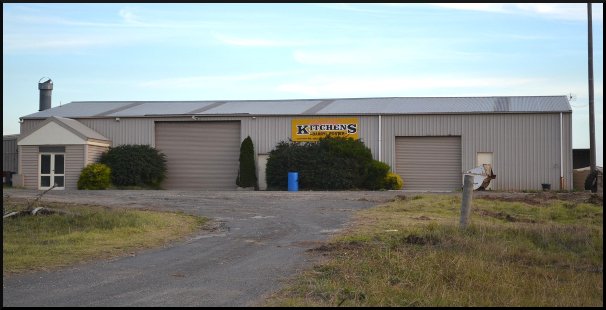
All locked up with nowhere to go: the Wangoom Rd shed bought by the Warrnambool City Council that will cost up to $90,000 to relocate.

Exclusive – Carol Altmann

There is no doubt the hard-working staff within the Warrnambool City Council do many good things to keep our city ticking along, but occasionally they make financial decisions which are difficult to understand – like this shed.

Take a good close look at this shed because, if you are Warrnambool ratepayer, you now own it … and nobody else wants it.

The former premises of Daryl Porter’s cabinet making works on Wangoom Rd was sold by its new owner, developer Graeme Rodger, to the Warrnambool City Council earlier this year for a price understood to be between $40,000 and $50,000.

The sale was sealed on behalf of the council by its director of City Infrastructure, Peter Robertson, who by way of his position has the authority to make purchases up to $149,999 under the council’s procurement policy.

The idea, Bluestone has been told, was to have the shed relocated to council land in the west Warrnambool industrial estate, most likely at the council depot.

Unfortunately neither Mr Robertson or the council’s media manager will answer Bluestone’s questions about the shed, and perhaps the reason why is because it is shaping up as a major liability.

How? Because it has to be moved, and that is a very expensive exercise.

The 700m2 shed and an attached 300m2 lean-to are made of laminated timber, with a Colourbond steel roof and fully clad walls.

Bluestone has learned that the council received quotes to remove, relocate and re-assemble a shed of this type and found it would cost somewhere between $80,000 to $90,000 and this does not include the cost of a concrete slab.

So a $40,000 to $50,000 shed was now going to cost ratepayers well over $120,000.

No doubt realising that the shed was an unnecessary extravagance at a time when budgets are tight, the council recently tried to get rid of it – but nobody was interested in buying.

shed advert
A newspaper advertisement for the shed, placed just days before the auction.

The shed was a late inclusion in an on-site auction held on Tuesday March 31, where auctioneer Brian Hancock tried his best to extract even a single bid from the crowd.

Hands stayed firmly down and the shed was passed in at $20,000.

It might not be so bad if the shed could stay where it was, and perhaps the council could rent it out to the many community and sporting groups around Warrnambool who could use the storage space, but there is a final twist.

Graeme Rodger needs the shed gone to make way for his residential subdivision later this year.

Indeed the auction advertisement reflected a sense of urgency, with bold letters stating: “Set time for removal. Payment day of sale.”

Mr Rodger told Bluestone that he was not putting any pressure on the council to move the shed, but that some time “in the next few months” would be reasonable.

The council has found itself in a checkmate and the question now is whether it spends tens of thousands of dollars on moving and re-establishing the shed, or walking away and cutting its losses.