Letters: Region suffers as training kitchens stand idle
[box]We encourage readers to write a letter to Bluestone Magazine if you have something to say, or a special event to promote. Write to us at editor@bluestonemagazine.com.au.[/box]
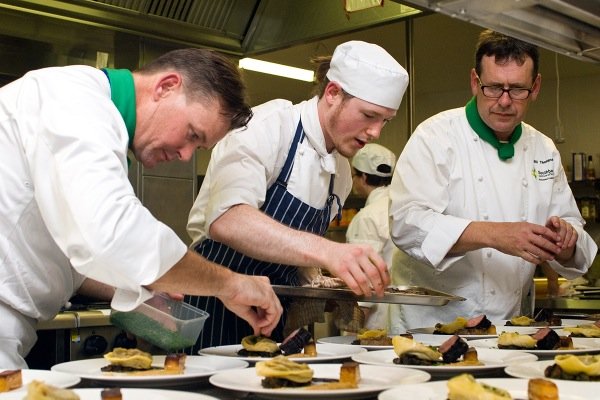
Apprentice chefs in the south-west are having to travel to Geelong for their TAFE classes and access to commercial training kitchens. File shot: Queensland TAFE.
[dropcap style=”font-size: 60px; color: #8F9F59;”] D [/dropcap]ear Editor,
I am writing to you on behalf of many voices within South West Victoria regarding an issue that can no longer be ignored.
Quality training for those in our local community who wish to fulfil their dream of becoming a successful chef in our region is out of reach.
Our hospitality industry is growing in leaps and bounds, but trained professionals are nowhere to be found.
Why?
We no longer offer cookery students a place to blossom and learn paramount skills here in Warrnambool or surrounds.
How do I know this? I drop my partner off at the Warrnambool train station each Monday morning at 5:30am to go to the city of Geelong to attend the Gordon TAFE to fulfil her dreams.
This has serious consequences.
Serious consequences for individuals, industry and the communities here within South West Victoria.
I hear of many people from Warrnambool, Portland, Hamilton, Horsham who work within the industry and then have to source the time, energy and money to travel to the city of Geelong to the Gordon TAFE to undertake their full day cookery classes.
Safety and knowledge for the student, productivity for the local food establishment, and long term community benefit are all suffering from cookery training no longer being offered through South West TAFE.
A once bustling TAFE restaurant now sits empty. Another industrial-sized kitchen at Brauer College sits awaiting eager hands once more. Two ‘A’ class facilities left to gather dust and cobwebs.
We are a progressive and fast growing city and region. We must demand quality tertiary education for those who wish to better themselves. We have an obligation to individuals, industry and the community to provide high level training and skills within our fast growing and highly popular food and hospitality industry here in this region.
No longer as a community can we remain complacent with this current situation.
Action is needed now before we all become losers in this current no winner scenario.
Roxanne Thomson, Warrnambool.
[box]You can write to us at editor@bluestonemagazine.com.au Please include a full name, address and contact number. Letters are published at our discretion and may be edited for length or clarity.[/box]
Peter Ronald on the destruction of 100-year-old ‘Rowitta’
Fading away: the 100-year-old wooden steamer, Rowitta, is being pulled apart after it was decided by Flagstaff Hill to discontinue all maintenance. Image: Amanda Turnidge-Jones.
Bluestone invited the former director of Flagstaff Hill, PETER RONALD, to write on the imminent destruction of the Rowitta, one of the oldest vessels at the Flagstaff Hill Maritime Village:
ANALYSIS – Peter Ronald
The Rowitta has involved some difficult decisions for Flagstaff Hill over the years, but it seems the vessel will soon no longer exist. (*The WCC has since announced the removal of the Rowitta began on April 20, 2015.)
The destruction of historic ships is an unusual pursuit for maritime museums and accordingly, I have been asked by Bluestone Magazine to contribute my opinion on the issue.
I do so with some reluctance, but perhaps it is timely to put some matters on the record. I have always sought to grace an honest question with an honest answer; that is simply my aim here. Anybody seeking my views on this issue would have received precisely this same answer.
The vessel’s hull was originally purchased and moved onto the site with the idea of creating the impression of a sailing ship as the centrepiece of the village. This initial concept was – without any disrespect to those responsible – primarily about creating atmosphere rather than the noble goals of maritime heritage conservation.
As I attempted to steer Flagstaff Hill from “maritime village” to “Maritime Museum”, it became essential to reassess the role and significance of this primary centrepiece: the Rowitta hull. Options for the hull were clear; to pursue the “atmospheric” notion, restore the vessel to its original configuration, return it to the ocean (for sale/use elsewhere), or just let it rot (a “caged” shipwreck on the Shipwreck Coast).
I suspect that these may have been the sorts of options reconsidered by current Flagstaff Hill management. The underlying question however is, why?
Why, some 20 years after the decision to restore and preserve the vessel, was the matter revisited? Why does total destruction of the Rowitta now seem like a good idea? The answers are clear, but it is not a pretty story.
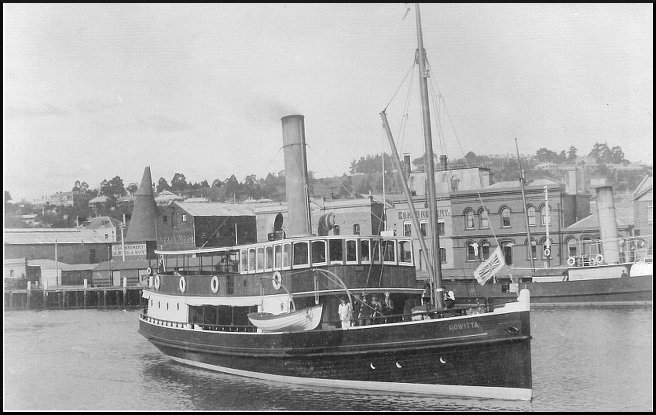
The Rowitta in her prime as a steamer on the Tamar River, Launceston, shortly after her launch in 1909. Image: On the Tide (Vol 1), reproduced courtesy of Launceston Reference Library.
Historic ship preservation is a well practised activity around the world and typically involves a period of extensive restoration, followed by meticulous maintenance. Through the research, hard work, and amazing skills of the late Ron Stewart, the hull was ultimately restored to its former glory as the historic steamer, Rowitta.
When I left Flagstaff Hill, the restoration was largely complete (the reconstructed aft cabin being used as an education centre/classroom) and maintenance was ongoing.
What happened next, in my view, is that Flagstaff Hill entered a “dark age” from which it is yet to recover.
Let’s be clear, under the planned and precise direction of the City’s then Administrators (and followed by subsequent Councils), the ethical constraints of the museum philosophy which had guided development for a decade, were abandoned in favour of a “tourist” focus.
The logic was that a change in emphasis from museum to tourist facility would herald even higher levels of economic success. Well, the scores are now on the board in relation to that failed experiment, and the Rowitta is symbolic of the collateral damage.
No longer an historic object in the care of a Maritime Museum, maintenance lapsed under the new direction. The high standard of restoration that had been achieved was simply eroded through neglect. That splendid work, so diligently accomplished by Ron Stewart, apparently deteriorated to the point that it was no longer even safe to enter the vessel.
The rotting Rowitta: the boat has been off-limits to Flagstaff Hill visitors for some time after it was considered unsafe to board. Image: Bluestone Magazine
The debate around “historic” ship or mere replica, raises a relevant and well studied aspect of historic ship preservation. It is true that any historic vessel preserved in an open-air environment will, as the result of basic maintenance, require the replacement of original fabric.
Over time, the percentage of original fabric present in any such vessel will therefore, effectively diminish: this is particularly true of timber vessels. In the Rowitta’s case, the hull is of completely original configuration and, I would argue, of primarily original fabric.
The deck has been renewed and the upper-works have been replicated. The end result of this equation, however, and by the standards of international maritime museum practise, is that the Rowitta was – and remains – an historic vessel.
To suggest otherwise is simply an argument of convenience used to justify a predetermined outcome.
Curiously, if the vessel was positioned just 350 metres to the south (ie. on the beach) it would now automatically be afforded the full protection of Historic Shipwreck legislation.
With the above background, I can only sympathise with present management. I believe the current manager is again pursuing museum goals for Flagstaff Hill, and for this I commend him, but the policy decisions of the past make the task a truly formidable one.
It should never have come to this: Flagstaff Hill’s “dark age” was unnecessary and, in any case, lasted far too long.
In the Rowitta example, the cost of the failed experiment will now be born by future generations through the loss of a piece of Australia’s maritime heritage: a 100-year-old historic ship.
I observe with sadness that Warrnambool’s maritime museum has been taken to the point of “burning the furniture”; one of it’s oldest and largest historic artefacts. Flagstaff Hill may never recover from the “dark age”, but there are foundational lessons to be learned from this current humiliating predicament.
Your feedback to us…
Hello subscribers and Bluestone readers,
Thankyou to those people on our newsletter list who provided us with feedback on what you enjoy about Bluestone and the ideas you have for our continued growth.
What we have heard is that you enjoy the sense of community that Bluestone has fostered in the south west in past 18 months, and many of you have subscribed because you don’t want to lose that. Thankyou!
A lot of you have also subscribed because you enjoy our focus on the arts, and people, and stories that highlight the positive aspects of the region.
An equally large group like that we ask the hard questions of those in power and have subscribed to help us continue our analysis and investigations of the local issues that affect our community.
We will continue this balance of stories, but we are also making changes to Bluestone as a result of your feedback.
[dropcap style=”font-size: 60px; color: #DC943C;”] M [/dropcap]ore rewards for subscribers:
A large part of the feedback from subscribers is that we give away too many stories for free – and that this deterred people from subscribing.
We think the time is right to password protect more stories, giving early access to subscribers only.
[box]A fresh password will be sent to subscribers monthly via email. (Check your emails for the March password.)[/box]
We have also introduced a free photo service for subscribers. If you would like a free high-res copy of an image taken by Bluestone, simply email us.
[dropcap style=”font-size: 60px; color: #DC943C;”] Y [/dropcap]our letters page:
We’ve also decided to create a space for more public debate and from this edition you’ll see a “Your letters” section.
Subscribers and non-subscribers will be welcome to submit letters, short or long (up to 800 words) about any local issue, but publication is at our discretion.
You will have to provide a name and contact details for your letters, but only your name will be published.
[dropcap style=”font-size: 60px; color: #DC943C;”] M [/dropcap]ore contributors from the community:
We welcome ideas and contributions from those doing interesting work in the community that they would like to share.
This edition, we have the team behind the Big Life project – Michael Barling and Sean Kenny – writing about how it all works.
If you would like to write a piece for Bluestone, email us with your idea and we can see if it fits with the focus of our magazine: editor@bluestonemagazine.com.au
We hope our subscribers like the direction we are heading and that more readers will make the leap from reading us, to supporting us.
Thanks again for taking the time to respond to our survey.
[dropcap style=”font-size: 60px; color: #A5CECD;”] I [/dropcap] live only 400 meters from the proposed milk drying plant and proposed freezer storage facility behind Midfield Meats, which if developed will be the largest of its kind in the southern hemisphere.
I have received an offer from a local real estate agency stating that my house would be devalued due to the proposed development and they had a buyer who’d be interested in purchasing my house to support the workers at the plant.
Warrnambool needs entrepreneurial businessmen like Colin McKenna, owner of Midfields Meats and the rendering plant. They provide investment and employment which contribute to the growth and development of this wonderful city.
Objections to the current proposals generally support the development of these industries in Warrnambool, but argue that the current site is too close to residential zones and therefore these new plants should be sited elsewhere.
The expansion of inappropriately sited industries and the proposed introduction of heavy industry so close to residential zones, will negatively impact on the health and wellbeing of residents and should not be considered – a disaster in the making.
There needs to be a buffer zone, away from any residential areas and away from our pristine coastline. When Midfield Meats and the rendering plant were developed, they were out of town.
But things have changed, the city has grown and will continue to grow into the future. Warrnambool is a great city with many areas of natural beauty and such industrialisation so close to the city and the coastline is out of step and totally inappropriate.
Midfield Meats is less than 3k to the Warrnambool city centre Post Office and even less to the Merri River and the ocean. The rendering plant is right ‘on’ the ocean and ‘in’ Kelly’s Swamp – ridiculous.
The three industries of Midfield Meats, the milk processing plant and the rendering plant need to be placed out of town and on one large industrial site. They could be constructed using environmental best practice principals and become an industry leader for the 21st century.
Here is an opportunity to demonstrate a forward thinking vision, to create an industry model for the future, able to expand to meet the growing demands of domestic and international trade in the 21st century. Financial assistance could be sought from Federal, State and local Government and the new international investors in our dairy industry.
The issue here is about industrial development that is in sympathy with the development of healthy communities.
When turning into McMeekin Road from Koroit Street, the city side is to the left and the light industrial estate is to the right. Midfield Meats currently sits on the city side and with the push for further expansion, perhaps it is time to draw a line in the sand and have the city side rezoned as residential and small business. All industry to the left or further out as appropriate and the Warrnambool City Council develop a new “heavy” industrial site.
Bowing to forceful economic proposals is not the way forward.
Selling and rezoning land and making promises without proper community consultation is not sympathetic to the needs of either the community or the environment. It is imperative that Council, politicians and local entrepreneurs be visionaries, build for the future and listen and respond to community concerns.
Francis van der Mark, Warrnambool
[box]Please send your letters to editor@bluestonemagazine.com.au with a contact name and number that can be used for verification. All letters are published at the editor’s discretion and will include the author’s name. [/box]
The thinking behind building a Big Life
The Big Life program aims to prepare children for the challenges of life by helping them recognise their own strengths, qualities and talents. Image: Stockimage/
[box] We asked MICHAEL BARLING (Big Life program) and SEAN KENNY (President of Warrnambool Student Wellbeing Association) to write for us about the issues facing students in the south-west:[/box]
Guest writers: Michael Barling and Sean Kenny
[dropcap style=”font-size: 60px; color: #DC943C;”] I [/dropcap]ncreasingly the issues that kids are dealing with in schools are a product of a broader social problem.
We can help kids manage their immediate challenges through chaplaincy and other forms of case management, but the strategic aim is to also address the root causes and reduce the number of kids in crisis.
Put another way, there is always a need for an emergency department in a hospital because life happens and injury is a part of being human. But it also makes sense to teach people how not to injure themselves and create environments whereby the really big injury risks are avoided.
Over the years, chaplains have identified some consistent themes central to some of the emotional ’injuries’ people tend to get. We have framed these as five big questions. These are at the heart of the Big Life program.
[dropcap style=”font-size: 60px; color: #DC943C;”] T [/dropcap]hese questions are:
How do I relate to people who are different to me? (Living with difference)
How can I love and be loved? (Relationships & sexuality)
What is the meaning of life? (Spirituality and purposeful occupation)
How do I make family work – even if I haven’t got one or don’t want mine? (Family in the 21st century)
What do I do when bad things happen? (Grief and loss)
The appeal of framing A Big Life around The Big Life questions is that it gives schools a platform to engage and connect kids with life’s challenges in an optimistic and hopeful way.
This perspective involves allowing kids to identify and acknowledge their strengths, qualities and talents. From this broad direction, A Big Life is developing along the lines of a whole-school, strengths-based approach that seeks to develop daily habits, tools and routines that help develop the optimistic and hopeful perspectives of our kids.
At the application level, it has meant both Warrnambool and Brauer Colleges developing a Morning Welcome routine that leverages off the energy and commitment of our teachers to raise awareness to and build the strengths of our kids.
Our Morning Welcome focuses on modelling positivity and persistence, on learning and developing new capacities and applying those new capacities with a consistency so that they stick with our kids.
Underpinning our Morning Welcome is the development of a mindfulness habit that encourages kids to focus, become more self-aware, develop a sense of empathy and approach situations with a calmer perspective.
Former Emmanuel College teacher Michael Barling is steering the Big Life program in Warrnambool. Image: Supplied.
[dropcap style=”font-size: 60px; color: #DC943C;”] T [/dropcap]he structures and routines that are developing as part of our Morning Welcome are proving effective.
However, the multiplier effect of our teachers will be the determining factor in any success. The other great multiplier that we hope to harness is our parents and guardians.
As teachers undertaking the emotional labour of caring for our students, we have a strong appreciation of the next level of emotional labour our parents and guardians go to in caring for their children.
We have so much that we want to do.
A Big Life is in the swimming lessons game. We could be lifeguards pulling kids out of trouble. Or pool fence installers putting barriers between our kids and trouble. No, we want to be swimming teachers so we can develop the capacities and strengths of our kids to get themselves out of trouble.
Big Life builds on the work of school chaplains and extends into the family, school and home. Image: Huffington Post.
[dropcap style=”font-size: 60px; color: #DC943C;”] W [/dropcap]here has Big Life come from?
The ‘Big Life’ program has emerged out of the work of school chaplains who have been operating in Warrnambool secondary schools for more than 50 years.
The chaplaincy program has a long history of working in partnership with local schools and their community. Our chaplains have worked incredibly hard to support the wellbeing of kids, staff and parents, in both uplifting and devastating life situations.
At the heart of chaplaincy is a holistic view of the person.
It aims to offer pastoral care to people, walking a short part of an individual’s life with them. It sees people as neither a clinical issue to be fixed or social problems to be solved.
Chaplains help join the dots. Whether it is acting as a referral service for more intensive support and care, or helping people make sense of a troubling life situation, pastoral care aims to help people understand their needs, challenges and concerns more deeply, and act to improve their life.
It has become increasingly clear that whilst pastoral care can be offered individually, many of the challenges individuals face relate to how the broader community functions. Individual care is only effective when located in a community that cares.
That’s what Big Life is trying to do – extend these caring ideals beyond the individual, toward the community.
We want to help people live full and fruitful lives – and we can only do this by creating a community that understands what it means to grow, learn and live – together.
 Older letters here…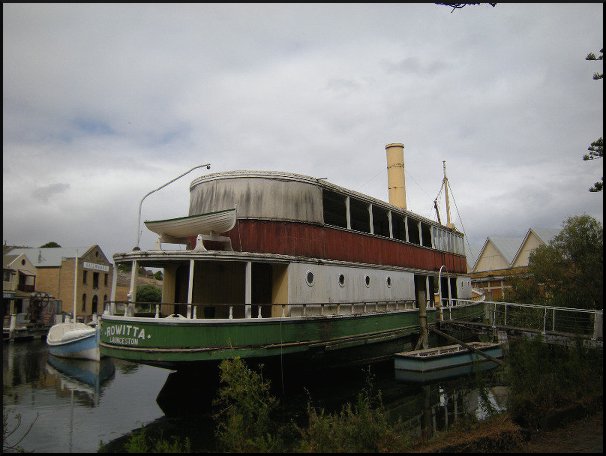





 You might also enjoy…