[dropcap style=”font-size: 60px; color: #A99E90;”] O [/dropcap]ccasionally, we post an item from Gumtree – the online sell/trade/swap site – that is odd, unusual, funny or just plain weird.
This week: the purrfect alternative to a real kitten for Christmas. This one doesn’t even require a litter tray!
[box] Kitten. Real fur. White in colour. It Purrs Scratches & Meows. $10[/box]
Members of the (surf) board: Teenagers Jade McCreddan (left), Mick Slockwitch and Isaak Jagoe have come up with their own surf wax recipe and are finding plenty of customers keen to try their product.
[dropcap style=”font-size: 60px; color: #A02F2F;”] E [/dropcap]ach member of the “board” is only 13 years old, but don’t for a moment think that the team behind a new, home-made surfing wax is not absolutely serious about making their product a winner.
Emmanuel College school buddies and surfing mates Jade McCreddan, from Yambuk, Isaak Jagoe, from Warrnambool and Mick Slockwitch, also from Warrnambool, spent most of last Saturday down at the Made by Me Market, at The Pavilion, in Warrnambool, where they put their surf wax – Stuck Wax – on sale for the first time.
While most boys their age would be heads-down playing with smartphones, Jade, Isaak and later Mick (who had to first compete in a surf lifesaving competition) chatted enthusiastically with customers about why their surf wax was better than the others. They also demonstrated its sticky superiority by leaving a lump attached to one of two surfboards they had brought in for display.
“We wanted to come up with our own recipe for a surf wax, so we started by looking around on the internet,” says Isaak.
Jade’s mother had some experience with wax through making beeswax candles, so the boys also sought her advice as they continued to experiment with various ingredients.
“I reckon we had about 12 different attempts until we worked out how we could make it really sticky,” Isaak says, “because that’s what you are looking for: something you can trust when you stand up on your board”.
“It is also eco-friendly and all natural ingredients,” Jade adds.
The Stuck Wax crew went public with their product for the first time at the weekend, with a stall at the Made by Me Market.
[dropcap style=”font-size: 60px; color: #A02F2F;”] T [/dropcap]he product was put to the test in the surf off Warrnambool and Port Fairy, where the boys have spent countless hours through last summer and winter since becoming “hooked” on the sport about a year ago.
Having nailed the winning formula, which, of course, they are keeping a closely guarded secret, the boys turned to marketing and package design.
“I must admit we spent a lot of time in our maths class at school drawing different designs and sharing ideas,” Jade says.
Somehow, we can’t imagine the teacher would mind.
Isaak’s father prints their package design on A4 paper that they then use to wrap each of the 70g wax cakes that are made in bulk in muffin trays in Isaak’s family kitchen.
“We put foil down everywhere,” he says, reassuringly.
About 60 bars were on sale for $4 a pop at the weekend and all were sold out by 4pm, but the boys are not counting their profits just yet.
“Well, first I owe Mum and Dad some money and then we have to buy more ingredients, and then, if we have anything left over, we will split it three ways,” Isaac explains.
With this sort of business acumen, Stuck Wax sounds like it will be sticking around.
[box type=”bio”] Depending on the surf over summer, the boys may be at other local markets, but in the meantime, you can buy Stuck Wax by emailing them at Stuck_Wax_Enterprises@hotmail.com[/box]
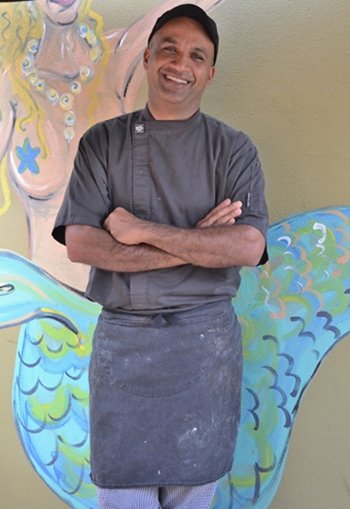
Jayaweera ‘Bundy’ Bandara started from scratch when he decided to move to Australia from Sri Lanka in the mid 1990s.
Most people know him for either his cricketing skills or his equally impressive cooking, but the story behind Jayaweera “Bundy” Bandara is also one of starting over to build a new life.
Bundy – who’s full name is Ganegala Walawwe Jayaweera Bandara – has been living in Warrnambool for 18 years since relocating from his native Sri Lanka and has become the cheerful, energetic force behind the popular FishTales Cafe, in Liebig St, where he is manager and head chef.
Since moving to South-West Victoria, Bundy, 43, has also established himself as one of the best cricketers in the region and was earlier this year named as the Warrnambool and District Cricket Association’s Division 1 Cricketer of the Year for his consistent batting. (His batting average was 69.29.)
Cricket has been a driving force behind Bundy’s life since playing the sport as a school boy in Colombo, Sri Lanka. His precocious talent saw him earmarked as a potential Sri Lankan test player and also gave him the opportunity to play in Australia.
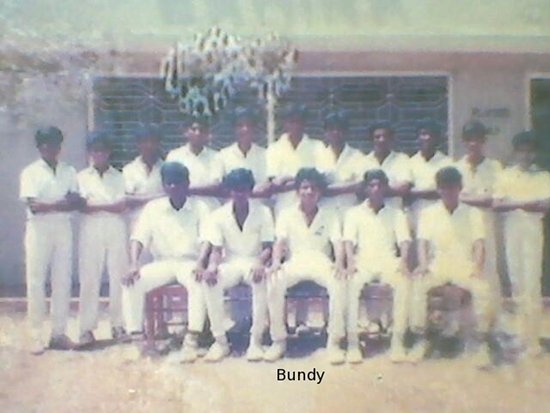
Bundy – front centre – in the school boy Under 17s in Colombo, Sri Lanka.
In his late teens, he was sponsored by the North Melbourne Cricket Club for the summer of 1989-90 and, the following year, he spent a season with the Footscray Cricket Club, where his team mates knew him as “Jaya”.
“I would be in Australia for six months and then return home and play there,” Bundy said.
Bundy’s cricketing career peaked in the early 90s when he played first-class cricket – one level below test cricket – in Sri Lanka for almost six years.
“Many of the Sri Lankan test players were my playing mates – we had nine players from the test team,” he said.
At the same time, Bundy was building a successful career off the field as a marketing executive with Bartleet Finance in Colombo.
Then, in the mid 90s, came one of those turning points in life when you decide to either keep following the familiar path, or try something completely different.
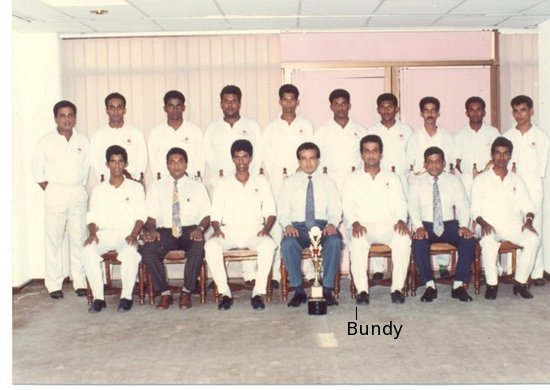
Bundy, third from right, during his playing days with the Barleet Finance group team in Sri Lanka.
Having made some friends in Warrnambool during his cricketing trips to Australia, Bundy grew to love the city – “it is so friendly, so lovely” – and so decided to accept a sponsorship to play for Dennington.
“I also decided to enrol in a cooking course at TAFE, because I wanted to become a chef,” he said, smiling.
“My first job was right here (pointing to the floor at FishTales), washing dishes.”
The former marketing executive and first class Sri Lankan cricketer found himself up to his elbows in soap suds, but it is this humility that has made Bundy such a well-loved person in his adopted home, where he is now very much one of the city’s personalities.
He and his wife Kylie, whom he married in Warrnambool in 2000, run a Sri Lankan Community group that welcomes Sri Lankans who have moved to the area and organises cultural events throughout the year. The group has also been involved in fundraising activities for underprivileged children in Sri Lanka.
And then there are the famous “curry nights” that Bundy introduced to FishTales, where locals flock to try the delicious flavours of Sri Lanka.
“At first people were a little unsure about the curries, but they try them and they are very happy,” he said, laughing.
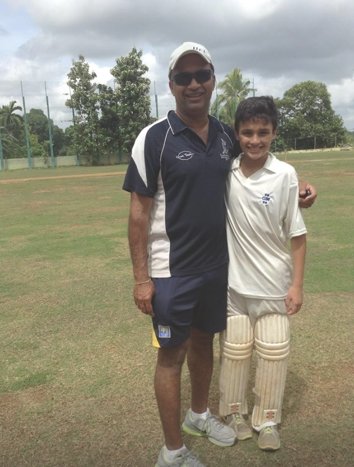
The local cricketing scene is also smiling, but not because of Bundy’s cuisine. Instead it is his son, Dominic (one of three children), who is already showing signs of being a champion batter.
“He has just been chosen for the Victorian Under 12 team – the only boy from this area – so we are very proud of that,” Bundy said, saving his widest smile for last.
A chip off the old block: son Dominic is already showing signs of becoming a top cricketer like his Dad. Bundy also has two daughters, Selena and Sriyani.
Behold this bluestone beauty
A labour of love: Ben and Helen Fennessy spent a year measuring up what lay ahead before deciding to take on the restoration of a rundown Rosebrook property that is now their home.
[dropcap style=”font-size: 60px; color: #A5CECD;”]T[/dropcap]aking on the restoration of a bluestone cottage in a rugged coastal landscape may sound romantic, but it is not a task to be taken lightly.
Artist Ben Fennessy and his wife Helen, who writes, spent a year deciding whether or not to buy a ramshackle, rundown dump on five acres that overlooked the Belfast Lough at Rosebrook, near Port Fairy, and turning it into a home.
The historic bluestone cottage and assorted add ons and out-buildings had been on the market for five years – five years! – when the Fennessy’s happened upon it during one of their visits to Port Fairy from their former home in the Otways.
The house sat unloved for years before the Fennessy’s took over.
The original kitchen …
The same space as it looks today.
[dropcap style=”font-size: 60px; color: #A5CECD;”] I [/dropcap]t took a special vision to see the beauty beneath the ugliness of the place, which had suffered from a combination of poor building extensions, a lack of maintenance and a series of tenants that showed little respect for the property, if not outright neglect.
(The state of the house was summed up when the Fennessy’s later removed boards covering the fireplaces and found piles of dirty nappies).
“It was very, very rundown and fairly hideous when we first saw it six years ago,” Ben said.
“We walked away for a year, but we kept coming back to it in our minds, thinking that it had really great potential, but that it would take a lot of work.”
The extent of the task ahead was laid bared in an Archicentre report that, Helen said, “ran to several pages”.
“The roof was being held up by tomato stakes,” she said, laughing at the memory.
Out with the Besser block extension: Helen Fennessy hard at work during the renovations…
And in with a light-filled, bluestone extension designed by Tim McLeod and that overlooks the Belfast Lough.
[dropcap style=”font-size: 60px; color: #A5CECD;”] U [/dropcap]nderneath all of the half-baked renovations, however, sat a sweet, four-room bluestone cottage that, despite all of its terrible makeovers, was as solid as the day it was built some time in 1856 as the engineer’s house for the local mill at Rosebrook.
“The original bluestone was actually in good nick, so we brought it back to that original footprint,” Ben said.
Over a two-year period, the Fennessy’s tore down a parasitic, 1970s extension at the rear of the cottage, restored the original cottage and added a magnificent big-windowed, light-filled space – designed by Warrnambool architect Tim McLeod – that overlooks the lough.
The result is a character-filled blend of the very old and the ultra modern – but the story doesn’t end there.
Clare meet Rosie, Rosie meet Clare: an old railway building and carriage have been converted into a self-contained living space.
[dropcap style=”font-size: 60px; color: #A5CECD;”] B [/dropcap]en’s eye for the quirky has seen two more fascinating additions that, together, form a separate, self-contained living space for their daughter and ceramic artist,Clare Fennessy.
Clare’s lounge room, small kitchen and bathroom is housed in a pre-fab railway building originally from the Warrnambool Railway Station that, when Ben found it, was being used as a hayshed out in a paddock.
“Rosie”, as the railway shed is now known, snuggles neatly against an antique railway carriage that dates back to 1911 and was once used to transport refrigerated goods. It is now Clare’s bedroom, complete with a roof insulated by horse hair.
“I’d seen it sitting in a paddock at Illowa and so I approached the owners and asked if they wanted to sell it,” Ben explained.
“It was being used as a fertiliser shed at the time.”
With the property finished, and two alpacas installed in the surrounding paddocks to keep the grass down, the Fennessys need only enjoy the inspiring space: perfect for such creative souls.
After many years of hard work, the renovation and restoration is complete.
[dropcap style=”font-size: 60px; color: #DDCE8D;”] T [/dropcap]o some people, the destiny of a sand plover sitting on a nest probably doesn’t mean all that much, but Bluestone supporters are different to most people.
We know this because of how they – perhaps including you – responded to our efforts to protect one small plover that had made the decision to nest in dry sand about 150 metres from the Hopkins River bridge, right where fishermen, walkers and plenty of energetic, beach-excited dogs like to roam.
In fact I was roaming when my big clodhopper shoe nearly wiped out the two speckled eggs that were so well camouflaged as to be almost invisible. (Mama bird was nowhere to be seen at the time: she had probably popped to the shops).
Thinking the eggs were abandoned, I admired them and moved on.
[dropcap style=”font-size: 60px; color: #DDCE8D;”] T [/dropcap]he next day, however, I was roaming again (I do that a lot, in the mornings) and Mama bird was draped over the eggs like a woman wearing a feathery ball gown: and so the quest to protect “Pip” and her eggs began.
We thought this would involve no more than a visit to Parks Victoria who would be able to protect the nest by roping off the area and banging a few signs into the sand, just as we had seen at other coastal nesting sites around Victoria.
But unfortunately Pip’s GPS was off.
If she had nested on the actual foreshore, another 750 metres away, she would have been in the domain of Parks Victoria. Instead, she was in a sort of no-birds-land that, upon investigation, was found to be managed by the local council.
The council, unfortunately, was up to its neck with other things – things obviously much bigger than Pip – and was unable to respond with the haste that we had hoped.
[dropcap style=”font-size: 60px; color: #DDCE8D;”] W [/dropcap]hile we waited for the cavalry to arrive, we made our own signs – from whatever we could find – and rigged up a very non-convincing fence using bits of old rope.
Days ticked by, during which Bluestone began to post “Pip” updates on its Facebook page and hundreds of people began to follow our progress, or lack thereof.
As the days turned into more than a week, we checked our fence and our signs and were constantly amazed that, despite some horrendous weather, both continued to hold.
[dropcap style=”font-size: 60px; color: #DDCE8D;”] W [/dropcap]e were also constantly amazed by how many of our readers wanted to know how Pip was faring – she was fast turning into a minor celebrity (although without an agent).
Last Wednesday – 13 days after Pip’s nest was first discovered – the council was finally able to stake out her nesting zone with string and wooden posts, and erect two serious-looking signs.
We have no doubt that the Bluestone FB page helped that to happen and just in time, as on Sunday (yesterday) the river was packed with people and dogs enjoying the first day of Summer.
[dropcap style=”font-size: 60px; color: #DDCE8D;”]S[/dropcap]omething else happened over the weekend too.
Our first Pip-ette.
The second, we have no doubt, is not far behind and both Pip and her partner (Pat?) are sharing the nesting and chick-watching responsibilities.
Thankyou Bluestone supporters – we have made a small but important difference.
The ‘Bluestone baby’ – between Mum and Dad – shortly after hatching at the weekend.
[box] Unlike many young birds, sand plovers are self-sufficient from the moment they leave the egg. They are not fed directly by their parents, but collect their own food (under the protective eye of Mum or Dad) and spend most of their time hiding in the sand dunes until they are old enough to borrow the car keys.[/box]
Do you enjoy Bluestone? Please subscribe so we can continue to grow.




 If you enjoyed this story, you might enjoy…