[dropcap style=”font-size: 60px; color: #A02F2F;”] I [/dropcap]f you thought you were going to get away without even ONE Christmas Carol from Bluestone Magazine, then think again.
After all, Carol is one half of Bluestone and this is her season!
Click on the image of the great crooner himself to enjoy our selection…
(And try not to feel like you are at your relative’s house already – that will happen on December 25!)
Merry Christmas everyone!
Homestyle cakes a recipe for success
Gina Walker and Jill Ellis get into the spirit of Christmas at Cafe Connect: a cafe where the cakes and slices are just like your Mum used to make. (If you were lucky enough!)
There is a fair chance that among all of the thousands of cafe reviews ever written, very few have featured a cafe inside a nursing home.
“A what?” we hear you say.
Yes – a nursing home. And the particular nursing home in question is the largest and oldest in Warrnambool – Lyndoch – where Cafe Connect has just celebrated its first birthday.
Whether we like it or not, most of us will have some connection to a nursing home at some point in our lives, either as a resident, a visitor, or even as a staff member, and Cafe Connect manages to connect with all three groups.
The key to its raging success – and it is incredibly successful – is that it operates as a regular cafe where anybody is welcome to drop in for a coffee and a cake, or something savoury, and the quality is outstanding.
People who remember Conn’s Cakes in Timor St, Warrnambool, will think that Rex Conn himself has returned to make sensational cream sponges (with real cream), jelly cakes, hedgehog, caramel slice, peppermint slice, apple charlottes, fruit cake, chocolate cake (are you drooling yet?), cupcakes, Anzac biscuits and passionfruit slice…and that is only some of the ever-changing selection available at very reasonable prices.
The cooking is all done on the premises by three talented and cheerful women who share the role – Jill Ellis, Gina Walker and Madeline Boyle – but Gina and Madeline happily nominate Jill as the driving force.
“Her cooking is just amazing,” says Gina.
Even more amazing is that Jill, who worked many years ago at the now defunct Echo’s cafe in Liebig St, never uses a recipe. Instead, she has a feel for what works and remembers the combinations in her head.
The choice of treats is also a deliberate throw-back to the past.
“I think one of the reasons that the cakes are so popular is that they remind people of the cakes and slices they enjoyed when they were younger,” Jill says.
The nostalgia doesn’t stop there. People also enjoy the sights, smells and sounds of cooking in the kitchen.
“One day I had the mixmaster going and I apologised to a customer about the noise and she said, ‘no, keep it going, because it reminds me of my Mum when she was in the kitchen and she always had the mixmaster going,”’ Jill laughs.
Cafe Connect, which was funded by Lyndoch’s annual community raffle and other community events, has become a vibrant, colourful hub to Lyndoch and, because it is located right in the main entrance, the general public are also able to wander in – and they do. (At least one member of Bluestone Magazine is known to drop in regularly, just to see what slices might be fresh out of the oven.)
In recognition of their success, Jill, Gina and Madeline recently received one of only two Excellence and Innovation Awards awarded annually by Lyndoch. Jill has also been inspired to become a chef and is studying for her qualification…but we secretly hope she still doesn’t stick to any recipe.
Madeline Boyle is the third member of the Cafe Connect team and keeps the friendly vibe going across the weekend.
Cafe Connect, Lyndoch, Hopkins Rd, Warrnambool, is open seven days a week.
Our history: while all hands are on deck to revive the recreated village of Flagstaff Hill, the authentic Pleasant Hill is slowly rotting away.
Analysis – Carol Altmann
It is supremely ironic that so much time and effort is being devoted to reviving the flagging Flagstaff Hill Maritime Museum, when a critical slice of our authentic history is being left to rot.
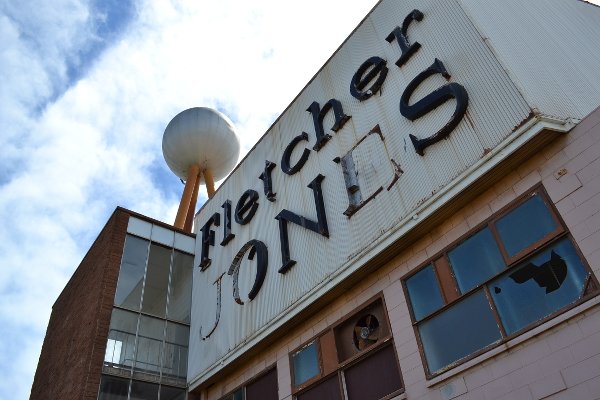
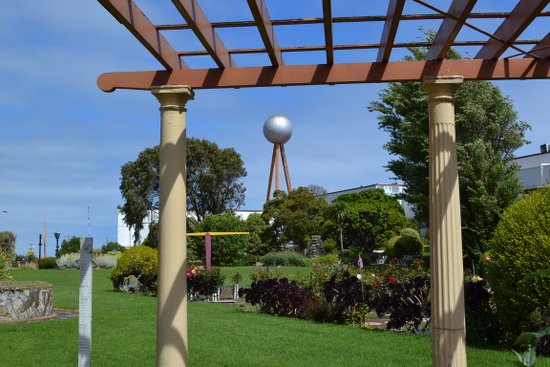
Unlike Flagstaff Hill, which was built in the 1970s as a pseudo-colonial tourist attraction popular in that era, theFletcher Jones factory, silver ball water tower and spectacular gardens have occupied a special place in the hearts and minds of the people of Warrnambool for almost 70 years.
Sir Fletcher Jones was one of our greatest philanthropists and Pleasant Hill was his special gift to the city; a gift that, I am certain, he thought would remain in perpetuity.
But if he were alive to see the site today, his heart would break.
That’s because Pleasant Hill is being ‘preserved’ in the way that Warrnambool seems to do best: coat a run-down heritage property with complex planning conditions, wait for a cashed-up developer to buy the site and then watch as they slowly go broke – or lose interest – because of these same conditions, and, in the final act, see the neglected site bulldozed or burnt down in a mysterious fire.
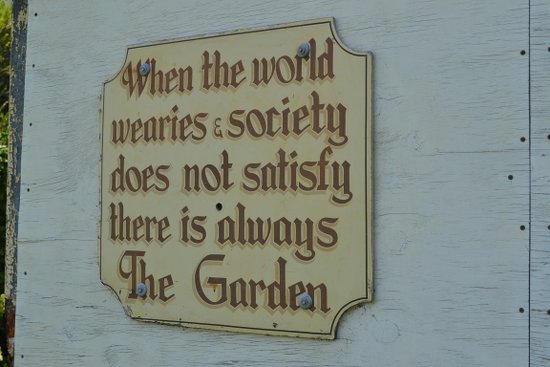
Some Fletcher Jones wisdom: if he could see his vision today, his heart would break.
We have seen this happen in recent years with the Criterion Hotel, the Grand Hotel, and the ill-fated cottage at 94 Merri St*, yet we still haven’t learnt that the only way to save our icons is to work together: for government bodies (including Heritage Victoria and the Warrnambool City Council), developers and the community to have a clear vision of what should happen with a site as precious as Pleasant Hill and to be prepared to share the cost of its preservation to make sure that it is, in fact, preserved.
And Pleasant Hill is precious because, unlike Flagstaff Hill, the Fletcher Jones story is our story.
As much as we would like to claim the sea-shanty tales captured in Flagstaff Hill as our own, Warrnambool was primarily a place of industry, farming and commerce.
The whaling story belongs to Portland and Port Fairy. The Loch Ard Gorge story belongs to Port Campbell and the entire shipwreck mythology is one that has been built around ships that, for the most part, were passing by Warrnambool on their way to somewhere else.
Hence we don’t have locals sharing tales of their sea-faring great grandfathers, but instead we talk about the Woollen Mill, Swintons, Crammond and Dicksons, Nestles, the cordial makers, millers and brewers, the dairy farmers, potato growers, butchers, bakers and bullock drivers and, of course, Fletcher Jones.
The Fletcher Jones story is our story: generations have grown up under the ‘Silver Ball’.
This is why there is a disconnect between Flagstaff Hill and the local community who, it seems, have stopped visiting or who don’t visit nearly enough.
And tourist numbers are also falling. I suspect one problem is that reconstructed, theme-park style villages have lost their lustre, despite the valiant efforts of the many volunteers involved.
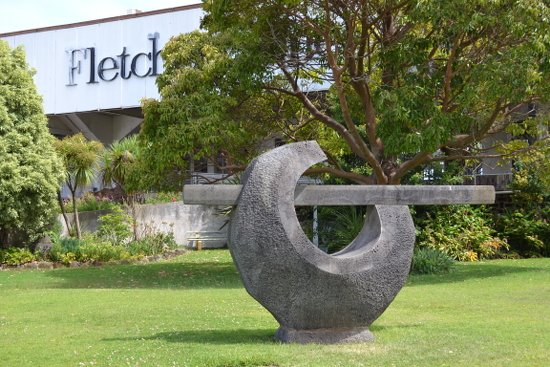
This tribute to Fletcher Jones by Robert Ulmann sets the scene for what could be a magnificent sculpture garden.
The cold-shower moment is to accept that Flagstaff Hill has had its day and will only continue to chew up funds as it recreates itself to fit changing tourism tastes.
The site could be returned to open space and the $13-15 million directed toward restoring and preserving Pleasant Hill, but as what? The suggestions so far include – god forbid – more housing, retail, offices, or even an aged care facility. How boring.
What about this: transform Pleasant Hill into a combined Warrnambool Art Gallery and Museum. Given FJ’s support for the arts, it is a perfect fit.
The already-squeezed art gallery in Timor St could be relocated and stretch out, including into the gardens that would become an outdoor sculpture park.
The best of the Flagstaff Hill collection could be housed in the museum, which would also include a tribute to Fletcher Jones and artefacts from the factory (much of which, unbelievably, ended up in skip bins before being retrieved by art students).
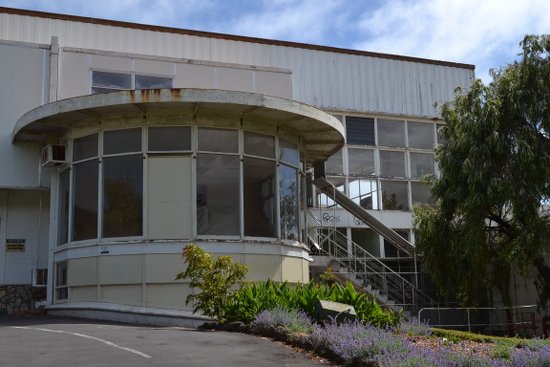
A table for two please: the ‘Round room’ could be converted into a restaurant or cafe.
The Tourist Information Centre would fit nicely, and the ‘Round Room’ – once part of the FJ canteen – would be perfect as a restaurant/cafe called Fletcher’s. The silver ball can just remain the silver ball: restored and shining.
There is more than ample – and completely unused – parking in the Raglan Parade median strip and a pedestrian overpass would solve the issue of crossing a busy highway.
It will take money, it will take vision and it will take commitment, but in 20 years time, which do you think will have the more enduring appeal: a “recreated” maritime village where people are strolling around in gingham caps and hooped dresses, or a dynamic art gallery and museum housed in one of our most iconic buildings?
We don’t need a crystal ball to predict the outcome: just a silver one.
*The Warrnambool Planning and Heritage Group wrote a report 18 months ago that warned Fletcher Jones faces the same fate as 94 Merri St, which was right across the road from Flagstaff Hill, unless action was taken now. The Warrnambool City Council’s response to the group’s 15 recommendations was tabled at its meeting last Monday: see pp 181-185 of agenda 9/12/13. Or you can see a summary here.
Subscribe
[dropcap style=”font-size: 60px; color: #A5CECD;”] T [/dropcap]hankyou for supporting us.
Bluestone Magazine has delivered on its promise to produce a quality read every week about the arts, people, food and places of beautiful South-West Victoria.
The response to our online magazine has been wonderful, but we are asking for your help to continue in 2014.
We need 200 subscribers happy to pay $8 a month or $85 for a full year (discount rate) to keep your independent magazine alive in South-West Victoria.
Does this sound like you?
If so, please sign up below using the Paypal button.
You do not need a Paypal account to subscribe – you can use a credit card.
[box]
[/box]
Need another option?
Direct bank deposit:
Account Name: Bluestone Magazine
BSB: 063533 (Commonwealth Bank)
Account No: 10776932
Thankyou so much!
Carol & Louise
[learn_more caption=”The story so far”]
Since we started on Sept 2, 2013, Bluestone Magazine has been showing you what is possible with an independent online magazine that is focussed on the arts, food, people and places of the South-West.
There are so many great people out there and we want to continue to share their stories.
We’ve told you the stories of emerging artists, established artists, quality food producers, cafes or just people who are fascinating because they work in unusual jobs or live in wonderful places.
We’ve shared with you some of the many ‘Quiet Heroes’ of the region and what they give back to our community, and we’ve given them a small reward, now sponsored by Lozzar’s and Wyton Cellars in Warrnambool, and Rocksalt in Port Fairy.
And you have liked it! So many of you have taken the time to tell us that you really enjoy the style and quality of the stories we write, and the design of our magazine. We are now nearing 3000 page views each week. Wow!
But for us to continue to grow and dedicate the many hours it takes to research, write and produce such a magazine, we do need your support.
Some of you have already made generous donations and we thankyou so much for getting us this far!
We have thought long and hard about our subscriber model and have settled on one that asks the reader to pay the equivalent of just $2 a week (or $85 if you sign up for the year).
We decided not to put up a paywall, so if you don’t subscribe, you will still be able to read our stories…but it is a little like driving on a road that only a few people help to maintain: the road will still be there, but it will soon be full of potholes!
So please subscribe – and continue to enjoy the ride.
[/learn_more]
End of the line for fine art at Sherwood Park
Last man standing: Graphic design and illustration lecturer Mark Rashleigh is the only staff member remaining in the former School of Art and Design at Sherwood Park, Warrnambool. (Artwork: Untitled (landscape), Martin Jones).
[dropcap style=”font-size: 60px; color: #A5CECD;”] M [/dropcap]ark Rashleigh is the last man standing at what was once a flourishing School of Art and Design at Sherwood Park, Warrnambool, and, come mid next year, he too will be gone.
It is indicative of how much things have changed that Mark, a lecturer in graphic designer and illustration, now has an office in the Faculty of Business and Law at the Deakin University campus because the former visual arts studios are closed due to various structural concerns.
A similar, if metaphorical, corrosion has also claimed the art school that will officially end next year after starting life under the former Warrnambool Institute of Advanced Education in Timor St (now South-West TAFE) in the late ’60s, before relocating to the Sherwood Park campus in the 1980s. There, as a university degree, it became part of the Deakin merger.
“When I first started here, in 1985, there were about 13 staff teaching a very broad visual arts degree that included painting, sculpture, art history, photography, print making, graphic design and ceramics,” Mark, who will retire in June, said.
At that time, the teachers – most of whom were established artists – would mount joint exhibitions, maintaining a tradition that began when the school first started.
A document held by the National Libraries of Australia, for example, records some of the names in a joint staff/student exhibition held at the City of Hamilton Art Gallery in November 1970 and it reads as a virtual who’s who of the early South-West Victorian arts scene: Ken Daniel** (lecturer), Ron Quick (lecturer), Graeme Birt (lecturer), David Wormald, John Elphick, Jill Fitzgerald, Jennifer McConnell, Christine Taylor, Ken Saddler, John Rogers, Trevor Morrison, Peter Bond, Lilian Baxter, Alan Murdoch, Frank O’Brien, Chris Carroll, Gary Sparks, Judith Lovell, Gary Heath, Lorrain Callow, Michele Hill.
Beginnings; A teenage Graeme Altmann surrounded by some of his early paintings created in the former School of Art and Design studios at Sherwood Park. Photo: John (Jack) Wilkins.
[dropcap style=”font-size: 60px; color: #A5CECD;”] I [/dropcap]n its prime, the airy studio space at Sherwood Park was alive with the sound, movement and colour of artists in action and gave the campus its energetic heart, usually to the beat of a paint-splattered cassette player set up in a corner.
Students pursuing somewhat more subdued degrees in economics, marine biology or primary school teaching could wander over and see what the “hippies” of the campus were up to.
The halcyon days of the 70s, 80s and 90s, however, crashed into the economic rationalism of the 2000’s when university degrees around Australia were no longer about providing knowledge and skills, but also a financial return.
In this new climate, art schools were in a hopeless position.
And while Mark can’t speak about Deakin directly, he can reflect on the challenge facing all visual art degrees.
“A visual arts degree is a quasi-industrial process: they cost a lot to run. There is the high cost of the studio spaces, and the high cost of running courses for small groups of students, because that is how the learning happens, in small groups, not in a large lecture theatre,” he said.
Skilled staff who leave or retire are not replaced, and, suddenly, painting is no longer available, or sculpture, or perhaps print making, and the degree is reduced to a husk.
Room to move: Artist Barbara Fulton with some of her large canvases in the painting studio in the 1980s. Image: John (Jack) Wilkins.
[dropcap style=”font-size: 60px; color: #A5CECD;”] A [/dropcap]t the same time, Australians love art: according to the ABS, more than a quarter of us visit a gallery or museum at least once a year.
“The returns on the investment in art schools and courses cannot be measured in dollars, but in what we get back – as a culture – from the artist,” Mark said.
Yet Mark remains optimistic. As he closes the door on his career, and that of the school, South-West TAFE is refocussing its visual arts courses at its new location in the Timor St complex.
The wheel has turned full circle.
“Art changes its address, but it’s not going away,” Mark said.
** Ken Daniel established the art school at WIAE in 1970. When the school amalgamated with Deakin University around 1985, he was appointed Dean of the fine arts across all Deakin campuses.