Award-winning sculptor Jon Dixon has spent 20 years creating the Lyons Sculpture Park, near Heywood, in an organic and creative project that has no end.
[dropcap style=”font-size: 60px; color: #A02F2F;”] I [/dropcap]f sculptor Jon Dixon had his way, this story would contain only a single sentence: “art is important”.
“That’s all you need to write,” he says, as we start our tour of the 15-acre Lyons Sculpture Park that he and his wife, Chris, have created on their bush property 21km west of Heywood.
After walking just two or three minutes through what is a combination of sculpture, gardens, raw bush, and farmland it is patently clear, however, that one sentence is not going to cut it. Sorry Jon.
Indeed it is difficult to describe the park, because it refuses to slot into any simple category.
It is a “park”, but not a manicured one. It is a gallery, but without an entry fee or labels on any of the works. And it is full of stone, wood and metal sculptures, some of which are obvious to the eye, but also others that are tucked in nooks and crannies: up a tree, behind a bush, attached to a fallen log.
The natural bush on the 15 acre property is studded with gorgeous sculptures, including this one from pink dolomite.
[dropcap style=”font-size: 60px; color: #A02F2F;”] T [/dropcap]he sculpture park – and the Dixon home – sits on what was once the township of Lyons and covers 30 individual titles: all half acre blocks that were once occupied by the small community built around the timber industry.
Jon and Chris bought the property 20 years ago, after Jon decided to quit his executive lifestyle and return to his first love of art.
“I was running my own industrial door company (in Melbourne) and I watched all of the company executives I knew climbing up the corporate ladder, stepping on heads along the way, burning people off along the way…and they were all miserable,” he said.
Once Jon and Chris, who is a secondary school English teacher, found the Lyons property, they knew it was the perfect place to stretch out and exercise their creativity.
Born in England, but raised in working-class New Zealand, Jon was immersed in the artistic and cultural symbols of the Maori people and this influence is clear in his style today.
[dropcap style=”font-size: 60px; color: #A02F2F;”] M [/dropcap]ost of Jon’s sculptures are worked from local limestone and bluestone, sometimes paired with “found” objects such as a recycled milk vat or a cemetery headstone, or the remnants of industrial farm machinery, equipment or tools. He also creates large metal sculptures, the most striking of which is a life-size silhouette of a rearing horse placed among the tall, yellowing grass of the property.
[box] Jon has generously donated a gorgeous sculpture valued at $600 to be given away to one lucky paid subscriber. Click here for details on how to win this wonderful piece.[/box]
One of the engaging things about the park is that there is no particular theme and it moves easily from the abstract – an overgrown field full of female torsos – to the spiritual, such as the “Stonehenge” style installation in a perfectly mown circle of a grass, to the political. The lack of labels or interpretive notes lets the viewer see what they want to see.
The raw bush, which Jon clearly loves and is slowly restoring to its native state, also contains a range of works, including a simple stone disc punctured with numerous holes.
Jon tells the story of a visiting Asian family who were captivated by this piece after he invited them to find “the most beautiful leaf” from the many gum leaves on the ground and place it into a hole.
“This was a family that, at home, had to drive two hours to find open space and here we have beautiful, natural bush. They stood here for a long time, just picking up leaves – dead ones, green ones – and placing them into the holes,” he said.
You are right, Jon. Art is (so) important.
[box type=”bio”] Jon Dixon has received numerous accolades for his work, including winning the prestigious Montalto Sculpture Prize in 2003. You can see more of Jon’s work at his website here and find him on Facebook here. The Lyons Sculpture Park is at 4143 Princes Highway, Lyons. Ph: 0437 000 433. Open daily 9am – 5pm. Free.[/box]
Alice and Andy Hall, together with their children Daisy and George, have set down their roots in Killarney to run The Pantry Door at Basalt.
[dropcap style=”font-size: 60px; color: #A02F2F;”] P [/dropcap]astry chef Andy Hall has the sort of five-star resume to be a cliched, arrogant chef that we have come to know via “reality” television, but instead he has gone 360 degrees in the other direction.
Despite having previously working in not one, but two, Michelin-starred restaurants in the UK (The Vineyard at Stockcross and Le Manoir Aux Quat’Saisons) and stints at Vue De Monde, in Melbourne, and the Royal Mail Hotel, in Dunkeld, Andy’s feet are planted firmly on the ground.
For starters, he lives and works at Killarney, between Port Fairy and Warrnambool.
For seconds, he now runs a small, country style cafe/restaurant – The Pantry Door at Basalt – with his wife, Alice.
And for main, he has two small children, Daisy and George, that dictate his priorities and give him every reason not to return to the “madness” of five-star hospitality.
“I no longer wanted to be doing the 17-hour days that you have to do when working at that high level,” Andy says.
“I was happy to do those hard yards before I was settled, but things are very different now.”
The Pantry Door lives up to its name by offering a range of gourmet, home-made products to take home.
[dropcap style=”font-size: 60px; color: #A02F2F;”] L [/dropcap]ife began to change for Andy, who is originally from the UK, when he was invited by his friend, chef Cameron Goad (who was in charge before Dan Hunter) to join him at the Royal Mail Hotel which, at that time, still had the feel of an upmarket country pub.
Prior to taking up the Royal Mail position in 2006, Andy had already begun to back away from the intensity of the restaurant life by working in Port Douglas as a snorkelling instructor. He decided, however, to take up the offer from his friend.
Alice, from Hamilton, was working in the office.
“I was actually a nurse, but taking some time out and working at the Royal Mail – and that’s how I met Andy,” Alice explains, before having to duck out to meet the gardener who has turned up to discuss their vege patch.
The restaurant has a touch of class while still making people feel at home in the beautiful weatherboard building.
[dropcap style=”font-size: 60px; color: #A02F2F;”] T [/dropcap]he pair married in 2009 and explored different adventures, including 12 months overseas, before Alice’s connections to south-west Victoria (which include her family’s old beach shack at Port Fairy, where she spent many summers) eventually saw them invited to take over the restaurant at the Basalt winery.
“(Chef) Chris Grace had set up the original restaurant at Basalt and he was ready to move on, so (owner) Shane Clancey, asked us if we would like to take over the lease and do our own thing with it,” Andy explains.
The opportunity was too good to refuse and the pair opened their business in December 2012, the same week their first child, Daisy, was born.
Almost 18 months on, the Pantry Door at Basalt has established itself as a popular place for breakfast and lunch, but also, as its name suggests, a pantry that sells Andy’s home-made preserves, sauces, dressings and a range of other delicacies.
The couple has also recently introduced cooking classes, including those specifically for men, and is building its reputation as a gallery space for local artists.
“It was madness at times – when we were starting out – but we didn’t want to get to 80 and wish that we had taken the chance to run our own place,” Alice says.
Fresh apple tarts made from home-grown apples. Andy’s background is as a speciality pastry chef. Yum.
[box type=”bio”] The Pantry Door at Basalt, 1131 Princes Highway, Killarney, is open for breakfast and lunch Wed-Sun. P: (03) 5568 7442. You can also find them on Facebook. [/box]
[dropcap style=”font-size: 60px; color: #A5CECD;”] A [/dropcap]ward-winning sculptor Jon Dixon has very generously donated one of his work’s valued at $600 for us to give away to one lucky paid subscriber to Bluestone Magazine.
At the end of our interview with Jon (you can read our story here), he disappeared into his studio and emerged with a lovely piece that he insisted we offer as a prize to our readers.
The female torso is carved from limestone and stands 42cm tall.
In donating this piece, Jon wanted us to receive the value of the prize in new paid subscriptions as his way of supporting what we do and to help us reach our goal of 200 paid subscribers.
So, the first seven people to take out a paid subscription – either monthly or yearly – will be automatically included in the draw.
If you are already a paying subscriber – either monthly or yearly – you can enter the draw by simply dropping us an email to editor@bluestonemagazine.com.au
We will draw the winner* once we have reached the goal of seven new paid subscribers. What a perfect time to sign on to Bluestone!
Thankyou, Jon, for such a wonderful donation.
[box] * The winner will be announced here and also on our Facebook page, plus we will contact you personally. Please note the sculpture can be delivered to a Warrnambool address only, as we are unable to post such a heavy item! If you live more than 20km from Warrnambool, you will need to arrange collection. [/box]
David Jones Jr on the future of the FJ site
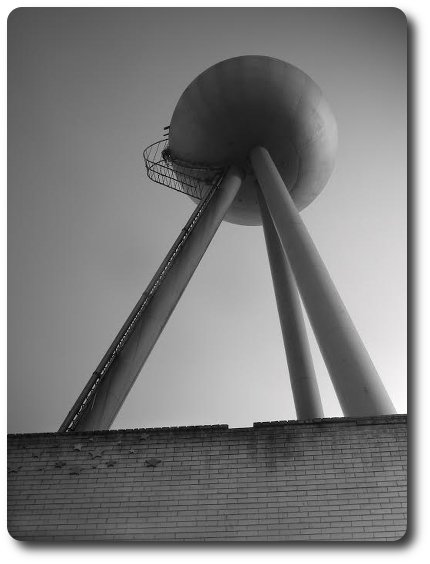
This stunning image of the Fletcher Jones’ silver ball was taken by Deakin University fine art academic Mark Rashleigh who has kindly given us permission to reproduce it here. It depicts the tower with its ladder and railings intact.
OPINION
[dropcap style=”font-size: 60px; color: #ABCCAB;”] A [/dropcap]s Heritage Victoria prepares to inspect the dilapidated Fletcher Jones factory in Warrnambool next Monday (7/4), the grandson of Fletcher Jones said his family would be delighted to see something “creative” happen with the site.
In so saying, however, David Fletcher Jones Jr said that his family fully appreciated the complexity of the situation that has developed since the current owner, Daramking (owned by failed Geelong businessman Ian Ballis), went into receivership in 2012.
“I am anxious to stress that we recognise how challenging this all is,” Mr Jones said in an exclusive interview with Bluestone.
Mr Jones is the son of the late David and Isobel Jones and lived in Warrnambool until his teenage years. As a result, he is keenly aware of the connection that many people feel to the Fletcher Jones factory site because of the high esteem in which his grandfather was held.
“How the site looks today is very sad,” he said.
“Everyone would like to see something better done with it.”
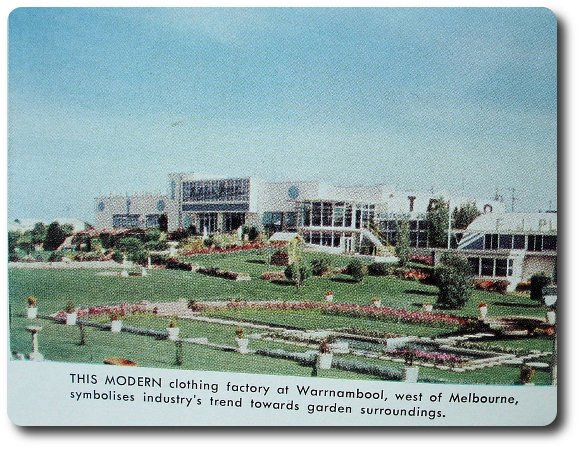
Fletcher Jones factory, Warrnambool circa 1950’s. Photo source: Land of the Southern Cross Australia. Published by The Australian Publicity Council. Private collection.
[dropcap style=”font-size: 60px; color: #ABCCAB;”] M [/dropcap]r Jones, who with his sisters, Susan and Anne, oversees the philanthropic FJ Foundation, said the debate around the future of the site reinforced that there was no easy answer and a solution would require a “thorough engagement with the council and the community”.
“Quite a complex and thoughtful solution is going to be needed,” he said.
“And we would be excited if something thoughtful and appropriate could be done.”
While Mr Jones did not wish to specify what sort of development he would like to see on the site, he agreed that a project that linked to the broader community would certainly reflect the values of his grandfather.
The Jones’ family have had no direct involvement in the FJ factory site since the company was sold in 1995, but the personal links remain strong.
The water tower was designed by Fletcher Jones’ son, Ralph, who was a consulting engineer and is now aged in his 80s. The Pleasant Hill gardens, meanwhile, were designed by Fletcher Jones’ brother-in-law Darby Boucher.
The heritage-listed water tower, gardens and other key elements of the iconic site have been central to recent discussions between Heritage Victoria, the Warrnambool City Council, the administrators and the mortgagors as to who has responsibility for maintaining these historic elements.
[dropcap style=”font-size: 60px; color: #ABCCAB;”] I [/dropcap]n the meantime, the various tenants occupying different parts of the building are still paying rent and, in most cases, repairing what they can as the building continues to crumble around them.
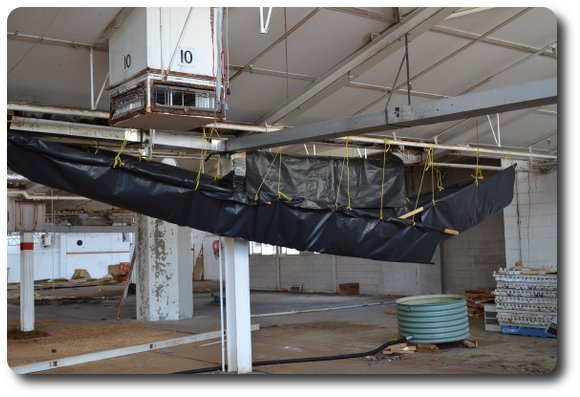
The Triton Woodworkers Club, for example, pays around $9000 a year for a space directly under the silver ball that is substantial in size, but leaks like a sieve whenever it rains.
The club has rigged up an improvised internal drainage system that keeps most of the rain off their equipment – if not the floor – but an outsider can’t help wondering why they are being charged anything at all, especially as a not-for-profit community group who, simply by being there, help to keep the vandals out.
So where does the long-term solution to the site lie?
Hopefully a constructive plan will emerge from the talks between the various parties, but, in the meantime, it is worth revisiting a key recommendation of the 2003 consultants’ report, commissioned by the council, into the site’s future.
It suggested the council, even if it no longer owned the site, keep the dialogue open between the community, any developer and the council to ensure its future life was in keeping with community expectations.
To date, this has not happened. This may change and, if it does, we may be on our way to the “thoughtful and appropriate” solution that such a high-profile and important site deserves.
[box] Postscript: According to the Warrnambool City Council, it spent almost $160,000 on the Fletcher Jones site between 2002 and 2008. A breakdown of this figure was unavailable, but it included repairs on the silver ball after an assessment in 2004.[/box]
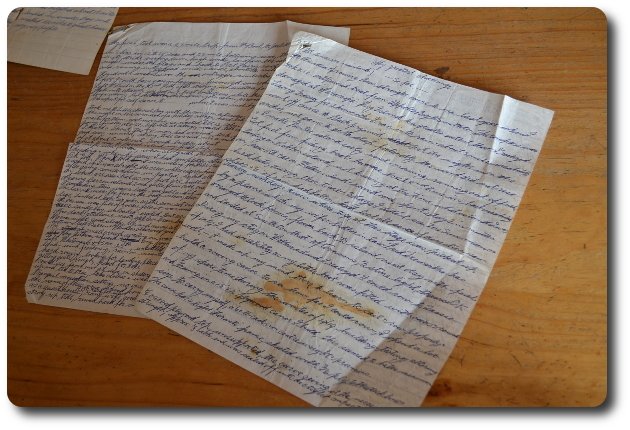
Last week we brought you the full story of Alf Altmann’s ill-fated attempt to row solo from Tasmania to Victoria in 1970. Alf, of Warrnambool, kept notes during his journey and at least a portion of these were found in a waterproof section of his kayak after it was retrieved off the Gippsland Lakes. His son, Alan, transcribed them in 2004. This is the first time they have been published.
“My Greatest Challenge”
– So Far –
The idea of rowing Bass Strait came to me last year when I took a 10’ outboard powered boat from Apollo Bay to Smithton.
The compass was damaged at Naracoopa, King Island to a greater extent than I realised. Leaving Grassy for 3 Hummocks Is. I ran into rain & about 3 miles visibility went off course to Black Pyramid, put the night in on the anchor, not game to sleep, fortunately the wind did not rise & I made Hunter island early next morning, running out of fuel.
Got fuel from fishing boat & became lost a second time in bad visibility, landing on Robbins island, not knowing at the time which island I was on, (I) saw old car on Walker island and rowed over, spent 2 days in mutton bird huts, during this time – 3 days – I didn’t see the sun, moon or stars & 6” of rain had fallen, had lost all sense of direction.
Saw Stanley (Tasmania) next day and knew where to go, at this stage was picked up by a plane which my wife & brother in law Fred Trewartha had arranged to look for me, flown back to (Robbins) island next day with fuel and landed at Smithton that afternoon, ½ stone light otherwise OK.
During my stay on Walker island I realised I could row to Tassie if only I had visibility, as my little boat was fitted with oars & rowed well.
I made up my mind there to learn to sail & row properly, build a rowing canoe to see how far I could row.
I spent a lot of my spare time during the winter of 1969 building – testing – altering and training in a 15’ by 2’ plywood canoe I built. This seemed to be the minimum size to carry myself, a 60 lb cast iron centre weight & provisions.
The canoe has a light ‘Meranti’ frame, sheeted with 3/16 ply to the deck line & 1/8 curved plywood top, unsupported, the curve giving it the necessary strength. Approx. 1/3 each end was sealed off into airtight compartments to assure floatation with airtight hatches to hold food, clothes & equipment and finally filled with plastic bottles.
I also packed foam floatation in the centre compartment where I rowed, this was fitted with a well, to house the centre-weight, which I bolted in. If the centre-weight was lost in this narrow craft, one would hardly survive at sea. After all this is a survival craft, not a showpiece.
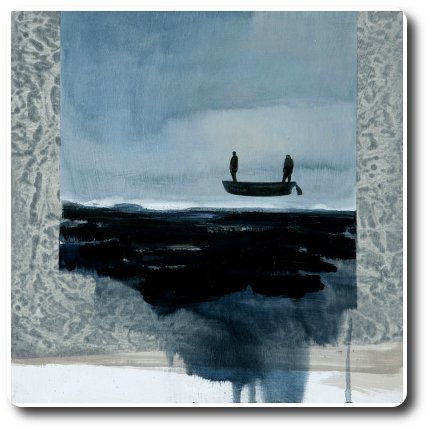
Waiting for high tide, by Graeme Altmann. Graeme, who is Alf’s nephew, has drawn upon Alf’s story for a series of works depicting men at sea.
I learnt to sail it, it ran well with the wind and I could do a fair reach with a small sail & jib. To cut down equipment I rigged an extension to an oar for a mast, one could be under sail in about 10 minutes, but this was only to run back if I struck strong head winds.
The idea was to be the first to row Bass Strait.
During tests I found out I could not capsize the craft and it would ride out strong winds & big seas, however it was possible to have it blown over with too much sail, with an unexpected gust.
I found out one could get out and soon get in the lee side, the craft righting itself, however I almost made as much speed with the wind with the oars running with the wind without much effort, without the risk of capsizing.
The rudder fitted keeps the craft on a much more even course, particularly running with fresh winds and big swells. Also set for beam winds to avoid rowing on one oar to keep on course which is tiring.
I purchased a pair of broken teak oars from our rowing club for $1 which when repaired were long enough for my craft. Light & strong!
I carry 2 sea anchors – essential for offshore boating, $1 each at disposals. A sand pick and 200’ rope, 2 smoke, 2 flame & 1 parachute flares, torch, alarm clock, floating fish knife, compass, tent, 2 sails, canvas cover which allows me to sleep in boat, tommy axe, multi grips & screwdriver, camera, 1 aluminium saucepan, 1 spoon. Yellow windcheater & trousers which I row in, in rough or cold weather, sleeping bag, plywood, copper tacks & ‘Pabco’ for repairs, one can tack 3/8” copper tacks through 1/8” ply for temporary repairs straight onto existing plywood & clinch them over making fast waterproof repairs.
Only enough clothes to be acceptable when landing & to keep warm. About 2 lb’s of bran biscuits, I have been eating these for 37 years, I must have eaten tons of them by now, a terrific health food, dried fruit, honey, powdered milk, nuts, ‘Granose’ biscuits & water. These are my main foods.
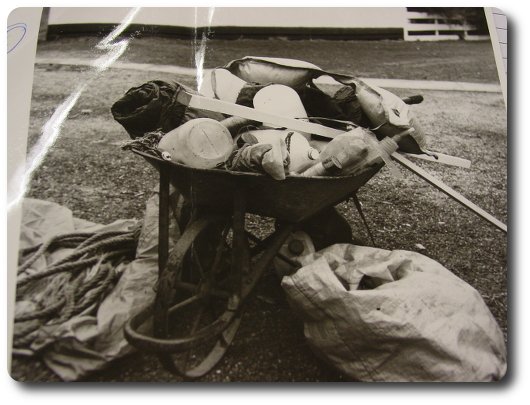
Equipment salvaged from Alf’s kayak after it was retrieved from the ocean off Snake Island, Gippsland.
I also carry flour, rice and cheese in case one is stuck on an island, fishing lines to catch fish, can usually get mutton birds this time of year. I carry a survival bag in case I have to leave the boat, this would be the last resort, I would only leave it if I looked like getting washed onto rocks.
In the bag, a complete wet suit, which keeps one afloat and warm. I feel I would always make it to land in one of these, also about 2 days supply of food and water with a knife, and a 30” beach ball which can be blown up to attract attention.
My final test was a 27 mile trip from Warrnambool to Julia Percy island in 7 hours in 12’ to 15’ seas and 25 mile following seas. The canoe took it in it’s stride surfing down high swells, landed on the island, slept the night under the stars and back to Port Fairy the next day in 90° heat and running into head winds & swell, about 14 miles return. I found out a weakness in the outrigger rowlocks, otherwise all OK. I felt I could have gone as far again, however got some chafe on legs from rolling seat.
Left Warrnambool on the 23rd of February, after studying our weather for years feel from late Feb. into March – we get our best conditions while the days are still reasonably long & warm.
Put the canoe on the ‘Empress’ & got a cabin, arrived at Burnie and got train transport for self and canoe to (illegible), where I was met by Jim Petrio of Gladstone who took me to Little Mussel Bay with the canoe on a trailer, unloaded near beach & slept waiting the night on the verandah of a holiday cottage.
Hard bed, little sleep, TV asked me to wait for them next morning, so waited till 12, and was about to go when I heard a shout, the TV man had arrived, took film for 10 to 15 minutes, got away, good seas, no wind, strong tide carried me a mile or two to west before I got out of it about 5 miles out.
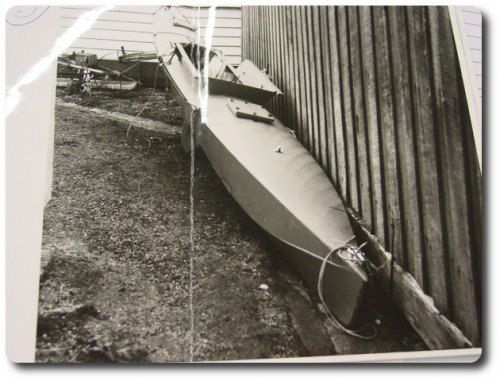
The home-made kayak that was tested off the waters of Warrnambool and Port Fairy before the Bass Strait crossing.
Rowed briskly, about (illegible) miles to go, late start, about ½ way to Barren Island, my first stop, saw some big fishing boat which swung my way, he swung in a wide arc following and finally blew his whistle for me to slow down. When alongside the ‘Skipper’ asked me where I was heading & when he saw I had completely stripped he said only 2 words ‘Oh God’.
When I told him I was making for Cape Barren island he appeared concerned & asked if I was alright, the crew were eagerly hanging over the side having a good look. After some directions we parted, rowed all day in the raw, only sand shoes on which are essential as my feet are built in to give power on the rolling seat.
Nearing Barren island 2 seagulls flew over, one turned back & had a second look, I concluding this was a lady seagull and it was time I put clothes back on. The less one wears the freer the body moves, also my swimming trucks where chaffing my legs.
Landed at Cape Sir John as the sun set, only about 3 miles from the settlement, but as the sea was full of rocks felt it was unsafe to go any later, pulled canoe up in nice sandy bay, unloaded and erected tent as fast as possible in sheltered scrub. Now dark, ate some nuts, apples & bran biscuits & honey, drink of water & off to bed. Warm night, good sleep.
Up and away at 7 a.m., lumpy & easterly winds funnelling between Cape Barren & Flinders, otherwise good run, some wind assistance, landed at Whitemark 1 p.m., small crowd waiting on wharf, a good welcome, stayed at Interstate Hotel. Left Whitemark 8-15 a.m. on 25th, unsettled weather, headwinds, can always turn back or land, wind freshening, rain on mountains, wind change to west, now beam on, hard rowing, looking for landing places, strong rip at (illegible), decide to press on.
The Sweep, another of Graeme Altmann’s works that reflect the relationship between the ocean and man.
Getting quite rough, head for Cape (illegible), finally land at Pine scrubs near a road I could see from out at sea on sheltered beach, easy to land, no breakers, pull canoe up and tie to tree, take clothes & walk up road, over hill. See large home in beautiful tranquil mountain setting, no one home, so sunbake.
Mr. & Mrs Syd Millyard of Leeka, the name of this area, arrived home about 6 p.m., had been shopping, they ran home as a guesthouse. ABC rang for news, rang wife, good nights rest, left for Kelliecrankie at 8-15, thru a strong rip tide, rowed hard for some 20 minutes and got thru, was baling out, looked up and found out I was being swept back at about 4 knots almost back into tidal rip, around Cape Frankland, almost hit sunken rock, it suddenly uncovered about 8’ away.
Good run along coast with some wind assistance to Killiecrankie, children waiting on beach, a very pretty sheltered little bay. Met Alf Stackhouse & wife, also local people, very friendly. Alf had full knowledge of all the islands & landing place right thru to the mainland. Also had his private plane, stayed the night with them. ABC reporters rang up.
Decided to miss Craggy island after seeing it and discussing it with Alf. Stayed the night with them, no sleep, thinking of 38 mile (illegible), hadn’t been this far before, arranged with Alf to fly over about 4p.m.
Set alarm for 3 a.m., in water at 3-20 a.m., can see Deal (Island) light flashing & head for it. Conditions good, slight side winds off Craggy island at 7 a.m., pleased with progress.
Winds freshening, thinking what have I done to deserve this, pray for good conditions.
Sighted Deal Island at 8 a.m., quite high in haze, winds dropping off (illegible) rock at 10 -15 a.m., strong tide pull… [notes end]
Postscript: The notes finish about half way through Alf’s journey which came to a fatal end on March 6, 1970, just 2km from the Gippsland Lakes. Before his death, Alf was already plotting his next adventure: to row from mainland Australia to Papua New Guinea.


 You might also enjoy…


 More on the Fletcher Jones campaign…