[dropcap style=”font-size: 60px; color: #A5CECD;”] S [/dropcap]hirley Handley and Brownyn Greene are two Warrnambool friends who are rarely seen apart when it comes to spreading a little joy in people’s lives.
The pair, who met through their local church, volunteer to visit people who may be sick, lonely or just in need of some company for an afternoon, be they in hospital, in an aged care home, or in their own home.
Their cheerful, smiling personalities are infectious and it is rare day when Shirley, in particular, is not armed with a quick joke or a funny one liner.
Between them, they bring light to the lives of those who are often forgotten, isolated or finding it hard to cope with daily life, including people struggling with addictions, and they never judge, or try to change anyone: they are just there to listen.
Philosopher Alain de Botton, on his recent tour of Australia, talked about how the mainstream news media has an obsession with the wrong sort of celebrities and that ordinary people who do good, simple deeds should instead be celebrated.
So, using Alain’s approach, we celebrate Shirley and Bronwyn as our Quiet Heroes: in our eyes, they are the “Laverne and Shirley” of Warrnambool who bring much-needed good humour and fun to every day lives.
[box] Shirley and Bronwyn will receive a coffee and cake vouchers from Lozzars Lounge Cafe, in Warrnambool. Thankyou Lozzar’s for supporting our quiet heroes.[/box]
“Choosing a direction” is among the striking works to be included in Warrnambool artist Barb Fulton’s show at The Artery that opens on April 30.
[dropcap style=”font-size: 60px; color: #A02F2F;”] T [/dropcap]he new exhibition space at The Artery, in Warrnambool, is already proving its worth with another top-shelf exhibition that runs until May 24 and features the works of Warrnambool artist Barb Fulton.
The exhibition is entitled “Threshold” and explores the themes of discovery, journey and possibility. The viewer is tempted to ask what lies beyond the threshold? What is hidden behind that door? What will I discover if I take a risk and step beyond my comfort zone?
Barb is the second artist to exhibit in the Timor St space, following the inaugural – and popular – exhibition by Gareth Colliton. Barb is also a much-loved figure on the local art scene, which she has been a part of since studying as a mature-age student in the now-defunct Fine Art Degree at Deakin University in the late 1980s.
Warrnambool artist Barb Fulton with Barrier, another of her works to feature in the exhibition, Threshold.
[box type=”bio”] The Artery is at 224 Timor St. Warrnambool, and is open Wed-Sun 10am – 4pm.[/box]
Love me, love my uke: Kevin O’Toole started the Warrnambool Ukelele Group with his partner, Annie Carmichael (at left – teaching beginners), in 2012: it now has more than 100 members.
[dropcap style=”font-size: 60px; color:#A02F2F”] I [/dropcap]t may look like a guitar that never grew up, but the plucky little ukulele has been enjoying a global surge in popularity that has reached all the way to South-West Victoria.
In fact the Warrnambool Ukulele Group (WUG) has proven so popular since it started with just eight people in 2012 that it now has about 120 members…and a waiting list.
Partners Annie Carmichael and Kevin O’Toole started the Warrnambool group after living in Hobart for a time, where Annie learned the ukulele with the Hobart Ukulele Group that operated under the gorgeous acronym, HUG.
“You can do a lot of things with a ukulele,” says Kevin, who is also an accomplished guitar player.
“It is easy to learn, easy for beginners and you can then take it as far as you want to go: we have people who play everything from Bach to jazz to rock and roll,” he explains.
WUG members Victor Reid with his deep-voiced bass ukelele and Graeme Bell (left) with his eye on the chords.
[dropcap style=”font-size: 60px; color:#A02F2F”] W [/dropcap]ith just four strings, the ukelele has a simple chord system compared to a guitar and, much like a harmonica, is the ultimate in portability at a cheap price.
Beginner ukeleles start at around $75, but a seriously good quality ukelele can cost up to $2000. They also come in three varieties – soprano, concert and tenor – plus the less common bass ukelele, like that played so beautifully by WUG member Victor Reid.
The WUG members, however, are less concerned about fancy ukeleles than simply having a good time: no matter how well each person might play or sing.
Both beginners and seasoned players meet every Monday night at the Royal Hotel, on the corner of Timor and Fairy streets, where publican John Bonney has kindly let them take over a back room attached to the dining area.
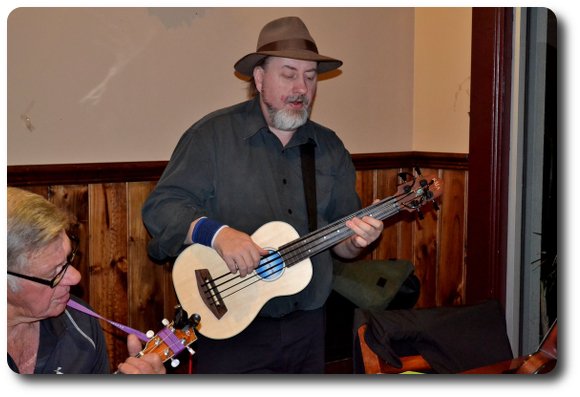
It’s sitting room only at the Royal Hotel when WUG members like Ian Brown break out their ukeleles for a night of singing and playing.
[dropcap style=”font-size: 60px; color:#A02F2F”] T [/dropcap]he night starts with a half-hour lesson for beginners, followed by a 90-minute session of music and singing from the official WUG songbook, including any specific requests from members.
It is at this point that anyone who happens to be eating in the Royal Hotel bistro is in for a treat. As they tuck into their counter meals, the back room erupts into a fusion of Irish-style pub singing, country-and-western ballads, foot-stomping, whistling and ukelele-playing fun.
The mood is infectious and almost enough to make even the most tone-deaf punter want to race out to buy a ukelele.
“It is all about having a good time, first and foremost, but if people are prepared to practice, they will also get better,” Kevin says.
“We have a lot of members who have never played a musical instrument in their life, but, as a group, we are also getting better and better.”
Like other ukelele groups around Australia, WUG doesn’t take itself too seriously during its occasional public performances (that included the Koroit Irish Festival at the weekend) and members dress up in a fancy dress theme for each “concert”.
“If nothing else, we are dressed very brightly, we are making a lot of noise and we are having a good time,” Kevin says with a laugh.
“At the end of the day, if you have got a ukelele in your hand and your not smiling, then your not playing a ukelele.”
WUG is a mixture of men and women players, with Anne Rea and Jan McCluggage among those enjoying the weekly jam session.
[box] You can find the Warrnambool Ukelele Group website here. Interested people are encouraged to put their names on the waiting list, as openings do come up relatively regularly. You can hear WUG in action each Monday night from 7pm at the Royal Hotel, Timor/Fairy streets, Warrnambool. [/box]
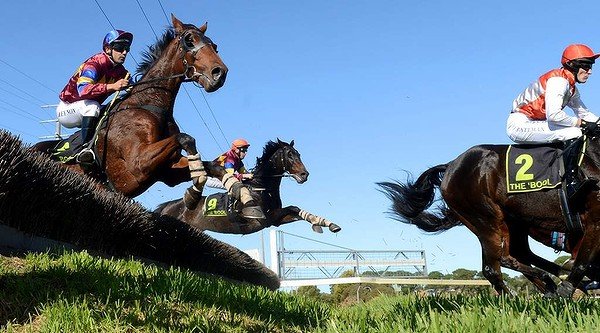
Regardless of the spectacle, the harsh reality is racehorses are continuing to die as a result of jumps racing in Victoria. Image courtesy of The Age.
As Victoria continues to buck the trend on placing a ban on jumps racing, we ask if steeplechasing really is integral to the success of the Warrnambool May Racing Carnival.
OPINION – Carol Altmann
Here we are at that awkward time of year again in Warrnambool when the city’s biggest local sporting event – the May Racing Carnival featuring the Grand Annual Steeplechase – is also the most difficult to embrace.
For no matter how we dress it up, the reality is that jumps racing is on the nose and has been for many years.
Despite this, the powerful figures that surround the “sport” continue to tell us that horses love jumping, that the local economy would wilt without the jumps races, and that those campaigning to have jumps racing stopped are just a bunch of lefty loopies without a sense of fun.
One of the most vocal “lefty loopies” is, of course, that highly radical and subversive organisation, the RSPCA, which has an ongoing campaign against the practice on the grounds of animal cruelty.
It appears that the RSPCA is welcome to tackle battery hens, sow stalls, duck shooting, puppy farms and run the cheerful Million Paws Walk, but if it dares to go near the sanctity of the steeplechase, it is accused of being “grandstanding hypocrites,” guilty of euthanasing thousands of unwanted cats and dogs each year.
That is how the former head of the Australian Jumps Racing Association, Rodney Rae, described the RSPCA president Dr Hugh Wirth in 2011, disregarding the fact that the RSPCA is the group that mops up the sad mess left behind by irresponsible pet owners around Australia.
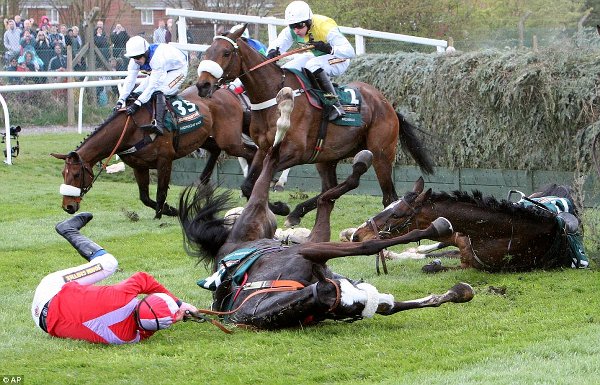
The Grand National Steeplechase in the United Kingdom remains one of the most controversial races in the world due to a high number of horse fatalities. Image courtesy of The Huffington Post.
But let’s return to jumps racing.
As most people know, this is a sport that no longer exists in any other states except for Victoria and South Australia. Jumps racing finished in Queensland more than 100 years ago. It stopped in WA in 1941 and in NSW in 1997. Tasmania joined their ranks in 2007.
A Senate committee in 1991 suggested it be phased out across Australia over a three-year period and, in 2010, this is exactly where things were headed for Victoria – until the state election prompted local MP Dr Denis Napthine to pledge $2 million to assist the racing industry if the Coalition won office.
The Coalition won and Dr Napthine, who part-owns a racehorse with local Federal MP Dan Tehan*, would be not only the Minister for Racing but also, eventually, Premier. Talk about friends in high places.
Despite the $2 million having surely being spent by now, horses still die in jumps racing.
It is a nasty, unavoidable truth of the “sport”, even if we try and disguise it behind the green curtain that is hastily erected around the broken horses before they are euthanased on the track.
According to the RSPCA, four horses died in jumps racing last year and there is no doubt that this week, many punters will be watching the three main jumps events at Warrnambool with their hearts in their mouths, hoping all the horses (and riders) make it home, while feeling a deep sense of unease that the horses are being made to perform this way in the first place.
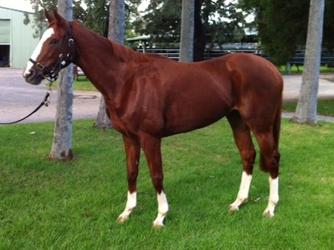
Spin the Bottle, part-owned by Premier Dr Denis Napthine and local Federal MP Dan Tehan. He is not a jumps racer.
The Warrnambool Grand Annual Steeplechase is 5.5 kilometres long – the Melbourne Cup is 2km shorter – and includes 33 jumps: the most of any steeplechase event anywhere in the world. That is a lot of running and a heck of a lot of jumping, even for a horse that “enjoys” it.
And for all of their Herculean efforts, hardly anyone remembers who wins. Can you name one winner of the Grand Annual Steeplechase? Or the Brierly Steeplechase? Or the Galleywood Hurdle?
At the end of the day, it all seems so cruel and so unnecessary, especially when such a small group of people has any significant investment in jumps racing and its immediate spoils.
The average punter, I believe, would be just as happy to go along to a three-day racing carnival at the beautiful Warrnambool racecourse and not see horses jump.
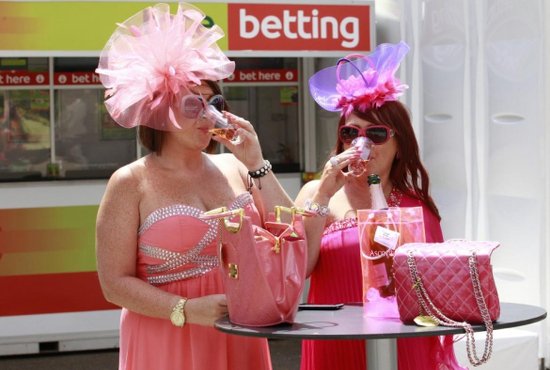
Some of the most popular – and charming – race carnivals in Victoria (think Dunkeld, Hanging Rock) attract thousands of people not because of the actual racing, but because of the atmosphere, and the chance to dress up and drink champagne for brunch.
Given the increasing awareness and activism around animal rights, especially among young people, it is only a matter of time until jumps racing is banned across Australia.
So why not cancel the jumps at Warrnambool, just for a year? Or maybe for three years, as happened during World War II when the Grand Annual Steeplechase was suspended because of more pressing matters than horse racing.
Then will we know whether the May Racing Carnival can truly stand on its own two legs, rather than relying on horses to stand on all four: despite all that is thrown at them.
*Since writing this piece, The Age has questioned the connections between Dr Napthine and Midfield Meats managing director Colin McKenna, another part-owner of Spin the Bottle.
Wouldn’t punters be just as happy wearing fancy clothes and sipping champagne trackside without the need for jumps racing?
Getting hooked on crochet, one stitch at a time
The face behind “Spincushion”, Shelley Husband, pictured with her daughter, Erin, is moving in a new direction with her craft…and her daughters are part of the change.
[dropcap style=”font-size: 60px; color: #ABCCAB;”] A [/dropcap]rtist Shelley Husband can write proficiently in at least two languages: one is English, and the other is crochet.
When Shelley slips into crochet, the sentences look something like this: “ch 1, dc in same space (ch 3, skip 2 sts, dc into next stitch) x 6, 3 ch, ss into 1st dc (7 x 3 ch loops and 7 dc)”.
It is this second language that Shelley, of Narrawong, is helping to take to the world via the wonders of the internet: it allows her to teach people from across the globe a skill that she has been perfecting since learning how to crochet about two and half years ago.
“I love stretching my brain and I love fine detailed work,” she says.
“I also love finding out how things work, pulling them apart and looking at how it fits together and crochet can be very much like that.”
A growing number of people are becoming hooked on crochet. Image: Shelley Husband
[dropcap style=”font-size: 60px; color: #ABCCAB;”] H [/dropcap]aving taught herself how to crochet via books, blogs and YouTube clips, Shelley is now teaching others the step-by-step methods behind various patterns that she has developed.
“I am doing my bit, I guess, to rejuvenate the art of crochet and to get people to go beyond the granny square,” Shelley says with a laugh.
Through her website, Shelley connects with crochet novices around the world, all of whom can follow the lessons for free, or purchase her unique patterns.
For Shelley, who is also a part-time school librarian and integration aide, refining her crochet skills is the second step in a three-step progression from where she began six years ago when she started her craft line, Spincushion.
Shelley elevated the humble pin cushion to a collectable work of art.
[dropcap style=”font-size: 60px; color: #ABCCAB;”] S [/dropcap]pincushion, as it sounds, is Shelley’s “spin” on the humble pin cushion, that she has taken and developed into an art form.
After first learning how to make “everybody else’s” pincushion patterns, Shelley began to design and make her own; creating beautiful, colourful and quirky pin cushions that are more works of art than a mere accompaniment to sewing.
Her first market, at Tyrendarra, proved a hit and Shelley soon became a regular face on the South-West Victorian market circuit, while also successfully selling her pincushions online via an etsy store.
Recently, however, Shelley decided to move right away from pincushions and focus on her crochet venture, “Beyond the Granny”, and a new collaboration with two of her three young daughters, Erin (14) and Megan (16), called “Quirkery Stitchery”.
“I really, really loved making the pin cushions and am very proud of what I achieved with those, but it is time for new challenges,” she said.
Quirky drawings by daughters Erin and Megan are the basis of Shelley’s latest venture, Quirkery Stitchery.
[dropcap style=”font-size: 60px; color: #ABCCAB;”] Q [/dropcap]uirkery Stitchery grew from a series of quirky drawings by Erin and Megan, who, together with their younger sister Brenna (11), are as creative as their Mum. While the girls create the images, Shelley brings them to life through embroidery.
It is a lovely connection and while the quirky characters are finding their own online market, Shelley says, for her, the creative process is first and foremost about the joy of it.
Using this philosophy, Shelley makes sure that even her “mistakes” are put to good use. She recently advertised a load of unwanted yarn left over from various crochet projects and it was snapped up by a woman to use for “yarn bombing” – the covering of public objects in crocheted or knitted wool.
“I will popping that in the post and it is nice to know it is going to a good home,” she laughs.
[A quick quiz: what is the difference between knitting and crocheting? If you said one involves two needles and the other a single hook, you are on your way to being crafty, unlike the author of this story.]
The gorgeous ladybug pattern was one of Spincushions signature designs.
[box] To find Shelley online, please visit her website here, where you will find links to all of her craft ventures, including her online crochet classes. You can also find her on Facebook. [/box]


 Meet more of our Quiet Heroes…

 You might also enjoy…




 You might also enjoy…