A Front Paddock just perfect for grazing

front paddock2
Drover’s daughter: Cheyanne Ainsworth has been overwhelmed by the response to the Front Paddock Cafe and Larder which she and her husband Chris recently opened in Derrinallum.

By Carol Altmann

[dropcap style=”font-size: 60px; color: #A02F2F;”] W [/dropcap]hen a groovy cafe with fantastic food opens on the main street of a small country town that happens to be enroute to Melbourne, you might expect a steady trade.

But nothing – not even a former career as an international flight attendant with Qantas – could prepare Cheyanne Ainsworth and her husband Chris for the phenomenal response to their venture, Front Paddock Cafe & Larder, which opened about eight weeks ago in what passes for downtown Derrinallum.

The town officially has a population of around 500, but many, many more than that pass through each day on their way to or from Melbourne and, up until now, it has been a long drive between delicious food and brewed coffees.

“It has been amazing,” Cheyanne says in between serving customers. “My friends say, ‘what did you expect?’ and I didn’t imagine this.”

Soon after opening, the cafe – which offers breakfast, lunch and dinner – was selling out of its entire supply of gourmet sandwiches, rolls, cakes (brought in from the cake capital, St Kilda, no less), pies and generously proportioned sausage rolls which have quickly gained a cult following.

Even during our visit last week, a backpacking cyclist wandered in, put his hands on the counter, smiled and said “I’m hungry and I have been told this is the place to come.”

front paddock-chris
Chris and Cheyanne Ainsworth taking a rare breather in their cafe. The pair also run a mixed farm at Derrinallum which means life is definitely never dull.

[dropcap style=”font-size: 60px; color: #A02F2F;”] O [/dropcap]f course a memorable cafe also needs style, character and atmosphere and this is where Cheyanne’s family history comes into play.

Her father, Bob, who occasionally drops in to help with the dishes, was a drover and Cheyanne is affectionately known as “DD” – drover’s daughter.

This strong rural connection is reflected not only in the name of the cafe – more about that shortly – but the beautiful fittings, including several wool classing tables bought at a clearing sale, that have been topped with glass and are used for shared dining and larger groups.

Related story: Mt Elephant rises from its slumber 

There are also salvaged saleyard signs and the inspired use of a bookmaker’s board where the tote prices reflect the coffee prices – except where Cheyanne has added “50 cents” because the old tote prices didn’t have that option.

“A lot of what you see here comes from people who Dad has known for years,” she explains.

Chris, who is a registered builder and bricklayer but also has a background in running family hotels, put the whole space together in what was previously an old butcher shop.

communal table front paddock
The communal table – an up-styled wool classing table bought at a clearing sale – is one of the many unique features in the cafe. Image: Front Paddock Cafe & Larder.

[dropcap style=”font-size: 60px; color: #A02F2F;”] I [/dropcap]f life wasn’t busy enough for the pair, Cheyanne and Chris have continued to work a mixed farm with “Bob the drover”, who manages both his own property and theirs.

So when they are not working in the Front Paddock, they could be working in the other front paddock – their Derrinallum property which carries Berkshire pigs, lamb and beef.

“By the end of the year we hope that all beef, lamb and pork served on the table is from our farm,” Cheyanne says.

“It has all happened at once, but we got to the point where we thought life was too short not to do what we have wanted to do for a long time.”

Which brings us to the name of the cafe.

The pair had hoped to call it the Long Paddock – a droving term – but so many ventures were already using that name that they instead opted for the Front Paddock.

“The front paddock is your best paddock, the one that everyone sees, so it works,” Cheyanne says.

Judging by the response so far, this is one front paddock that is perfect for happy grazing.

front paddock3
The recycled bookmaker’s board that is perfect for pricing coffees, made with “Ruby” the espresso machine. Image: Bluestone Magazine

[box]The Front Paddock Cafe & Larder is at 24 Main St, Derrinallum. Open for breakfast and lunch every day, but closed on Tuesday. Dinner is available Thursday-Sunday nights. Bookings: (03) 5597 6880 Find them on Facebook here. The cafe is finalist in the 2015 Savour Australia Restaurant & Catering Awards in the category of New Restaurant – Victoria Regional.[/box]

[button link=”http://the-terrier.com.au/subscribe-2/” type=”icon” icon=”heart” newwindow=”yes”]Bluestone needs at least 500 subscribers in 2015. If you wish to support independent media, please click here to become one.[/button]

newsletter Eat And Drink StonesYou might also enjoy…


Cooking up a seachange at Cape Bridgewater

Funky bar brings life to dead alley: Coffin Sally’s

From serious science to one cool cat: Day Kitty

Rocksalt rocks on in Port Fairy


Races, rates and rubbery figures

marquee
Budgets might be tight at the Warrnambool City Council, but there is still room for its annual May Race Carnival marquee. Judging by this shot, however, it was not an overly crowded affair.

Analysis – Carol Altmann

[dropcap style=”font-size: 60px; color: #A5CECD;”] T [/dropcap]here are two things which always go up each May: the Warrnambool City Council rates, and the council’s corporate marquee at the May Racing Carnival.

They make for a painful double.

Painful because ratepayers are again facing a 5.5% increase in their annual rate bill, following on from a 5.5% rise last year, which is more than double the inflation rate and amounts to an 11% increase in two years. (Glenelg Shire Council recently announced a 1.95% rate rise).

This means, for example, if you were paying $1700 in rates in 2013-14, you can expect to pay almost $1900 this financial year.

Cities the size of Warrnambool are not cheap to run and ratepayers collectively contribute around a third of the total $64 million operational budget, with the remainder coming from grants and user fees and charges, so every cent – and how it is spent – counts.

The council reminded us of this at its monthly council meeting (May 4) when it outlined where it had tried to make savings – by trying a different road building method, for example – and how some of the big-ticket items, like the drainage tunnel for Simpson St, were both necessary and costly.

“Times are tough”, “budgets are tight”, “things will only get harder when rates are capped”, are common mantras around the council at the moment, which is why a corporate tent at the May Racing Carnival seems like a complete waste of money and an insult to ratepayers.

Last year, the hospitality tent had a budget of around $25,000, but actually spent $17,000 on the 90 guests who attended out of 168 that were invited.

While $17,000 is small in an operational budget of $64 million, it is the perception that bites: the council’s corporate tent at the races is still considered “non negotiable” when it comes to savings.

(We asked, but have not been told, the budget or guest list for this year. Judging by the photo above, however, it may have at least been scaled back.)

It might be more palatable if the hospitality brought some tangible rewards, but based on last year’s event, the party is largely made up of council staff, councillors and members of the various boards, bodies and legal firms that the council already works with on a regular basis. In other words, it is a junket.

anson car
The “$10,000 car” provided to the council’s chief executive officer as part of a salary package: in reality it is a luxury Hyundai Genesis valued at around $60,000.

[dropcap style=”font-size: 60px; color: #A5CECD;”] P [/dropcap]erception also comes into play when we look at the vehicle provided to the Chief Executive Officer as part of a $288,000 annual salary package.

In the rubbery figure ways of corporate salary packages, this car is valued at $10,000, but don’t expect a car that is actually worth $10,000 – that is a reflection of the annual leasing cost.

In reality, the council provides its CEO with a sleek Hyundai Genesis that is worth around $60,000 and which sucks up 11.2 litres of fuel per 100km. Surely, in these cost-cutting times, something like a Toyota Prius would be a better choice and more environmentally friendly – if not as “corporate” – and send a message to ratepayers that everyone is doing their bit.

On the subject of rubbery figures, given the forensic nature of setting a budget and justifying where and why each dollar should be spent, it was extraordinary to learn earlier this week that some material provided to councillors has been cut and pasted from previous years.

Cr Peter Hulin made the discovery – which he shared at this month’s council meeting – after comparing what are called “service overviews” from previous budget papers to those provided in this year’s papers.

pool-general
Rubbery figures provided to councillors as part of budget papers showed attendance figures at Warrnambool’s Aquazone were exactly the same for three years in a row. Image: sportstock.com

[dropcap style=”font-size: 60px; color: #A5CECD;”] T [/dropcap]hese service overviews detail how an area has performed, and how much money it needs for the coming financial year, so, for example, Aquazone will detail how many people came through its doors, how many people enrolled in learn-to-swim classes etc.

Astonishingly, Cr Hulin found that the service overviews for at least 10 council areas – including Aquazone, Flagstaff Hill, the library, Lighthouse Theatre, art gallery and even environmental health services – had the same figures appearing year after year after year.

In the case of Aquazone, for example, precisely 213,377 people went through the gates and 19,596 people enrolled in learn to swim classes for three years straight.

Let’s be clear: these are figures presented to councillors as part of official budget documents and, irrespective of how much weight they carry in final deliberations, they are simply false. How does this happen?

CEO Bruce Anson could not provide an immediate answer to the meeting, although he did say that he believed the service overview sheets were not updated “for one year”.

“I will have to take the question on notice and get back to you,” he said.

The answer is certain to be interesting and underscores why, when it comes to budgets, it’s always worth reading the fine print.

[box]People can make written submissions on the proposed budget until Wed June 5. The budget will be formally adopted at the WCC meeting on June 22. You can download the draft budget here. [/box]

[button link=”http://the-terrier.com.au/subscribe-2/” type=”icon” icon=”heart” newwindow=”yes”]Bluestone needs at least 500 subscribers in 2015. If you wish to support independent media, please click here to become one.[/button]

Stones Smile newsletterYou can find more analysis here…


Why doesn’t Warrnambool have a major art prize?

W’bool City Council’s big shed shemozzle

Peter Ronald on the destruction of the 100-year-old Rowitta

Silencing councillors tightens grip on public right to know

The thinking behind A Big Life: Michael Barling & Sean Kenny


Win: A limited edition Ella Webb print

ella webb prize_10

CLOSED: The winner is Ginni Colee.

[dropcap style=”font-size: 60px; color: #A02F2F;”] N[/dropcap]ow this is literally a fabulous give-away for new and existing subscribers: a beautiful limited edition print by Warrnambool artist Ella Webb from Loop Studio.

Ella has been a long-time supporter of Bluestone Magazine and has kindly donated this 42 x 30cm print valued at $75 to help us in our quest to reach 500 subscribers by September 2015: we have 360.

The first six existing subscribers to email us at editor@bluestonemagazine.com.au will go in the draw.

PLUS the first six new subscribers will also be automatically entered into the draw. You can subscribe here.

This gives you a one in 12 chance of winning this gorgeous prize.

Thankyou so much Ella for your generous gift and the prize will be drawn as soon as we reach six new subscribers.

[box]You can find Ella Webb on Facebook and the web.[/box]


How David Jones saved “Metamorphosis”

Metamorphosis by Derek Giles
Metamorphosis, by Derek Giles, as it was on the side of the Fletcher Jones factory in Warrnambool. Image courtesy of the Warrnambool Art Gallery.

By Carol Altmann

A simple question – “what ever happened to…” –  has uncovered a story about the retrieval of a well-known sculpture taken from Warrnambool, while also shining a light on the artist who made it.

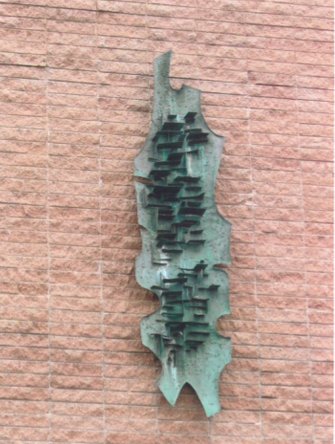
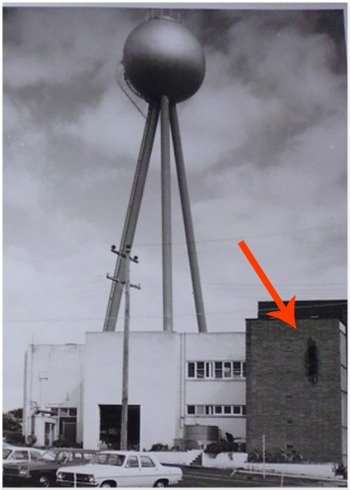
The 3 metre tall copper sculpture, Metamorphosis, was installed on the eastern wall of the Fletcher Jones factory in Warrnambool on August 1, 1967 – the same year as the famous silver ball water tower was built just metres away.

The pair looked down on the factory workers, East Warrnambool school kids and passersby for more than 25 years until the collapse of Fletcher Jones saw the business taken over by Pelaco and the buildings sold to the Warrnambool City Council.

Bluestone recently posted a 1967 photo of the silver ball and sculpture to the Facebook page, Save the Silver Ball and Fletchers Gardens, which prompted a question from one follower: “whatever happened to that sculpture?”

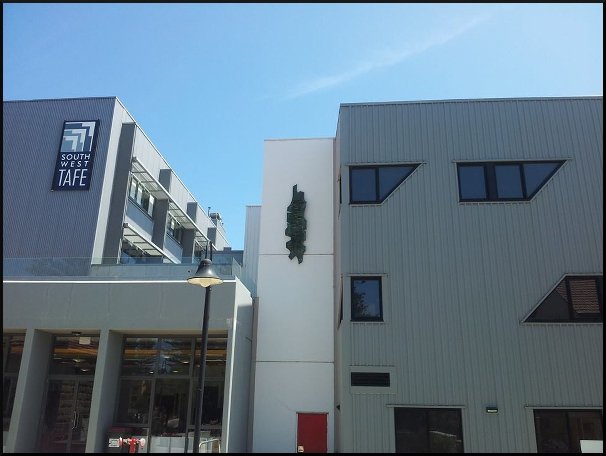
Before long, the answer was provided by Lesena Selvage: it sits on an eastern wall of the South-West TAFE building, overlooking Gilles St, which is just one letter away from the name of the artist who created Metamorphosis, Derek Giles.

But what has never been revealed, until now, is that the sculpture was taken from Warrnambool to Melbourne and it was only through the dogged determination of the late David Jones, son of Sir Fletcher, that it was returned.

sculpture at fj
The Metamorphosis sculpture shortly after being installed on the site in August 1967 – the same year as the silver ball water tower was built. Image: Ralph Jones collection, courtesy of Melbourne University Archives.

Letters penned by David Jones reveal that he became aware by early 2007 that the sculpture had been removed by Pelaco and shipped to its factory in Maidstone, Melbourne.

While David didn’t name Pelaco, he urged the council to do all it could to ensure the sculpture was returned from “the company”.

“As chairman of (the City Art Advisory) committee and because of my past association with the Pleasant Hill establishment, I express my deep concern that this object has been taken from Warrnambool,” he wrote to then chief executive of council, Lindsay Merritt in February 2007.

“My understanding of the sale of the Pleasant Hill site to the WCC in the early 90s was that the infrastructure including the buildings and the gardens were transferred into the ownership of the city. I cannot imagine why the company could or should have formed the view that they had ownership of this sculpture.

“I request that you take whatever action is necessary to recover the sculpture and that the City Art Committee select a new site for the work.”

By December that same year, little progress had been made, despite the issue being raised by the City Art Committee at least four times.

sculpture lesena selvage
Since 2009, the sculpture has been on permanent loan from the Warrnambool City Council to South-West TAFE and now overlooks Gilles St. Image: Lesena Selvage.

It appears a clearly frustrated David Jones did what any self-respecting supporter of local arts would do and approached the media to apply a little more heat to the flame.

A story ran in the local newspaper on 28 December 2007, asking people to help locate one of the city’s “most unusual artworks” that had “gone missing”.

“It’s 40 years old, a unique piece and worth several thousand dollars, but more importantly it’s owned by the citizens of Warrnambool and we should make every attempt to recover it,” David is quoted as saying.

The story ended with a request for “anyone with information” to contact the council or David, even though both knew exactly where the sculpture was.

David’s tactic clearly worked, because within 12 months the sculpture was back home – we are not sure how it was finally retrieved – and discussions were underway with the City Art Committee as to where it should be displayed.

South-West TAFE was chosen because of Derek Giles’ links to the art school.

It has long been thought that Derek Giles was an art teacher at the Warrnambool Technical College (now TAFE), but in fact he was a primary school teacher who lived with his wife and young family near the Fletcher Jones factory and who studied art as a mature-age student.

derek giles
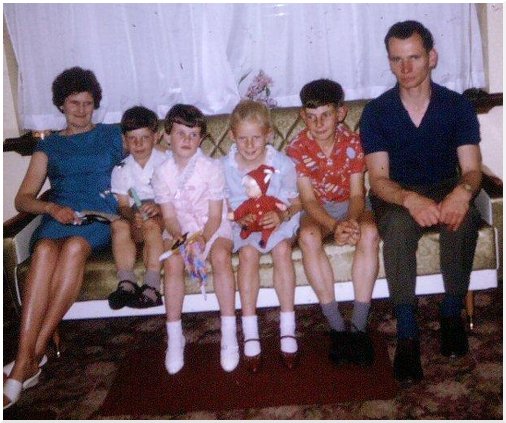
The artist, primary school teacher Derek Giles, with his wife Meryl, who worked for David Jones, and his young family around the time of the commission. David Giles is next to his father. Image courtesy of David Giles.

I actually helped Dad build it,” said Derek’s oldest son, David Giles, by phone from Melbourne.

“It was put together in our garage (in Emma Ave) and I would hold bit this and that bit, while Dad kept saying ‘don’t look at the flame, don’t look at the flame,'” he laughed.

David, one of four children, was in Grade 6 at the time and, from what he understands, the commission came about through his mother, Meryl.

“My mother worked as a secretary to David Jones for about 12 months and I think one of Dad’s penultimate assignments for his art course was to produce a work, so Mum approached David to see if Dad could make him a sculpture,” he said.

Derek Giles, who was born in Melbourne, taught in primary schools around the south-west in the 1960s, including Port Fairy Consolidated and Warrnambool Primary School, but always had a penchant for art and worked across a range of mediums.

Metamorphosis is a wonderful connection to Warrnambool for the whole family: it is a real focal point,” David said.

“As kids, we always thought of it as Dad’s sculpture…(but) not really being art aficionados, we joked that he had made a high-rise for the birds, because they used to love to roost in the horizontal panels when it was mounted on the wall.”

Derek Giles died in 1993, at the age of 58.

There is little doubt that had David Jones not pushed for the return of Metamorphosis, it would have been gone for good, with the Pelaco factory at Maidstone since closed.

Later this year the Giles family will complete the final vision that both they, and David, had for the sculpture, which is to install a simple plaque naming him as the artist.

 I would like to acknowledge retired art academic Ross Gray and Warrnambool Art Gallery Curator Murray Bowes for their assistance with this story.


Why doesn’t W’bool have a major art prize?

iwd winners_40
Winners of the inaugural South-West IWD Women’s Art Prize, Marion Manifold, left, Claire Drylie, second from right, and Megan Radley with judge, Dr Carmel Wallace, centre. Image: Bluestone Magazine.

Analysis – Carol Altmann

[dropcap style=”font-size: 60px; color: #A02F2F;”] M [/dropcap]ost of us probably haven’t heard of the Tatiara District Council and I certainly hadn’t until I stumbled across its $12,000 biennial art prize.

The acquisitive prize  began in 2013 and offers $10,000 to the winner, plus another $2000 shared across a range of categories: this is a $12,000 investment by a council with a population of around 7000 people spread across places including Keith and Bordertown.

Further afield, in the red-dust steel town of Whyalla (popln: 20,000), there is a biennial City of Whyalla Art Prize offering a total of $28,000 courtesy of the local council and some serious support from the local mining companies.

And if we cast our eye around regional Victoria, we can find, for example:

  • Australia’s most prestigious ceramic prize – the $50,000 Sidney Myer Fund Australian Ceramic Award – hosted at the Shepparton Art Gallery;
  • the $20,000 Guirguis New Art Prize hosted every two years by Ballarat Art Gallery (and funded by a local surgeon);
  • and the fantastic Corangamarah Art Prize, a $7500 acquisitive prize organised by Colac Health and Red Rock Regional Theatre and Gallery.

In Warrnambool, however, the council doesn’t fund or facilitate any art major prize and has no immediate plans to do so.

And despite our city being home to some very wealthy individuals and businesses by virtue of inheritance, hard work or both, they appear to be a miserly bunch when it comes to supporting a major art prize.

enviro-winner_15
SCOPE Galleries director Dr Liza McCosh, left, with guest judge for last year’s Art Concerning Environment award, Marita Smith, director of Gallerysmith North Melbourne. Image: Bluestone Magazine.

[dropcap style=”font-size: 60px; color: #A02F2F;”] T [/dropcap]he most lucrative Warrnambool-based art prize, as it stands, is the biennial SCOPE Art Concerning Environment Award ($5000 first prize) organised since 2012 by SCOPE Galleries owner, Dr Liza McCosh, who has set a standard that few others have chosen to follow.

Instead, apart from a few notable exceptions, most of the private support for the arts comes from the estates of past benefactors – such as the Fletcher Jones Foundation, and Gwen and Edna Jones Foundations – or from generous souls who live elsewhere, like Professor Barbara Van Ernst and Geoff Handbury.

Over the years, Warrnambool has had some highly respected art prizes, such as the Henri Worland Memorial Print Prize in the 80s and 90s.

The most recent was the New Social Commentaries Art Prize – a biennial $15,000, acquisitive prize hosted by the Warrnambool Art Gallery (WAG) and funded by the FJ Foundation from 2004 until 2008. Unfortunately, in 2008, a controversy over the awarding of the prize  saw it lose much of its lustre.

Shortly after WAG director John Cunningham was appointed in 2010, he announced the prize was being reviewed. It has not been seen – or replaced – since.

The council won’t allow John to speak to me directly, and he has since announced he is leaving Warrnambool to take up a new position, but council spokesman Nick Higgins said there was “no plan” to replace it.

In the gap, it is not surprising that two, smaller art prizes have been embraced enthusiastically by the local art scene.

artlink-jen
Where the Warrnibald began: former Artlink teachers and artists Gayle Clark, left, and Jenny Altmann, with artist Alex Rees. Image: Bluestone Magazine.

[dropcap style=”font-size: 60px; color: #A02F2F;”] F [/dropcap]irst, the inaugural South West IWD Art Prize organised by Women’s Health and Wellbeing Barwon South-West and the IWD Alliance saw a record crowd pack into The Artery for its launch earlier this year.

Despite the predictable, put-down comments from some men about it being limited to women artists, this $1500 acquisitive prize has the potential to grow into something very special for Warrnambool, along the lines of a mini Portia Geach Memorial Award that has become so prestigious, artists are thrilled just to be long-listed.

With more funding – and perhaps a catchier title – the women’s art prize could easily become a premier art event for south-west Victoria and The Artery.

Similarly, the Warrnibald portrait prize is so perfect for Warrnambool – because of our links to father and son John and Joseph Archibald – that I can’t believe it hasn’t been running for decades.

It was the brainchild of Gayle Clark, who formerly worked at Artlink, which is run by WDEA to help disadvantaged people or those with disabilities. The first Warrnibald was held in 2012 and attracted a full house.

When WDEA closed the Artlink gallery in 2014, it looked like the popular Warrnibald would go too, but thankfully the Warrnambool Art Gallery has seen the merits of hosting this prize in 2015, even if the council has failed to throw any money into the prize pool.

So we have two art prizes, still in their infancy, just begging to be nurtured with philanthropic, business or council dollars to cement their place in our art calendar.

Can we do it – or will Tatiara District Council leave us looking like a bunch of tight wads?